
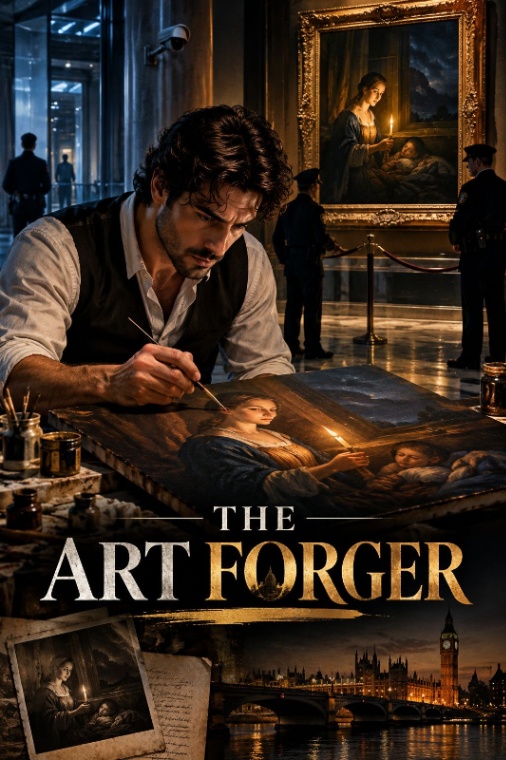
The world's most secure museum had never been robbed. Its cameras watched every corner. Its guards knew every shadow. Its priceless paintings were protected by technology worth hundreds of millions.
But the greatest thief in Europe wasn't planning to break into the museum.
He was planning to make the museum steal from itself.
The first time Adrian Vale saw the painting, he was twelve years old.
The second time, he was standing over a dead man.
The third time, he intended to steal it.
And if he failed, he would spend the rest of his life in a prison that officially did not exist.
The painting was called The Last Light.
A woman stood at an open window, holding a candle against the darkness. Behind her, a small boy slept beneath a blue blanket. Outside, a storm swallowed the horizon.
It was not particularly large. Barely three feet tall. Painted in 1642 by the mysterious Dutch master Elias Vermeer, it had survived wars, fires, revolutions, and the disappearance of three royal families.
Its estimated value was $280 million.
Its actual value, to Adrian Vale, was considerably higher.
His father had died trying to prove that the painting had been stolen.
Twenty-three years later, Adrian intended to finish what he had started.
The problem was that The Last Light hung inside the Bellwether Museum in London, an institution designed around a single principle:
Nothing entered or left without permission.
The museum occupied a converted nineteenth-century bank, rebuilt beneath a modern glass structure. Its underground vaults were surrounded by reinforced concrete. Every painting was monitored for vibration, temperature, movement, and microscopic changes in position.
There were thermal cameras, biometric checkpoints, armed guards, and a security system that had cost £90 million to develop.
No thief had ever breached it.
Adrian had studied its defenses for fourteen months.
He had reached one conclusion.
Breaking in was impossible.
Fortunately, he was not a burglar.
He was a forger.
And he was the best in the world.
"You want to steal a painting from the Bellwether?"
Mara Voss stared at him across the table.
They were sitting in a closed restaurant near the Thames. Rain scratched against the windows, and somewhere in the kitchen, a refrigerator hummed.
Adrian slid a photograph toward her.
Mara looked at it.
Then at him.
"You're insane."
"Probably."
"That painting is protected by a system designed by the same people who build security infrastructure for nuclear facilities."
"I know."
"Three independent monitoring networks. Guards who rotate randomly. Sensors that can detect someone breathing too close to the frame."
"I know."
"And you want me to help you steal it?"
Adrian leaned forward.
"No. I want you to help me replace it."
Mara frowned.
"With what?"
He placed a second photograph beside the first.
The paintings were identical.
Every brushstroke. Every crack in the varnish. Every subtle imperfection.
Mara examined them carefully.
"Which one's the original?"
Adrian smiled faintly.
"That's the question."
She studied them for another minute.
Then her expression changed.
"You already made the forgery."
"Six months ago."
"How?"
"Twenty-three years of practice."
Mara put the photographs down.
"Even if the copy is perfect, you can't simply walk into the gallery and switch them."
"I don't intend to."
"Then what's your plan?"
Adrian looked toward the dark river.
"I'm going to convince the museum that the original is fake."
Mara stared at him.
Then she laughed.
But Adrian didn't.
And slowly, she stopped.
Three weeks earlier, a letter had arrived at the Bellwether Museum.
It contained no return address.
Inside was a photograph of The Last Light, accompanied by a short handwritten message.
The painting you display is not authentic.
Examine the lower-left corner beneath ultraviolet light.
You will find what the artist never painted.
The museum's director, Sir Malcolm Hargreaves, dismissed the letter as a hoax.
His chief conservator, Dr. Eleanor Shaw, did not.
She was fifty-two, meticulous, and famous for identifying a counterfeit Rembrandt that had fooled experts for forty years.
She requested permission to examine the painting.
Hargreaves reluctantly agreed.
Under ultraviolet light, Eleanor discovered something disturbing.
A tiny mark beneath the varnish.
Three intersecting lines.
A symbol associated with a nineteenth-century restoration workshop notorious for creating convincing reproductions.
The museum immediately initiated a confidential authenticity review.
And Adrian Vale, sitting in a small apartment overlooking the Thames, received a message.
THEY FOUND IT.
He deleted the message.
Then he burned the phone.
Mara arrived at Adrian's workshop the following morning.
It was hidden above an abandoned printing company in East London.
Inside, the walls were covered with sketches, chemical formulas, photographs, and reproductions of famous paintings.
A dozen unfinished canvases rested on wooden easels.
At the center of the room stood The Last Light.
Mara approached it.
For a long moment, she said nothing.
"My God."
Adrian continued cleaning a brush.
"Don't touch the surface."
"It looks real."
"It should."
"How did you reproduce the cracks?"
"Time."
"Adrian."
He looked up.
"Heat, humidity, pressure, and a few techniques I won't explain."
Mara examined the woman's face.
There was something haunting about it.
Not sadness exactly.
Recognition.
"Why this painting?" she asked.
Adrian stopped working.
For several seconds, the only sound was the rain.
"My father was a restorer," he said. "He worked for a private collector named Victor Sloane."
Mara recognized the name.
Sloane was a billionaire philanthropist who had donated much of the Bellwether Museum's collection.
"He discovered that Sloane was trafficking stolen art. Paintings taken from families during wars. Collections seized from people who never returned home."
"And The Last Light?"
"Belonged to my grandmother."
Mara turned.
Adrian's voice remained calm.
"During the occupation of Amsterdam, her family hid the painting behind a wall. They were deported before they could recover it. My grandmother survived. The rest didn't."
"How did Sloane get it?"
"He bought it from a man who had helped confiscate their property. Then he manufactured a legal ownership history."
Mara looked at the canvas again.
"Your father tried to expose him."
Adrian nodded.
"He collected evidence. Documents, photographs, payment records. Then he was found dead in his studio."
"Police?"
"Suicide."
"You don't believe that."
"My father had arranged to meet a journalist the next morning."
Mara said nothing.
Adrian set down his brush.
"I was nineteen. I went to his studio after the funeral. Everything was gone. His notebooks. His photographs. Even the letters my grandmother had written him."
"And now?"
"Now I have proof."
He opened a drawer and removed a small envelope.
Inside was an old photograph.
A woman stood beside The Last Light in a modest Amsterdam apartment.
On the back, in faded ink, someone had written:
For my little Willem, so he will always remember the light.
Mara studied it.
"Your grandmother?"
"Her mother."
He took the photograph back.
"The museum knows the provenance is questionable. But Sloane donated too much money. They won't investigate unless they're forced."
"So you want to steal it to prove it belongs to your family."
"No."
Adrian's expression hardened.
"I want to steal it because Sloane is about to move it."
Mara frowned.
"Where?"
"Geneva. A private collection. Once it disappears, we'll never see it again."
"Then we go public."
"With what? A photograph and a story? Sloane has lawyers who can bury us for twenty years."
Mara folded her arms.
"You're leaving something out."
Adrian hesitated.
Then he said quietly, "The original painting contains my father's final evidence."
The plan began with a lie.
Not a spectacular lie.
Not one that required guns, explosives, or forged identities.
Just a small, carefully placed doubt.
The ultraviolet mark discovered by Eleanor Shaw was genuine.
Adrian had not planted it.
His father had.
Twenty-three years earlier, while restoring the painting for Victor Sloane, Willem Vale had discovered that the ownership documents were fraudulent.
Knowing Sloane was watching him, Willem concealed a coded message inside the painting's frame and placed the restoration symbol beneath the varnish.
He left one clue in a letter to his son.
When they question the painting, they will finally listen.
Adrian had spent years trying to understand those words.
Now he did.
The museum's authentication process was the opening he needed.
If the painting's authenticity became uncertain, it would be removed from public display and transferred to the conservation department.
There, it would be examined.
And if experts concluded it was a counterfeit, the museum would place it in secure evidence storage while the investigation continued.
The painting would move.
Not outside the building.
Not yet.
But away from its seemingly impenetrable gallery.
And movement meant opportunity.
Mara studied the museum's publicly available conservation procedures.
"They use a dedicated internal transport team," she said.
"I know."
"All movement is recorded."
"I know."
"Every object gets a unique tracking identity."
Adrian nodded.
"Then we don't change the tracking identity."
Mara looked at him.
"We change what the identity means."
The following Monday, Eleanor Shaw received an anonymous package.
Inside was a small canvas fragment.
A note accompanied it.
Compare this with the painting's lower-right edge.
Eleanor performed the comparison.
The fragment appeared to match an undocumented repair made to The Last Light decades earlier.
More importantly, its pigments were consistent with materials used in the nineteenth century.
If the fragment was genuine, the painting might have undergone extensive alterations.
If it wasn't, someone was conducting a sophisticated deception.
Either possibility demanded investigation.
Eleanor called an emergency meeting.
Sir Malcolm Hargreaves sat at the head of the conference table.
Victor Sloane joined by video.
"Absolutely not," Sloane said.
Eleanor remained composed.
"We have evidence suggesting the painting's history may be inaccurate."
"That painting has been authenticated by six experts."
"Authentication is not infallible."
"Are you suggesting I donated a forgery?"
"I'm suggesting we need to examine it."
Sloane leaned toward the camera.
His face filled the screen.
"Dr. Shaw, I have supported your institution for twenty years. I would hate to see its reputation damaged by irresponsible speculation."
The threat was obvious.
Eleanor didn't blink.
"Then you should welcome an independent examination."
For a moment, nobody spoke.
Finally, Hargreaves cleared his throat.
"We'll authorize a temporary transfer to conservation."
Sloane's expression went cold.
"That would be a mistake."
The call ended.
That evening, Adrian received another message.
TRANSFER APPROVED. THURSDAY. 02:00.
Mara read it over his shoulder.
"Who keeps sending you these?"
"Someone who believes the painting should go home."
"That's not an answer."
"It's the only one I can give you."
She stared at him.
"You're trusting someone inside the museum?"
"Yes."
"Who?"
Adrian hesitated.
"Eleanor Shaw."
Mara stepped back.
"The chief conservator?"
"She knew my father."
"And she agreed to help you steal a painting?"
"She agreed to help me find the truth."
"Those aren't the same thing."
Adrian said nothing.
Mara looked toward the reproduction.
"Does she know you're planning to switch it?"
"No."
"Then you're using her."
"I'm using the opportunity."
Mara shook her head.
"That distinction won't matter when she's arrested."
Adrian turned away.
For the first time, he looked uncertain.
Thursday arrived beneath a sky the color of wet steel.
At 1:47 a.m., Adrian entered the Bellwether Museum through its main entrance.
He was not disguised as a guard.
He wore no stolen uniform.
He carried no weapons.
He entered as himself.
And the guards let him through.
Because Dr. Eleanor Shaw had invited him.
"Mr. Vale," she said, meeting him in the lobby.
"Dr. Shaw."
"You look like your father."
"I've been told."
"He was a good man."
Adrian held her gaze.
"Good men don't always survive."
Something flickered across her face.
"No," she said. "They don't."
She led him through two security checkpoints and into the conservation wing.
Mara was already there.
She had been hired as an independent photographic documentation specialist, a legitimate assignment arranged through a contractor who owed Adrian a favor.
The forged painting had entered the building separately, concealed in plain sight as a declared comparison reproduction.
Every inch of it had been inspected.
Every document approved.
The museum knew it was a copy.
That was essential.
The forgery wasn't smuggled inside.
It was invited.
Eleanor stopped before two covered easels.
"Your reproduction is extraordinary, Mr. Vale."
"Thank you."
"But I still don't understand why you insisted on bringing it."
"Because I want you to see something."
He removed the covering from his painting.
Eleanor examined it.
Then she turned toward the original, resting inside its conservation transport frame.
For nearly a minute, she compared them.
"Impressive," she murmured.
"Which one is better?"
"The original, of course."
"Why?"
"Because a copy can reproduce technique. It cannot reproduce history."
Adrian smiled sadly.
"My father used to say that."
Eleanor looked at him.
"Then perhaps you understand why this investigation matters."
"More than you know."
At 2:16 a.m., the lights went out.
Not throughout the museum.
Only in the conservation wing.
Emergency lighting activated immediately.
An alarm sounded.
A recorded voice announced a temporary systems fault.
Security personnel began moving toward the affected area.
Mara looked at Adrian.
This wasn't part of the plan.
"Did you do that?" she whispered.
"No."
The security door locked.
A second alarm began.
Then a third.
Eleanor approached the wall panel.
"Control, this is conservation. We have a local power failure."
Static answered.
Adrian's phone vibrated.
A message appeared.
HE KNOWS.
Adrian felt the blood drain from his face.
Then the door opened.
Three men entered.
They wore dark suits.
No museum insignia.
No visible identification.
The man in front carried a pistol fitted with a suppressor.
"Everyone away from the paintings."
Eleanor stiffened.
"Who are you?"
The man ignored her.
His eyes settled on Adrian.
"Mr. Sloane sends his regards."
The first shot shattered the overhead glass.
Mara screamed.
Adrian grabbed Eleanor and dragged her behind a steel examination table.
A second shot struck the wall.
The gunman moved toward the original painting.
"Don't damage it," one of the others warned.
That was when Adrian understood.
They weren't there to arrest him.
They weren't even there to recover the painting.
They were there to make it disappear.
And everyone who knew why would disappear with it.
"Adrian!" Mara shouted.
He looked toward her.
She pointed at a wheeled equipment cabinet.
Adrian understood.
He kicked the cabinet toward the nearest attacker.
It struck the man's knees.
The gunman stumbled.
Mara grabbed a heavy metal lamp and swung it into his wrist.
The pistol clattered across the floor.
The second man lunged at her.
Adrian intercepted him, driving his shoulder into the attacker's chest.
They crashed against a workbench.
Glass shattered.
Paint containers spilled.
The attacker punched Adrian in the ribs.
Pain exploded through his side.
Adrian grabbed a metal frame clamp and struck the man's forearm.
The attacker recoiled.
Across the room, the first gunman recovered his weapon.
He raised it.
Eleanor stepped between him and the painting.
"Stop!"
The gunman hesitated.
Only for a second.
But it was enough.
Mara slammed a fire extinguisher against his shoulder.
He collapsed against the wall.
The third attacker seized the original painting's transport frame.
"Move!" he shouted into his radio.
A voice answered.
"Service exit. Now."
Adrian ran after him.
The man drew a knife.
Adrian stopped.
They stood on opposite sides of the painting.
The attacker smiled.
"You really think this is worth dying for?"
Adrian looked at the woman in the painting.
The candle.
The sleeping child.
The storm beyond the window.
Then he looked at the man.
"No."
The attacker relaxed slightly.
Adrian continued.
"But some things are worth refusing to surrender."
He shoved the transport frame sideways.
The attacker instinctively grabbed it to prevent the painting from falling.
Adrian struck him.
Once.
Twice.
The man staggered backward.
Mara arrived behind him and drove the equipment cabinet into his legs.
He fell.
The knife skidded beneath a table.
For a moment, everything was silent except the alarms.
Then Eleanor spoke.
"Adrian."
He turned.
She was holding his reproduction.
And her expression had changed.
"You weren't here to help authenticate the painting."
Adrian said nothing.
"You were here to switch them."
"Yes."
Eleanor looked at the copy.
Then at the original.
"Your father would be ashamed."
Those words struck harder than the attacker's fists.
Adrian swallowed.
"Maybe."
He approached her slowly.
"But he would be more ashamed if I left it here."
The museum's emergency security team arrived six minutes later.
By then, the three attackers had been restrained.
The police were called.
The conservation wing was sealed.
Adrian, Mara, and Eleanor were ordered to remain inside.
No one was permitted to touch either painting.
And Adrian knew his chance was gone.
He sat on a bench, pressing a cloth against a cut above his eyebrow.
Mara sat beside him.
"Well," she said, "that went beautifully."
He almost laughed.
Almost.
"We're finished."
"Not necessarily."
"The police are coming. Sloane knows who I am. The original stays here."
Mara looked toward Eleanor.
"Maybe the original isn't what we need."
Adrian frowned.
"What?"
Mara lowered her voice.
"You said your father hid evidence in the frame."
"Yes."
"Then why are you trying to steal the entire painting?"
"Because the frame is sealed. The museum won't let us dismantle it."
Mara glanced toward the conservation table.
"But Eleanor can."
Adrian followed her gaze.
Eleanor stood beside The Last Light, staring at its lower-left corner.
He approached her.
"Dr. Shaw."
"Don't."
"Please."
"You brought criminals into my museum."
"I didn't know Sloane would send them."
"But you knew you were committing a crime."
Adrian looked down.
"Yes."
Eleanor's voice trembled with anger.
"Your father trusted me."
Adrian froze.
"What?"
She looked away.
"Twenty-three years ago, he came to me. He said he'd found evidence that could destroy Victor Sloane. He asked me to help."
"Why didn't you?"
"I was young. Frightened. Sloane had influence everywhere. I told Willem to go to the police."
"And he died."
Eleanor closed her eyes.
"I've lived with that decision every day."
Adrian's anger dissolved into something colder.
"Then help me now."
She looked at the painting.
"What do you want?"
"Ten minutes."
"To do what?"
"Open the frame."
Eleanor hesitated.
Then she reached for her tools.
The original frame had been examined many times over the centuries.
But Adrian's father had been clever.
He had not hidden the evidence inside an obvious compartment.
He had incorporated it into the frame's restoration.
A narrow strip of wood along the rear edge was slightly newer than the surrounding material.
Eleanor carefully loosened it.
Beneath the strip lay a thin metal cylinder.
Adrian stopped breathing.
Eleanor removed it with tweezers.
Inside was a tightly rolled sheet of translucent film.
And a letter.
Adrian recognized the handwriting immediately.
His father's.
His hands shook as he unfolded the paper.
My son,
If you are reading this, I have failed to protect what matters.
The painting belongs to our family, but it is only one of many things stolen by Victor Sloane. The records on this film show the people he paid, the families he deceived, and the officials who helped him.
Do not mistake revenge for justice, Adrian. Revenge will make you like the men who took everything from us.
Bring the truth into the light.
And whatever happens, remember this: I did not die because I was brave. I was brave because I loved you.
Adrian read the letter twice.
Then a third time.
His vision blurred.
For twenty-three years, he had imagined his father frightened and alone in that studio.
He had imagined the final moments.
The unanswered telephone.
The locked door.
The silence.
Now, for the first time, he imagined something else.
His father sitting at a desk, carefully writing a letter to a son he hoped would never need to read it.
Adrian pressed the paper against his chest.
Mara stood beside him.
Neither spoke.
Eleanor quietly placed the film inside a protective sleeve.
"This is evidence," she said.
Adrian nodded.
"Yes."
"And it belongs with the police."
He looked at the painting.
Then at his father's letter.
For the first time since entering the museum, he understood what he had to do.
"Call them."
Victor Sloane was arrested eleven days later.
The film contained photographed financial ledgers, correspondence, shipping records, and transaction documents linking his companies to an international network of stolen art.
It was not enough by itself.
But it gave investigators the names, dates, and accounts they needed.
The attempted armed theft at the Bellwether Museum provided another crucial piece.
One of the attackers agreed to testify.
Within weeks, authorities opened investigations across six countries.
Warehouses were searched.
Private collections were examined.
Families who had spent generations searching for lost possessions began receiving telephone calls they had never expected.
And The Last Light became the center of the largest restitution case in the Bellwether Museum's history.
But Adrian Vale was not celebrating.
He was in custody.
The museum had discovered the planned substitution.
His forged painting was confiscated.
Mara faced charges for her involvement.
And although the evidence against Sloane was overwhelming, Adrian had still attempted to steal a priceless work of art.
The prosecutor offered a deal.
Cooperate fully, surrender his forgery, and accept responsibility for the attempted theft.
Adrian agreed.
He received a suspended sentence and community service, with restrictions on his professional work.
Mara received a lesser penalty after testifying about the attack and helping investigators reconstruct the events.
The painting remained in the museum pending the restitution proceedings.
Adrian returned to his empty workshop.
And for the first time in his adult life, he had nothing to forge.
Eight months later, a letter arrived.
It was from Eleanor Shaw.
Dear Adrian,
The restitution panel has reached its decision.
The Bellwether Museum has accepted that the painting was unlawfully taken from your family. Your grandmother's surviving descendants have been recognized as its rightful owners.
The museum wishes to discuss its future.
There is something else.
During the final examination, we discovered a detail that no one had previously recorded.
I think you should see it.
Adrian read the letter three times.
Then he booked a train to London.
The gallery was empty when he arrived.
Eleanor stood beside The Last Light.
The painting hung beneath soft illumination, its golden candle glowing against the darkness.
"You look well," she said.
"I've been sleeping."
"That must be a novelty."
He smiled.
"What's the discovery?"
Eleanor handed him a magnifying glass.
"Look at the window."
Adrian approached.
He had studied the painting thousands of times.
He knew every crack.
Every brushstroke.
Every shadow.
But beneath the window, almost invisible against the dark wood, was a tiny inscription.
He leaned closer.
Four words.
Written in Dutch.
Het licht blijft altijd.
Adrian translated them aloud.
"The light always remains."
Eleanor nodded.
"Your grandmother's mother apparently asked the artist to include it."
Adrian stared at the words.
For years, he had thought the painting was about a woman protecting a child from a storm.
Now he saw something else.
The storm was enormous.
The candle was small.
But the woman did not look frightened.
She looked determined.
The darkness could surround her.
It could destroy the house.
It could swallow the world outside.
But as long as she held the candle, it could not claim everything.
Adrian lowered the magnifying glass.
"What happens now?"
"Legally, the painting is yours and your family's."
"And the museum?"
"We would like to keep it on display. With the correct history. Your family's history."
Adrian looked at the empty gallery.
For twenty-three years, he had wanted to take the painting away from this place.
To punish the people who had displayed it beneath a false name.
To reclaim what had been stolen.
Now he imagined locking it in a private room.
Keeping it where no one could ever see it again.
And suddenly, that seemed like another kind of theft.
"Keep it here," he said.
Eleanor looked surprised.
"Are you certain?"
"On loan. With the truth beside it."
She smiled.
"I think your father would have liked that."
Adrian looked at the painting.
"I hope so."
One year later, the Bellwether Museum unveiled a new exhibition.
Its centerpiece was The Last Light.
The plaque beneath it no longer credited Victor Sloane as its generous donor.
Instead, it told the story of a family from Amsterdam.
A mother who loved her child.
A painting hidden during a war.
A grandmother who survived.
A father who died trying to uncover the truth.
And a son who finally brought that truth into the open.
Beside the original hung another painting.
An extraordinary reproduction, created by Adrian Vale.
The museum had acquired it as part of the legal settlement.
Its label read:
THE LAST LIGHT - A MODERN REPRODUCTION
Adrian Vale, 2026.
Created as part of an attempted theft that ultimately exposed the unlawful ownership of the original painting.
Visitors often stood between the two canvases, trying to identify the differences.
Most couldn't.
Some preferred the original.
Others preferred the copy.
Children pointed at the candle.
Art students studied the brushwork.
Tourists photographed both.
And almost everyone asked the same question.
How could a forgery be this perfect?
One afternoon, a young girl stood before the paintings with her grandfather.
She looked at the original.
Then at the copy.
"Grandpa?"
"Yes?"
"Which one is the real one?"
The old man pointed to the painting on the left.
"That one, sweetheart."
The girl frowned.
"But they look exactly the same."
"They do."
"Then why is one worth so much more?"
The grandfather considered the question.
"Because that one has a history."
The girl looked at the copy.
"Doesn't this one have a history too?"
The old man smiled.
"I suppose it does."
Across the gallery, Adrian Vale heard the conversation.
He was standing near the exit, unnoticed.
Mara stood beside him.
"Still think you made the perfect forgery?" she asked.
Adrian studied the two paintings.
For years, he had believed that perfection meant making something indistinguishable from the truth.
Now he understood that resemblance was not the same as authenticity.
His painting contained every visible detail of the original.
Every shadow.
Every color.
Every crack.
But the original had passed through the hands of his ancestors.
It had survived a war.
It had witnessed loss.
And it had carried his father's final message for more than two decades.
There were things no brush could reproduce.
"No," Adrian said quietly.
Mara looked at him.
"No?"
He smiled.
"I made a very good copy."
"And the perfect forgery?"
Adrian glanced toward the plaque that now told his family's story.
"That was Sloane's ownership history."
Mara laughed softly.
"Fair point."
They walked toward the exit.
Outside, London was drowning beneath another afternoon of rain.
Mara opened her umbrella.
"So," she asked, "what does the world's greatest art forger do now?"
Adrian considered the question.
Then he looked back through the museum doors.
At the painting.
At the woman holding the candle.
At the little boy sleeping safely beneath the blue blanket.
And he thought of his father.
"I think," he said, "it's time I painted something of my own."
They stepped into the rain.
Three months later, Adrian Vale completed his first original painting.
It was small.
Unremarkable, according to critics.
A simple image of a father sitting beside his young son at a kitchen table.
The father was teaching the boy how to hold a paintbrush.
Sunlight entered through a nearby window.
There were no storms.
No hidden messages.
No priceless jewels.
No secrets.
Adrian titled it The First Light.
He never sold it.
He hung it above his workbench, where he could see it every morning.
And beneath the frame, he placed a single line from his father's letter.
I was brave because I loved you.
For twenty-three years, Adrian Vale had devoted his life to copying the work of dead masters.
He had fooled collectors, experts, and museums.
He had created paintings so convincing that people were willing to risk their fortunes, their freedom, and even their lives to possess them.
But the greatest thing he ever created was not a forgery.
It was a life that no longer needed one.
And for the first time, the man who could imitate anything finally became himself.
THE END