
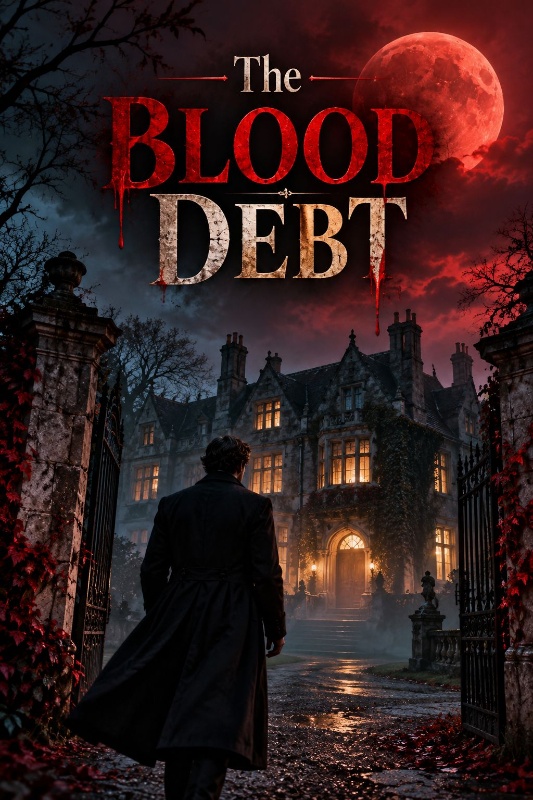
The first time Thomas Ashbourne saw the visitor, he was seven years old.
He remembered the moon most clearly.
It had hung above the hills like a pale, watchful eye, illuminating the gardens of Ashbourne Hall and the bare branches of the old yew trees. Beyond the iron gates, the countryside slept beneath a blanket of October mist. Every window in the house had been covered with heavy curtains, and every candle had been extinguished except the one burning in the kitchen.
Thomas had crept downstairs because he was thirsty.
He had found his father standing at the back door, holding a silver bowl in both hands.
His father had been a tall, imposing man, with silver beginning to thread through his black hair. Thomas had never seen him frightened before that night. Not when storms shattered the windows. Not when a horse broke its leg in the stables. Not even when his mother died.
But as his father looked through the narrow gap between the curtains, his hands trembled so badly that the blood inside the bowl rippled.
"Go upstairs," his father whispered.
Thomas had stared at the bowl.
"Whose blood is that?"
His father turned sharply.
"Thomas. Upstairs. Now."
There was something in his voice that frightened the boy more than the darkness outside.
Thomas obeyed.
He had almost reached the landing when three knocks sounded at the door.
Not loud.
Not hurried.
Three patient taps, as though someone had arrived for dinner and was waiting for the family to finish preparing.
His father closed his eyes.
Then he opened the door.
Thomas watched from the staircase.
A figure stood on the steps.
It was dressed in a long black coat that reached almost to the ground. Its face was hidden beneath a wide-brimmed hat, and its hands were covered by pale gloves. Mist curled around its boots, but the figure itself remained perfectly still.
It did not breathe.
It did not move.
It simply held out one hand.
His father placed the silver bowl into it.
The visitor lowered its head.
"Your house remembers," it said.
Its voice was quiet, almost gentle.
Thomas would remember that voice for the rest of his life.
His father swallowed.
"Yes."
"Your blood remembers."
"Yes."
"And the debt remains."
His father bowed his head.
"Until the debt is paid."
For a moment, the visitor said nothing.
Then it turned toward the garden.
Thomas expected it to walk down the steps, cross the lawn, and disappear through the gates.
Instead, it walked directly into the stone wall beside the yew trees.
Its body passed through the masonry as though the wall were made of smoke.
The silver bowl disappeared with it.
His father shut the door and locked it.
Then he leaned against the wood and began to weep.
Thomas had never seen his father cry before.
He would never see him cry again.
Three weeks later, his father died in his sleep.
The doctors called it a heart attack.
The family solicitor called it an unfortunate coincidence.
Thomas's grandmother called it the price of a broken promise.
And then she took the boy into the library, locked the door, and showed him the book.
It was bound in black leather, with no title on the cover. Its pages smelled of dust, old wood, and something faintly metallic. Names filled its yellowed paper, written in different hands across three centuries.
At the bottom of the final page was a date.
October 31.
And beneath it, in his father's handwriting, were four words.
Thomas is the next.
Twenty-three years later, Thomas returned to Ashbourne Hall for his father's funeral anniversary.
He had spent most of his adult life avoiding the estate.
He had studied in London, worked in the city, and built a quiet existence far from the village of Blackthorn, where the locals still crossed themselves when his name was mentioned.
He had told himself that his childhood memories were distorted by grief.
He had told himself that his grandmother was a frightened old woman who had filled a child's imagination with nonsense.
He had told himself many things.
But the black leather book had followed him everywhere.
He had found it among his grandmother's belongings after her death, hidden inside a locked drawer with his birth certificate and a bundle of letters. He had taken it to London, placed it inside a cabinet, and refused to open it.
Until the morning of October 31.
He had received a letter from the estate solicitor three days earlier.
There are matters concerning the family property that require your presence.
The letter had contained no explanation.
Now, as his car climbed the narrow road toward Ashbourne Hall, Thomas watched the estate emerge from the mist.
The house looked smaller than he remembered, though no less imposing. Its stone walls were dark with damp, its windows tall and narrow, its chimneys rising above the slate roof like the fingers of a buried giant.
The gardens had grown wild.
The iron gates hung crookedly.
Beyond them, the old yew trees stood in their familiar rows, their branches black against the pale sky.
Thomas stopped the car.
For several seconds, he sat with his hands resting on the steering wheel.
Then he noticed the front steps.
Someone had placed a silver bowl on them.
It was empty.
Thomas stared at it.
A cold sensation moved through his chest.
He had not brought the bowl. He had not told anyone he was coming.
Yet there it sat, precisely where he remembered seeing it as a child.
Beside it lay a folded piece of paper.
Thomas got out of the car.
The air smelled of wet earth and distant woodsmoke. Somewhere in the surrounding fields, a crow called once and fell silent.
He climbed the steps and picked up the paper.
There was only one sentence written on it.
The visitor has been waiting for you.
Thomas crumpled the note.
"No more," he whispered.
He did not know whether he was speaking to his dead father, his grandmother, or whatever had walked through the wall twenty-three years earlier.
But for the first time in three hundred years, the Ashbourne heir had made a decision.
That night, there would be no blood in the bowl.
And whatever came to collect it would leave empty-handed.