
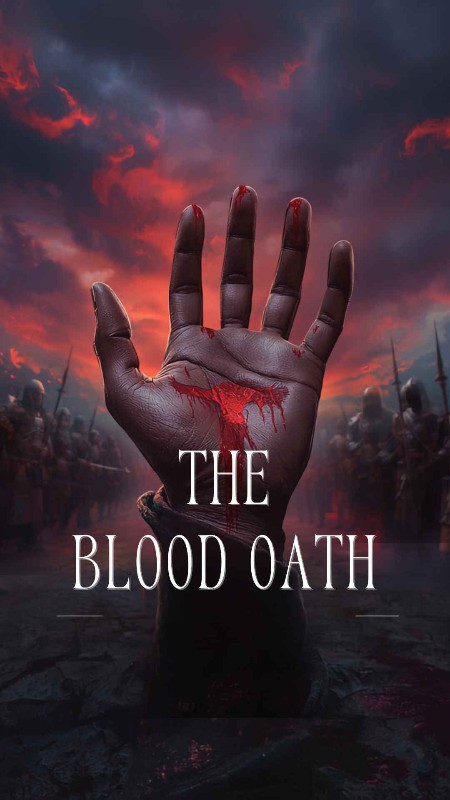
Part One: What the Scar Remembers
The scar knew before he did.
Davan felt it at dawn - a pull along the old wound on his palm, tight and hot like a coal pressed just beneath the skin. He'd had the scar for nineteen years. Long enough that he'd stopped seeing it. Long enough that some mornings he forgot what it meant.
This morning, it reminded him.
He was sharpening his sword outside the barracks when the messenger arrived - a boy, maybe fourteen, riding a horse that had been pushed past sense. The animal's sides heaved. Its eyes showed white. The boy slid from the saddle before it stopped moving and hit the ground on one knee, which Davan supposed was either trained deference or exhaustion. Possibly both.
"Commander Davan." The boy held out a sealed letter. The wax was black.
Black wax. Not the gold of King Aldric's court. Not the deep river-blue of Thessan's ruling house.
Black.
Davan took the letter. Didn't open it. Just turned it over once in his hands, feeling the weight of it, which was wrong - too light for what it clearly carried.
"Who sent you?"
"The border garrison at Vel Karath, sir. Captain Orryn said to ride through the night and put this in your hands alone."
Davan looked at the boy. Looked at the horse. Looked at the road the boy had come down, white with morning dust, empty all the way to the tree line.
He broke the seal.
He read it twice.
Then he sat down on the sharpening stone, which was not something commanders were supposed to do, and looked at his palm.
The scar was glowing. Faint - barely visible in the morning light - but gold. Unmistakably gold. It hadn't done that since the night the oath was sworn.
The letter said three things.
King Aldric of Varath was dead.
His son Cael had taken the throne by morning.
And Cael had burned the Oath-Temple at Vel Karath to the ground.
---
The Blood Oath was older than either kingdom.
That was the part people always forgot, or chose not to think about too hard. They called it Varath's oath, or Thessan's oath, depending on which side of the Karath river they'd grown up on. They hung it in tapestries and taught it to children as a story of two kings who chose peace over pride.
What the tapestries left out was the cost.
The oath had been sealed in the old way - not with signatures, not with witnesses, not with the soft diplomacy of men who wanted to feel important. It had been sealed in blood and fire and a word spoken in a language that most living scholars couldn't read and none could speak. A word that meant something. That did something.
Both kings had cut their palms. Both had pressed their hands to the altar stone. Both had spoken the word - coached by the last oath-keeper, a woman named Sera who was ancient even then and died three months later with the particular look of someone who had finished what they came to do.
The altar had drunk the blood. The fire had turned gold for exactly three seconds. And every person in that room - soldiers, priests, advisors, servants - had woken the next morning with a scar on their right palm.
Not the kings. The kings had been dead within the decade, as kings tend to be.
Their soldiers. Their people. The ones who would actually have to live inside the peace.
Davan had been seventeen. A junior swordsman in Varath's garrison, present only because his commanding officer had wanted bodies in the room to make Aldric's delegation look larger than it was. He'd stood in the back. He'd watched the fire turn gold.
He'd woken the next morning with the scar and understood, in the dim way of a seventeen-year-old, that something enormous had happened to him without his permission.
Nineteen years later, he commanded the joint border garrison - the one institution both kingdoms maintained together, the living proof that the oath still held. Half his soldiers were Varath-born. Half were Thessan. They argued about food and weather and the correct way to shoe a horse, and they trusted each other with their lives, and Davan had spent nineteen years quietly believing that this - this - was what peace actually looked like. Not the tapestries. Not the speeches. This. Two sets of soldiers who'd rather complain together than fight each other.
And now.
He looked at the letter again.
Cael has burned the Oath-Temple.
The temple wasn't just a building. Davan knew that. Everyone with a scar on their palm knew that, in the deep wordless way you know things that live in your blood rather than your head.
The temple was where the oath lived. Where the altar stone still held the brown stain of two kings' blood. Where the oath-fire had burned continuously for nineteen years, gold-tinted, never going out, tended by a small order of keepers who took the job as seriously as people take things when they know the alternative is war.
If the temple was gone-
His scar pulsed. Once. Hard.
He closed his hand into a fist.
"Boy." The messenger looked up. "Go to the kitchens. Eat something. Don't speak to anyone about this letter until I tell you to."
He was already walking toward the garrison hall before the boy could answer.
---
Part Two: The Shape of What's Coming
His second-in-command was a Thessan woman named Mira who had opinions about everything and was right about most of them, which Davan found useful and occasionally exhausting. He found her in the armory, inventorying arrowheads with the focused expression of someone who finds counting things calming. He understood this. He found sharpening things calming. They were, in this way, compatible.
He put the letter on the table in front of her.
She read it. Didn't read it twice, which meant she'd understood it the first time. Mira was like that.
"How long?" she said.
"Before they mobilize? If Cael moved on the temple, he'd have staged troops first. My guess-" He didn't want to say it. "Three days. Maybe four if we're fortunate."
"We're not usually fortunate."
"No."
She set the letter down. Looked at her own palm. The scar there matched his - same shape, same placement, same faint pull he could see her feeling in the slight tension around her eyes.
"It's already changing," she said quietly. "Can you feel it? It's-" She paused. "Looser. Like something's coming untied."
He could feel it. That was the worst part. The oath had been the background hum of his life for nineteen years and now it was changing pitch, fraying at the edges, and what replaced it was not silence but something that felt like the held breath before a scream.
"We need to send word to Thessan's court," he said. "Queen Sera-"
"Queen Sera will mobilize the moment she hears. She has to. If Varath moves first and Thessan doesn't answer, she looks weak. She won't risk it." Mira said it without judgment. Just fact. She was good at that - holding politics at arm's length long enough to see their shape. "We'll have armies on both sides of the Karath within a week."
"Then we need to stop it before that."
Mira looked at him.
"Davan. The temple is gone. The altar is ash. Short of-" She stopped. Something moved across her face. "No."
"I haven't said anything yet."
"You have that look."
"What look."
"The one where you've already decided something terrible and you're working out how to tell me so I don't argue."
He was quiet for a moment.
"There's a second altar," he said.
The armory was very still.
"That's a rumor," Mira said carefully. "Old keeper-talk. No one's ever-"
"Sera told me. The oath-keeper. Not the queen - the original one. She told one person before she died." He held up his palm. "She told whoever carried both halves of the oath-coin."
Mira stared at him. Then at his palm. Then back at him with the specific expression of someone recalculating everything they thought they knew about a person they'd worked alongside for eleven years.
"You have them," she said. "Both halves."
"I recovered them from Vel Karath two years ago. After the last keeper died without an apprentice. I didn't tell anyone because I didn't think-" He stopped. "I didn't think I'd need to."
The coin had been minted on the day of the oath - a single disc of gold-threaded iron, stamped with the joined seals of both kingdoms, then split cleanly down the middle. One half to each kingdom's keeper. A symbol, or so most people thought. A key, as it turned out.
He'd been carrying both halves for two years in the worn leather pouch he kept against his chest. He could feel them now - warmer than usual. Responding to whatever was happening to the oath.
"Where is the second altar?" Mira asked.
"Below the Karath. There's a ford three miles north - in the riverbed itself, there's a stone. Old. Pre-kingdom. The oath-keeper said it's where the original binding was spoken, centuries before either Varath or Thessan existed." He paused. "The fire there never needed tending. It just-burned."
"And if you go there. With the coin. What happens?"
This was the part he'd been turning over since dawn. Since the scar woke him. Since some part of him - the part that had carried nineteen years of someone else's peace in his blood - had already known this day was coming and had been quietly, without his permission, preparing for it.
"The oath can be rebound," he said. "The original text - the keeper's record I found with the coin - says the binding can be renewed. Reset. Not by kings. The kings are dead. By whoever carries the oath in their blood."
"Everyone with a scar carries it."
"Everyone with a scar and the coin carries the right to speak for it."
Mira was quiet for a long time. Long enough that someone walked past the armory door and kept walking, sensing the weight inside.
"And if the oath is rebound," she said, "what does it cost?"
He didn't answer.
Which was an answer.
"Davan."
"The original binding cost both kings a hand's worth of blood and a spoken word. The record says that a renewal - a re-binding after a breaking - costs more. Because you're not making a new oath. You're repairing a torn one." He looked at his palm. "The magic takes back what it's owed."
"Which is what, exactly."
"The record isn't specific."
"That's not reassuring."
"No."
She looked at him for a long time with the eleven-years look - the one that had learned to read the spaces between what he said. Then she picked up the letter, folded it precisely, and set it down again.
"When do we leave?" she said.
"*We* don't-"
"Don't." Her voice was quiet. Flat. Final. "Don't do that. Don't decide I'm not coming."
He opened his mouth.
"I have a scar too," she said. "I've carried this oath as long as you have. Longer, some mornings, when it pulls." She flexed her hand once, slowly. "You don't get to do this alone just because you've decided to."
He looked at her.
The thing was - he'd been going to go alone. He'd known it since he read the letter. Some part of him had already composed the note he'd leave her, already planned the hour of departure, already framed the whole thing as a solitary undertaking because it was easier, somehow, to walk toward something terrible when no one was watching.
Mira knew this about him. Had always known it. Found it, he suspected, somewhere between maddening and heartbreaking.
"We leave at nightfall," he said.
She nodded once. Went back to counting arrowheads.
---
Part Three: The Karath at Night
They rode north with four soldiers - the minimum Davan could justify, the maximum he could risk knowing where they were going. The Karath river ran silver in the moonlight, wide and cold and indifferent to kingdoms and their politics. It had been running here since before either nation had a name. It would run here after.
Davan found himself thinking about that. The river's indifference. How a thing could be present for every event without being of any of them. He'd always found rivers philosophically interesting in the way that people find things interesting when they've spent too many years in their own head.
"You're doing it again," Mira said from beside him.
"Doing what."
"Thinking so loud I can almost hear it."
"I'm not-"
"You get this look. Like you're very far away but very focused on whatever's out there."
He didn't answer, which she accepted as confirmation.
They rode in silence for a while. The river road was empty. The night was warm enough that the darkness had a texture to it - thick summer air, the smell of water and mud and something floral he couldn't name. Frogs sang in the reeds. Normal things. The kind of things that continued regardless.
"Tell me about the second altar," Mira said eventually.
"I've told you what I know."
"Tell me again. I process things better when I hear them twice."
He looked at her. She was watching the road ahead, her posture easy in the saddle, her right hand resting on her thigh with the scar facing up. A habit she'd had as long as he'd known her - palm up when she was thinking hard, like she was reading something written there.
"The original oath-keeper," he said, "believed the magic wasn't in the words or the blood specifically. She believed it was in the intent. The genuine desire for peace held by enough people that the magic had something to bind to." He paused. "She wrote that the oath was only as strong as the people carrying it believed it to be."
"Then it should still be strong," Mira said quietly. "I still believe it."
"So do I."
"So do most of the people wearing these scars. On both sides." She turned to look at him. "It's one man, Davan. Cael. One new king who burned a building because he wanted a war. The oath didn't break because the people stopped believing. It broke because-"
"Because the temple was the physical anchor. The belief needs something to live in." He felt the coin against his chest. Warm, now. Almost uncomfortably so. "That's what we're going to give it."
She nodded slowly.
"And if the cost is your life," she said. Flat. Not a question.
"Then the oath survives and forty thousand people on both sides of this river don't die in a war that one ambitious boy started."
"I see the logic," she said.
"Good."
"I still hate it."
"I know."
She looked away. The river moved beside them, silver and constant. Somewhere ahead, invisible in the dark, the old stone waited in the riverbed.
His scar pulled.
Getting close, he thought.
---
Part Four: The Stone
They found the ford by the scar's direction more than any map.
Davan dismounted at the riverbank. The water here was shallow - knee-deep at most, running clear over pale stones. He could see the bottom. And there, ten yards out, half-submerged and dark with age, a stone that was wrong in the way that very old things are sometimes wrong. Too regular. Too intentional. Covered in markings that weren't writing exactly but weren't decoration either.
He gave his reins to one of the soldiers. Looked at Mira.
"Stay here."
"Davan-"
"If this goes wrong, I need someone who knows what happened to tell the garrison. To tell both courts." He held her gaze. "That's not nothing. That's everything. If no one knows why the oath held, it won't mean anything."
She stared at him for a long moment.
Then she said, "Don't you dare die without telling me the plan first."
"There isn't much of a plan."
"Then don't die."
He almost said something. There was something right there - something that had been there for eleven years, maybe, living in the space between working alongside someone and knowing them the way you only know people when you've been afraid together enough times. Something he was better at not saying than saying.
He looked at her hand. The scar. His match.
Nineteen years, he thought. Both of us carrying the same thing.
"I'll be back," he said. Which was not what he'd almost said, but was what he could say. Was what he was capable of.
She looked at him like she knew the difference.
He waded in.
---
The water was cold. Shockingly cold for a summer night - the kind of cold that has nothing to do with temperature and everything to do with age. With how long the stone had been sitting here holding whatever it held.
He reached it. Put his hand on it.
The markings lit up. Not gold - older than gold. Something amber, something deep, something that felt like the color of a thing before it had a name.
He reached into his shirt and took out the leather pouch. Opened it. Held both halves of the coin in his scarred palm - and they pulled together immediately, the two halves wanting to be whole, and he let them meet, and the joining made no sound but he felt it in his teeth.
The stone's light intensified.
He understood, suddenly and completely, what the oath-keeper's record had meant about cost.
It wasn't that the magic would kill him. It wasn't that clean. The oath had been carried in his blood for nineteen years. The re-binding would take that - would pull nineteen years of belief and intent and the genuine bone-deep desire for peace out of him and pour it back into the stone. Back into the oath.
He would live.
He would just not carry it anymore.
The scar would be gone. The gold pull. The nineteen years of waking up with something larger than himself living quietly in his palm. He would be ordinary. He would be just a man.
He hadn't known until this moment how much of himself the oath had become.
The magic takes back what it's owed.
Behind him, on the bank, he heard Mira say his name. Quietly. Like she'd felt the change in the air.
He looked back at her.
She was standing at the water's edge, her right hand pressed flat against her chest, feeling what was happening. What was being asked. Her expression was - not afraid. Something more complicated than afraid. Something that looked like grief for a thing not yet lost, and underneath it, something that looked like pride.
She nodded once.
He looked back at the stone.
---
There was no dramatic word. No ancient syllable spoken aloud.
He drove his sword into the riverbed beside the stone - deep, both hands, blade in the silt - and he held the coin against the surface and he simply meant it. With everything the nineteen years had made him. With all the mornings he'd watched Varath and Thessan soldiers argue about horseshoes and share rations and trust each other with their backs. With every life in the garrison. With the body of the boy messenger who'd ridden through the night. With Mira on the bank.
He meant it the way you can only mean something when you know what it costs.
The stone blazed.
The river ran gold for exactly three seconds.
And then he was on his knees in the water, gasping, and his palm was smooth. The scar was gone. Not healed - gone. As if it had never been. As if seventeen-year-old Davan had never stood in the back of a room and watched a fire change color and woken the next morning different.
He was empty where it had been. Light. Terrifyingly ordinary.
He stayed there for a moment. Just breathing. Just a man in a river.
Then Mira was there - in the water, she'd waded in, she had his arm and was pulling him upright with the matter-of-fact strength of someone who had decided what they were doing and was doing it.
"Up," she said. "Come on. Up."
He stood. Let her take his weight for a moment, which he would not normally have done, but nothing about this was normal.
She looked at his palm.
Then she looked at her own.
Her scar was still there.
He blinked. "Mira-"
"I know." Her voice was very steady. "I felt it. When you gave yours - the stone took it and it filled, and-" She curled her fingers slowly. "Mine is still here. Because it didn't need it. Because one was enough." She looked at him. "You gave everything and it only needed half."
He didn't know what to say to that.
"Does it hold?" she said. "Is it done?"
He put his smooth palm against the stone.
The markings were dark. Quiet. Not extinguished - resting. The way a fire looks when it's found enough fuel to last.
"It holds," he said.
She let out a breath.
Then she said, very quietly, "I'm going to need a minute."
"Take it."
She stood in the river in the dark, the water running cold around her boots, and she pressed her scarred hand to her mouth for a moment, which was the closest he'd ever seen her come to falling apart. Then she lowered it. Straightened.
"We need to send riders to both courts," she said. "Tonight. The oath is renewed - Cael can march his army to the Karath and find nothing to fight. The soldiers on both sides will feel it." She touched her scar. "They'll know."
"Yes."
"And then we need to deal with the fact that a new king just burned a temple and destabilized nineteen years of peace and there are going to be political consequences that have nothing to do with magic."
"Yes."
She looked at him. Her expression was doing several things at once - the eleven-years look, complicated now by this, by the river, by what she'd watched him do and what it had cost.
"You were going to leave a note," she said.
He was quiet.
"For me. You were going to go alone and leave a note and-" She stopped. Made a small sound that wasn't quite a laugh. "Eleven years, Davan. Eleven years and you were going to leave me a note."
"Mira-"
"Don't." She held up her scarred hand. Not angry. Worse than angry - honest. "I know why. I know how you work. I know you thought it was protecting me or giving me something useful to do or-" She shook her head. "I just want you to know that I know. That I saw it."
He looked at her.
His palm was smooth. The oath was gone from him. He was just a man in a river.
"I see it too," he said.
She looked at him for a long moment. The water ran around them, cold and patient, silver under the moon.
"Good," she said finally. "Don't forget it."
She waded back toward the bank.
He looked at his hand. Empty palm. No scar. No gold pull. No nineteen years of something larger than himself living quietly there.
Just his hand.
He thought about what the oath-keeper had written. The oath is only as strong as the people carrying it believe it to be.
He looked at Mira on the bank, her scar glowing faint gold in the moonlight, still carrying it. Still believing it. Enough for both of them now.
Enough, he thought, is what peace always turns out to be. Not everything. Just enough.
He picked his sword out of the riverbed.
He waded back to shore.
---
Three days later, King Cael's army reached the Karath and found the river running quiet and gold-tinged, their own palms burning, and men on both banks who looked like soldiers but were already, somehow, brothers. The king turned his army around and rode home. He would claim, later, that it had been his choice.
It wasn't.
The oath held for another generation. And another. Long after Davan and Mira were gone, long after the garrison they'd built had been given a name and a monument and a place in the tapestries, the stone in the river still rested quietly in the riverbed, dark and patient, waiting for the next time.
It is waiting still.
---
THE END