
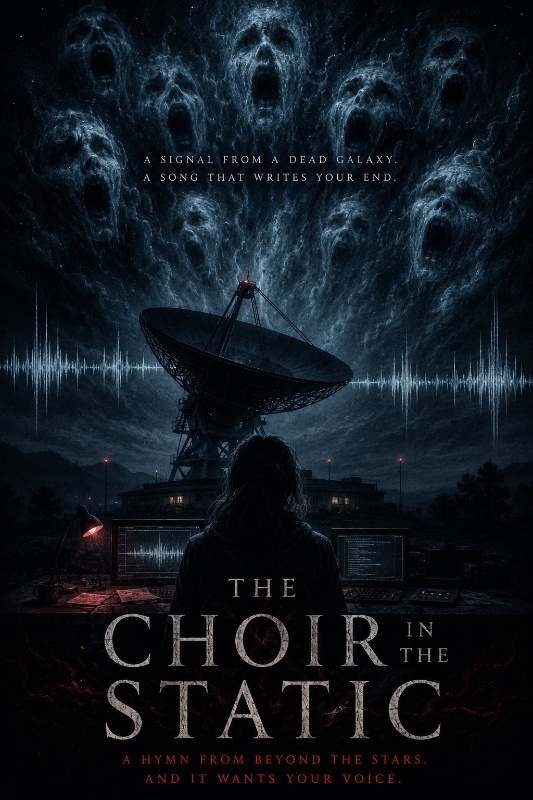
The first thing Dr. Anika Rao heard was her own voice singing from a speaker that wasn't connected to anything.
She was halfway through a sandwich.
That was the stupid part.
She remembered the mustard on her thumb. She remembered the fluorescent light above the monitoring desk flickering every eleven seconds. She remembered thinking she should've gone home two hours ago because the rain had started and she'd promised her daughter she'd be back before dinner.
She remembered all of that.
Then the speaker whispered:
"Here lies Anika Rao..."
Anika dropped the sandwich.
For a moment she didn't move.
The control room at the Kodaikanal Radio Astronomy Observatory hummed around her. Servers. Cooling fans. The old air-conditioning unit that sounded like somebody dragging furniture across a floor.
She looked at the speaker.
It was dead.
Not sleeping.
Dead.
The power indicator hadn't worked in three years.
"Very funny."
Nobody answered.
Anika wiped mustard from her thumb onto her jeans.
She looked toward the glass wall separating the control room from the main observation room.
Arun was there, hunched over a monitor.
He hadn't reacted.
"Arun?"
He lifted one finger.
Wait.
She waited.
Then the speaker crackled again.
"She was forty-three years old..."
Anika stood.
Her chair rolled backward and struck the wall.
Arun looked up.
"What?"
"You heard that?"
He frowned.
"Heard what?"
The speaker whispered:
"She had a daughter she loved very much..."
Anika's mouth went dry.
Arun slowly removed his headphones.
"What's happening?"
"I don't know."
The speaker clicked.
Static poured from it.
Then a voice began humming.
Three notes.
Low.
Warm.
Almost beautiful.
Anika stared at the dead speaker.
She knew, suddenly and with absolute certainty, that the humming was coming from somewhere very far away.
Not from the room.
Not from the observatory.
Not even from Earth.
And underneath the static, almost too quiet to notice, hundreds of voices were singing with it.
The telescope had been listening to the wrong galaxy.
That was what Anika wrote in her notebook.
Not:
We detected a signal.
Not:
Possible extraterrestrial transmission.
Not:
Unknown source.
She wrote:
The telescope has been listening to the wrong galaxy.
Then she crossed it out.
Then wrote it again.
The signal had arrived at 2:13 AM on a Tuesday.
It wasn't supposed to be there.
The observation schedule was aimed at a quiet region of sky containing several distant galaxies, none of them particularly interesting. The telescope had been collecting background radio noise for seventeen hours.
Then, suddenly, one frequency spiked.
No warning.
No gradual increase.
Just—
There.
A narrow-band transmission.
Extremely weak.
Extremely precise.
Arun found it first.
He was thirty-six, married, permanently tired, and had the peculiar habit of cracking his knuckles whenever he was lying.
He cracked them now.
"Could be interference."
Anika stared at the graph.
"No."
"Satellite?"
"No."
"Military?"
"Probably."
"That's reassuring."
"No, I mean it isn't."
Arun looked at her.
She pointed.
"The signal is redshifted."
"So?"
"So it's coming from outside the galaxy."
"How far?"
Anika typed.
The computer calculated.
She stared.
"No."
"What?"
"Run it again."
Arun did.
Same result.
The source was approximately eleven billion light-years away.
Arun leaned back.
"That's not possible."
"I know."
"Something that far away shouldn't be this clean."
"I know."
"And the frequency?"
"Exactly."
"Exactly what?"
Anika turned the monitor toward him.
The waveform was repeating.
Every seventeen seconds.
Seventeen seconds of static.
Then three seconds of silence.
Then the signal.
Again.
Again.
Again.
Arun frowned.
"That's a pattern."
"Yes."
"Could be natural."
"Natural things don't usually repeat at exactly the same interval."
"Sometimes they do."
"You're trying to make yourself comfortable."
He smiled faintly.
"Yes."
Anika didn't.
The signal continued.
Seventeen seconds.
Three seconds.
Seventeen.
Three.
Seventeen.
Three.
Then, at 2:27 AM, something changed.
The static became a voice.
A single syllable.
Neither of them understood it.
But both of them recognized the sound.
It was singing.
The first death happened six hours later.
A technician named Vikram went into the bathroom.
He locked the door.
He began singing.
Nobody thought anything of it.
At first.
People sing at work.
Quietly.
Badly.
Under their breath.
Vikram had always sung.
He'd sing old Bollywood songs while repairing equipment. He'd sing during lunch. Once, after three beers at a staff party, he'd sung for twenty minutes without realizing everyone had stopped listening.
But this wasn't a song anyone knew.
It was slow.
Unaccompanied.
Almost spoken.
A cleaner heard him through the door.
She laughed.
"Vikram, what are you doing?"
The singing stopped.
Then he said:
"I'm practicing."
"Practicing what?"
"My funeral."
The cleaner laughed again.
She told the others.
By lunchtime, everyone knew.
By 3 PM, Vikram had been found dead.
He'd hung himself from a pipe above the bathroom door.
He'd left no note.
Except on the wall, written in blue marker:
PLEASE DON'T LET THEM SING IT BACKWARDS.
Nobody knew what that meant.
Anika saw the message.
She didn't sleep that night.
At 1:12 AM, she called her daughter.
Mira answered on the fourth ring.
"Mom?"
"Hey."
"Are you coming home?"
"Yeah."
"When?"
"Tomorrow."
"You said that yesterday."
"I know."
"You always say tomorrow."
Anika closed her eyes.
"I'm sorry."
Mira was quiet.
Then:
"Are you okay?"
Anika almost said yes.
Instead she said:
"I heard something today."
"What?"
"A song."
"Is it scary?"
"No."
The lie came too quickly.
Mira noticed.
"Mom."
"Yeah?"
"Don't lie."
Anika swallowed.
"I'm scared."
Silence.
Then Mira said:
"Okay."
"Okay?"
"Yeah."
"I thought you'd—"
"What?"
"Nothing."
"You should come home."
"I will."
"When?"
"Tomorrow."
"Promise?"
Anika looked through the window.
The telescope was pointed toward the sky.
"Promise."
She hung up.
The speaker in the hallway clicked on.
No power.
No connection.
No reason.
A man's voice whispered:
"Here lies Anika Rao..."
She ripped the speaker from the wall.
Behind it was nothing.
Just concrete.
And a thin black wire disappearing into the darkness.
By Thursday, twelve people had died.
By Friday, forty.
By Saturday, nobody at the observatory was allowed to use the word "song."
They called it the signal.
The phenomenon.
The transmission.
The audio event.
Anything but what it was.
That helped.
For a while.
Anika discovered the pattern on Friday morning.
The signal wasn't broadcasting a hymn.
It was broadcasting thousands.
Every person heard something different.
Arun heard a funeral prayer in Tamil.
The director heard a Christian hymn he'd learned as a child.
One technician heard a lullaby.
A visiting astronomer heard nothing but static.
He was dead by evening.
That frightened Anika more than anything else.
Because the signal wasn't choosing people based on what they could hear.
It was choosing what they feared.
And then it was making them sing it.
Not immediately.
First came the humming.
Then the words.
Then the compulsion.
People described the same progression.
A tune appeared in their heads.
They couldn't stop hearing it.
Then they began adding words.
Their own words.
Their own names.
Their own memories.
Their own deaths.
One woman sang about drowning.
She lived in Rajasthan.
She had never learned to swim.
One man sang about being buried alive.
He died in his sleep.
A child in Bengaluru sang an eighteen-minute eulogy for herself.
She was alive.
She remained alive.
But she hadn't spoken normally since.
She only sang.
And every night, at exactly 3:33 AM, she asked her mother:
"Is everyone coming?"
Nobody knew who she meant.
Anika stopped listening to the signal through headphones.
That was the official recommendation.
It didn't matter.
She could hear it through walls.
Through running water.
Through the air-conditioning.
Once she heard it inside the refrigerator.
She opened the door.
The light came on.
Milk.
Vegetables.
A jar of pickle.
Nothing else.
Then the refrigerator motor clicked.
And for half a second, she heard a choir.
She slammed the door.
"Enough."
Her own voice sounded strange.
She was alone.
She knew that.
She had checked.
She had locked the door.
She had looked under the desk, behind the curtains, inside the bathroom.
Nobody.
Still, she whispered:
"I'm not listening."
The static answered.
Not from anywhere.
Just—
inside her head.
She sat on the floor.
Covered her ears.
The song continued.
She began humming along.
Stopped herself.
Bit her tongue.
Blood filled her mouth.
The song stopped.
Anika spat into the sink.
She stared at the blood.
Then she laughed.
A small, exhausted laugh.
"That's it?"
She wiped her mouth.
"You need me to sing?"
Silence.
"Fuck you."
The lights flickered.
"Fuck you."
Nothing.
She smiled.
Then the speaker above her desk whispered:
"She was a difficult woman."
Anika froze.
"She didn't trust easily."
The voice was her mother's.
Dead for twelve years.
"She loved her daughter."
Anika began crying.
"She should've gone home."
"No."
"She should've gone home."
"No."
"She promised."
Anika covered her ears.
"STOP."
The voice changed.
It became Mira.
Her daughter.
"Mom?"
Anika screamed.
"STOP!"
"Mom, I'm scared."
"No."
"Mom?"
"You're not her."
A pause.
Then the voice said:
"Neither are you."
Anika stopped breathing.
She drove home.
She wasn't supposed to.
The observatory had been placed under quarantine.
She didn't care.
She took her car at 4:40 AM.
The road down the mountain was wet.
Mist hung between the trees.
She drove too fast.
Once, a truck nearly hit her.
The driver leaned on his horn.
Anika laughed.
"Sorry."
She kept driving.
She needed to see Mira.
That was all.
Nothing else mattered.
At 6:11 AM she reached her apartment.
The door was open.
Anika stopped.
Her hand remained on the key.
"Mira?"
No answer.
She pushed the door wider.
"Mira?"
The apartment smelled like toast.
Normal.
Warm.
There was a cartoon playing on the television.
Mira's backpack was on the floor.
Her shoes were beside it.
"Mira?"
Anika walked through the living room.
"Mira?"
She found her daughter in the bedroom.
Sitting on the floor.
Eyes open.
Still.
"Mira?"
The girl looked up.
"Mom."
Anika dropped to her knees.
"Oh God."
She grabbed her.
Mira was warm.
Alive.
Anika held her so tightly the girl complained.
"Mom."
"I'm sorry."
"You're hurting me."
"Sorry."
Anika pulled away.
Mira looked at her.
"Why are you crying?"
Anika wiped her face.
"I missed you."
"I saw you yesterday."
"I know."
Mira frowned.
"You didn't come home yesterday."
Anika stared.
"What?"
"You called."
"When?"
"Last night."
"No, I was at the observatory."
Mira's face changed.
"You were."
"Yes."
"But you called."
"No."
Mira stood.
"Mom."
"What?"
"You said you were sorry."
"I am."
"No."
Mira backed away.
"You said you were sorry for dying."
Anika couldn't speak.
The apartment became very quiet.
Then the television went black.
The speakers crackled.
And Anika heard herself singing.
"Here lies Anika Rao..."
Mira began screaming.
Anika didn't remember leaving the apartment.
She remembered the road.
She remembered the rain.
She remembered stopping at a red light for eleven minutes because she couldn't understand what the red light meant.
She remembered a man in the car beside her singing.
She remembered looking at him.
He was smiling.
His eyes were closed.
He was singing his own name.
At the observatory, the signal had become stronger.
Much stronger.
The telescope wasn't receiving it anymore.
It was transmitting.
Arun was standing in the control room.
His face was pale.
"We've been sending it back."
"What?"
"The telescope."
"No."
"I didn't know."
"How?"
"The receiver isn't passive."
Anika stared at the screen.
"Turn it off."
"We tried."
"Then cut the power."
"We did."
"Disconnect the dish."
"We did."
"Burn the fucking thing."
Arun looked at her.
"I've been thinking about that."
"Good."
"We'd have to go outside."
"So?"
He smiled.
"I don't want to go outside."
Anika understood.
The singing had started in the corridor.
Soft.
Distant.
Hundreds of voices.
Maybe thousands.
The sound was beautiful.
That was what made it unbearable.
It wasn't loud.
It wasn't monstrous.
It sounded like people who loved each other.
People singing at a funeral.
People who knew exactly what they'd lost.
Arun whispered:
"Do you hear that?"
"Yes."
"That's not coming from the telescope."
Anika looked at him.
"Where is it coming from?"
He pointed upward.
The ceiling.
The sky.
Everything.
"They're answering."
At 2:13 AM, the observatory doors opened by themselves.
Nobody touched them.
The rain had stopped.
The sky above the mountain was clear.
Too clear.
The Milky Way stretched across the darkness.
Anika stepped outside.
Arun followed.
"You shouldn't."
"I know."
"We don't know what happens if we hear it directly."
"I know."
"Anika."
She stopped.
He was crying.
She'd never seen him cry.
"I'm going to miss my wife."
Anika looked at him.
"Don't say that."
"I'm sorry."
"Don't."
"I just—"
"Don't."
He nodded.
They stood together.
The telescope turned slowly.
Pointing upward.
Then—
the entire dish began to hum.
Anika felt the sound in her teeth.
Her jaw vibrated.
Her chest tightened.
The air seemed to thicken.
Then the sky answered.
A single note.
Low.
Deep.
Impossible.
Arun fell to his knees.
"No."
Anika grabbed his shoulder.
"Arun."
He began singing.
Not loudly.
"Here lies Arun Mehta..."
"Stop."
He couldn't.
"He loved his wife..."
"ARUN."
"He lied about the drinking..."
Arun's face collapsed.
Anika slapped him.
He kept singing.
"He never told her he was afraid..."
"STOP!"
The song continued.
Then Arun looked at her.
His eyes were wet.
"Anika."
"What?"
"Don't listen."
"I'm not."
"You are."
"No."
"You've been listening for days."
She stepped backward.
The song changed.
Now it was her voice.
"Here lies Anika Rao..."
She covered her ears.
It didn't help.
"She was a mother."
"No."
"She was a scientist."
"No."
"She was tired."
"Stop."
"She promised she'd come home."
Anika fell to the ground.
The gravel pressed into her palms.
She began to sing.
"No."
The word came out as a note.
She clamped her mouth shut.
Her throat burned.
The music continued inside her.
She could feel the words forming.
She knew what came next.
"She died alone—"
Anika screamed.
The singing stopped.
For one second, there was absolute silence.
Then a voice said:
"Wrong."
Anika opened her eyes.
Arun was gone.
The telescope was gone.
The observatory was gone.
She was standing somewhere else.
A field.
No stars.
No moon.
No buildings.
Just black grass moving beneath a wind she couldn't feel.
And thousands of people stood in the distance.
All singing.
All facing her.
Some were strangers.
Some were people she'd known.
Her mother.
Vikram.
Arun.
Daniel.
Her father.
People she hadn't thought about in decades.
People who hadn't existed.
People she had forgotten.
People she had never met.
And at the front stood Mira.
Her daughter.
Mira was crying.
"Mom."
Anika ran toward her.
Then stopped.
Because Mira was singing.
"Here lies Anika Rao..."
"No."
Mira smiled through her tears.
"She was a good mother."
"No."
"She loved her daughter."
"Stop."
"She didn't always tell the truth."
Anika shook her head.
"That's not you."
Mira's voice changed.
Hundreds of voices joined hers.
"She didn't always tell the truth."
"Stop."
"She didn't always come home."
"Stop."
"She didn't always know who she was talking to."
Anika covered her ears.
The choir grew louder.
"She forgot her mother."
"No."
"She forgot her father."
"No."
"She forgot Daniel."
"No."
"She forgot herself."
"No."
The voices stopped.
Mira looked at her.
"Mom."
Anika lowered her hands.
"Yeah?"
"Do you know why they're singing?"
Anika couldn't answer.
Mira stepped closer.
"Because that's how they remember us."
Anika stared at her.
"Who?"
Mira pointed upward.
There were no stars.
Still, Anika looked.
Something vast was moving behind the darkness.
Not in the sky.
Behind it.
Like a face pressed against thin fabric.
The outline of an enormous mouth appeared.
Then another.
Then thousands.
The choir began again.
Anika understood.
The signal wasn't a message.
It wasn't an invitation.
It wasn't an attack.
It was a record.
A graveyard.
A library.
Every civilization that had ever heard it had added its own dead to the song.
Every species.
Every language.
Every final breath.
The galaxy they'd been listening to wasn't dead.
It was singing.
And Earth had finally been added to the choir.
Anika looked at Mira.
"Can you hear them?"
Mira nodded.
"Yes."
"What are they saying?"
Mira wiped her face.
"They're saying we're almost finished."
Anika woke on the floor of the control room.
Morning.
Sunlight.
People shouting.
Alarms.
She couldn't remember how she'd gotten there.
Arun was alive.
Barely.
The telescope was destroyed.
The signal was gone.
The observatory was evacuated.
Nobody could explain what had happened.
The official report called it a mass psychological event.
Then a neurological contagion.
Then an unexplained acoustic phenomenon.
The language changed every few weeks.
The deaths didn't.
By the end of the year, seventeen thousand people had died.
Some killed themselves.
Some simply stopped eating.
Some sang until their throats bled.
Some survived.
Those were worse.
They could no longer hear music without crying.
Anika left astronomy.
She moved home.
She kept her promise.
Mostly.
She cooked for Mira.
She took her to school.
She went to parent-teacher meetings.
She bought groceries.
She complained about electricity bills.
Sometimes they watched terrible television together and laughed at things that weren't funny.
Life became boring.
Blessedly boring.
Anika liked boring.
She began sleeping with the television on.
Not because she liked television.
Because silence was worse.
Six months passed.
Then a year.
Then two.
The world learned to forget.
It always does.
There were other disasters.
Wars.
Elections.
Floods.
A pandemic nobody wanted to discuss anymore.
The signal became a story told on late-night podcasts.
A conspiracy theory.
A hoax.
A strange chapter in the history of astronomy.
Anika never corrected anyone.
She didn't talk about the field.
She didn't talk about Mira singing.
She didn't talk about the voices.
She didn't talk about what had stood behind the stars.
She lied.
She lied because sometimes lying is how you keep a family alive.
Then, on an ordinary Thursday afternoon, Mira came home from school.
She put her bag down.
Took off her shoes.
Went into the kitchen.
"Mom?"
Anika looked up.
"Yeah?"
"Can I ask you something?"
"Sure."
Mira hesitated.
"Do you know the song?"
Anika's hands went cold.
"What song?"
Mira frowned.
"The one everybody used to sing."
"I don't know."
"You do."
"No."
Mira stared at her.
Then she began humming.
Three notes.
Low.
Warm.
Almost beautiful.
Anika dropped the glass in her hand.
It shattered on the floor.
Mira stopped.
"Mom?"
Anika couldn't breathe.
"No."
"What?"
"No, no, no."
Mira looked frightened.
"Mom, what's wrong?"
Anika grabbed her shoulders.
"Don't sing that."
"I wasn't."
"You were."
"I was just humming."
"Don't."
Mira began crying.
"I don't understand."
Anika pulled her close.
"I'm sorry."
"What did I do?"
"Nothing."
"Mom."
"Nothing."
The lights flickered.
Once.
Twice.
Then the television turned itself on.
Static.
No picture.
Anika froze.
Mira whispered:
"Mom?"
The static softened.
A voice emerged.
Anika's voice.
Older.
Much older.
"Here lies Anika Rao..."
Mira screamed.
Anika grabbed the remote.
Nothing.
She pulled the television from the wall.
The screen stayed on.
"She lived for sixty-three years..."
Anika stared.
"Sixty-three?"
She was forty-five.
The voice continued.
"She died peacefully at home, surrounded by—"
Anika smashed the television with a chair.
The screen exploded.
Silence.
She stood there shaking.
Mira was crying on the floor.
Anika knelt beside her.
"It's okay."
"No."
"It's okay."
"Mom."
"What?"
Mira pointed at the broken television.
Something was still playing.
Not through the speakers.
Through the static trapped inside the shattered screen.
Anika leaned closer.
There were voices.
Hundreds.
Thousands.
A choir.
And beneath them—
a new voice.
Mira's.
Singing softly.
"Here lies Anika Rao..."
Anika shut her eyes.
She didn't scream.
She didn't run.
She simply held her daughter.
And listened.
Because there was something different about the song now.
Something the others had never heard.
A space between the notes.
A pause.
A tiny, impossible silence.
And from inside that silence came another voice.
Not singing.
Not speaking.
Waiting.
Anika opened her eyes.
Mira looked at her.
"Mom?"
Anika couldn't answer.
Outside the window, the afternoon sky was perfectly blue.
No stars.
Not one.
But Anika knew where they were.
She could feel them.
All of them.
Listening.
And for the first time in two years, she understood what Vikram's message had meant.
Please don't let them sing it backwards.
Because the song wasn't a eulogy.
It was a rehearsal.
And somewhere beyond the sky, something had begun singing the final verse.
Not for the dead.
For the living.
Anika held Mira tighter.
Then, very quietly, so quietly her daughter almost didn't hear it, she began to sing along.