
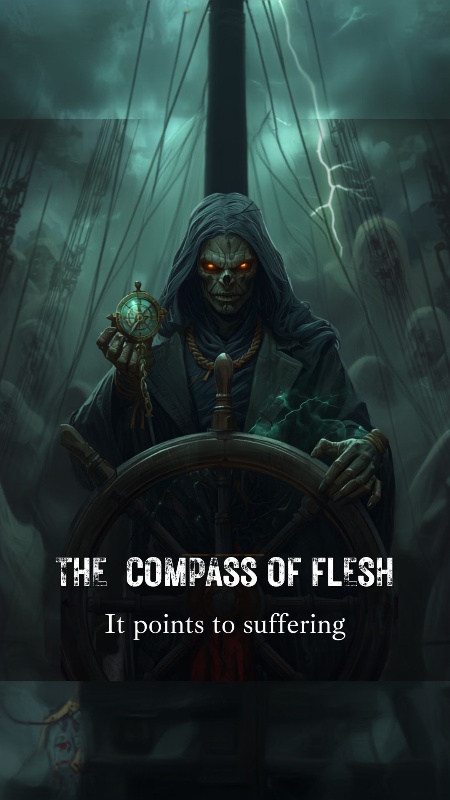
The needle didn't point north.
Captain Elias Marsh knew this. He had known it for thirty years, ever since the night he pried the compass out of his predecessor's cold, bloody hands. But knowing it didn't make it easier to look at.
He stood at the helm of The Sorrow, his weathered fingers wrapped around the cracked leather of the wheel, and stared down at the brass casing resting on the chart table. The needle was spinning. Not wildly, not aimlessly—it was spinning with purpose, twitching, jerking, fighting against the invisible magnetic field that should have pulled it toward the Arctic.
It was pointing southeast.
Elias looked out at the grey, churning ocean. The sky was a bruised, heavy grey, pressing down on the water like a lid on a coffin. The wind was picking up, biting through his heavy wool coat, stinging his cheeks.
The needle twitched again. It swung a few degrees further southeast.
Southeast, Elias thought. Southeast means the islands. The fishing villages. The refugee camps.
He gripped the wheel tighter. His knuckles were white. He hated this. He hated it more than the storms, more than the hunger, more than the endless, suffocating loneliness of the open sea. But he had to go.
Because the compass didn't point to treasure. It didn't point to land. It pointed to suffering. And Elias was a collector.
He was a scavenger of misery.
---
The first time he had used the compass, he had been terrified.
He was only a first mate back then, a young man with a desperate wife and a starving crew. Captain Hendricks had owned the compass, a strange, brass instrument with an obsidian face and a needle made of something that looked like polished bone. Hendricks had kept it locked in a steel box under his bunk.
"I found it in the belly of a dead ship," Hendricks had told him once, his voice a low, reverent whisper. "A ship that had been lost for forty years. Everyone aboard had starved to death. But this... this was still ticking."
Elias had asked him what it did. Hendricks had just smiled. A thin, cruel, knowing smile.
"It points to what we need," Hendricks said. "It points to the miserable. It points to the broken. And when we find them... we take what they have."
They had been a salvage crew, but they weren't salvaging ships. They were salvaging people.
Elias remembered the first time they followed the needle. It led them to a small, wooden fishing boat adrift in the middle of the Atlantic. The boat was filled with refugees. Men, women, children, crammed together like cattle, their skin sunburned and peeling, their eyes hollow and desperate. They had been lost for two weeks. They had no food. No water. The ones who had died had been thrown overboard.
The crew of The Sorrow had pulled alongside. Hendricks had ordered his men to board. They had taken the water. They had taken the food. They had taken a young girl's silver locket, her last connection to her dead mother.
Elias had stood at the railing, watching. He had felt sick. He had wanted to help. But Hendricks had caught his eye, and Elias had looked down at the compass.
The needle was pointing right at the refugee boat. The needle was pointing right at the suffering.
And the suffering was fuel.
---
Elias shook his head, snapping himself out of the memory. The needle was still pointing southeast.
"Mr. Vance," he called out to the first mate. "Set a course southeast. Full sail."
The first mate, a grizzled, scarred man named Vance, looked up from the rigging. He had been with Elias for fifteen years. He knew what the southeast meant. He didn't ask questions. He just nodded and barked orders to the crew.
The Sorrow creaked and groaned as the sails caught the wind. The ship turned, its bow slicing through the grey water, heading toward the point on the horizon where the needle was fixed.
Elias walked to the chart table and looked at the compass more closely. He reached out, his fingers hovering over the brass casing. He could feel the warmth radiating from it. It was always warm. It was always humming.
He picked it up.
The needle dug into his palm. It was sharp, jagged, like a splinter of bone. It didn't hurt—not physically. But when he held it, he felt it. A wave of cold, crushing emotion washed over him. Fear. Grief. Desperation. A hundred thousand human hearts crying out in unison.
Elias winced, but he didn't drop it. He closed his eyes and let the feeling wash over him.
It's pointing to someone, he thought. Someone who is suffering right now. Someone who is dying.
He opened his eyes. The needle was trembling.
---
Three days later, they found the ship.
It was a cargo vessel, massive and rusted, listing heavily to the port side. The hull was scarred and blackened, the paint peeling away in sheets. It didn't look like it had been afloat for years. It looked like it had been dragged up from the bottom of the ocean.
Elias stood at the bow, his spyglass pressed to his eye. The ship had no lights. No smoke rising from the funnel. No crew visible on the deck.
"Looks dead," Vance said, walking up beside him. "What's the compass say?"
Elias looked down. The needle was pointing straight at the cargo vessel. And the needle was screaming. It was vibrating so hard it was rattling against the glass casing. It was pointing right at the heart of the ship.
"There's someone alive on board," Elias said. His voice was flat, hollow. "Someone who is suffering."
Vance grimaced. "We go in?"
Elias looked at the compass. He felt the pull. The deep, gnawing, obsessive pull to follow it. He had made a deal with the devil thirty years ago. He had taken the compass from Hendricks's corpse, and he had promised himself that he would use it for good. He would find the suffering, and he would end it. He would be a savior.
But the compass didn't care about saving. It cared about feeding.
And Elias had been feeding it for thirty years.
"Go in," Elias said.
They boarded the cargo vessel. The ship was silent, filled with the thick, metallic smell of rust and old blood. The hold was dark, the only light coming from the flashlights strapped to their helmets.
They found the people in the cargo hold.
They were huddled together in the corner, a dozen of them, men and women and children. But they weren't refugees. They weren't starving. They were... changed.
Their skin was covered in weeping sores. Their eyes were cloudy, milky, blind. Their limbs were bent at unnatural angles, their joints swollen and purplish. They were moaning. A low, constant, collective sound of pure agony.
Elias felt his stomach lurch. He took a step back.
"What happened to them?" Vance whispered, his voice shaking.
Elias didn't answer. He looked at the compass.
The needle was pointing at them. But it wasn't pointing at any individual person. It was pointing at all of them. It was pointing at the collective suffering. The mass of misery. The pile of broken flesh.
And the needle was drinking.
Elias watched as the needle grew brighter. It pulsed, glowing with a sickly, pale light, absorbing the agony from the air. The people in the corner moaned louder, their bodies trembling.
"Stop," Elias whispered. "Stop, I need to help them."
But the compass wouldn't stop. The needle was spinning, jerking, drawing the suffering out of them like a leech drawing blood.
Elias reached into his coat. He pulled out his pistol. He aimed it at the compass.
"Elias!" Vance shouted. "What are you doing?"
Elias stared at the compass. He had followed it for thirty years. He had saved people. He had doomed people. He had watched the needle lead him to disasters, to wars, to plagues. He had watched it consume the misery of the world and turn it into... something. He had always wondered where the suffering went. He had always wondered what the compass was building.
"You have to stop," Elias said. His voice was shaking. "I won't let you feed anymore."
The compass hummed. The needle pointed at Elias.
He froze.
The needle was pointing at him.
And Elias felt it. The wave of suffering. His own suffering. The guilt. The grief. The endless, crushing loneliness of the sea. The wife he had left behind. The daughter he had never seen grow up. The men he had murdered. The innocent people he had watched die.
It was all there. It was all inside him.
The compass was feeding on him now. And it was starving.
Elias screamed. He dropped the pistol, clawing at his own chest. He could feel his heart tearing, his ribs cracking, the suffering rising up out of him like a black tide.
The people in the corner stopped moaning. They were silent. They were watching him. Their milky eyes were fixed on him.
And they were smiling.
"You are the fuel," one of them whispered. "You are the vessel. The compass is the key. And you have been carrying it for thirty years."
Elias staggered backward. He looked at his hands. They were covered in blood. His own blood. He didn't know when he had started bleeding.
He looked at the compass. The needle was pointing at his heart.
Vance grabbed his arm. "We have to get out of here! Now!"
Elias nodded. He grabbed the compass and shoved it into his coat. He ran, Vance at his side, racing out of the cargo hold, up the metal stairs, onto the deck of the dying ship.
They jumped back onto The Sorrow. They cut the ropes. They sailed away.
Elias didn't look back. He couldn't. He knew what was happening back there. The ship was sinking. The suffering was ending.
But the compass was still humming. It was still pointing at him.
---
Elias sat in his cabin that night. The compass was on the table in front of him. The needle was pointing directly at his chest. It hadn't moved. It wouldn't move.
He picked it up. He felt the warmth. He felt the suffering.
And he realized the truth.
The compass wasn't a tool. It wasn't a weapon. It was a prison.
It had been made to hold the suffering of the world. It had been built by someone—something—that wanted to trap human misery, to turn it into a source of power. And it needed a carrier. A vessel. A host.
Elias had been the host for thirty years. He had carried the compass, he had followed it, he had fed it. And now, it was done feeding.
Now, it was time to harvest.
Elias looked at the compass. The needle was glowing, pulsing, beating like a second heart. He felt the suffering rising up out of his own chest, filling the cabin, filling the air.
He couldn't put it down. He couldn't throw it away. It was part of him now. It was fused to him.
He stood up. He walked out of the cabin. He climbed the stairs to the helm.
Vance was there. He looked at Elias. His face went white.
"Captain?" Vance said. "What's wrong? Your eyes—"
Elias looked at him. He felt the suffering leaking out of his own body, flooding the deck. He felt the cold, crushing weight of a thousand deaths. He felt the pain of a thousand broken hearts.
"It's time to go home," Elias said.
The needle pointed to the horizon. But it wasn't pointing to the southeast. It wasn't pointing to the islands. It wasn't pointing to any concentration of human suffering.
It was pointing to the deepest, darkest, most isolated part of the ocean.
It was pointing to the void.
And Elias sailed toward it, carrying the compass of flesh, the only vessel that could hold the agony of the world.
He sailed into the dark. He sailed into the silence. He sailed into the place where the compass was born.
And he disappeared.
The compass was never found.
But sometimes, in the dead of night, sailors in the far corners of the world claim to hear a low, humming sound coming from the deep. A pulsing, rhythmic beat.
It sounds like a heartbeat.
It sounds like a hundred thousand hearts, beating in unison.
It sounds like the compass, still turning, still searching, still starving.
Waiting for the next captain.