
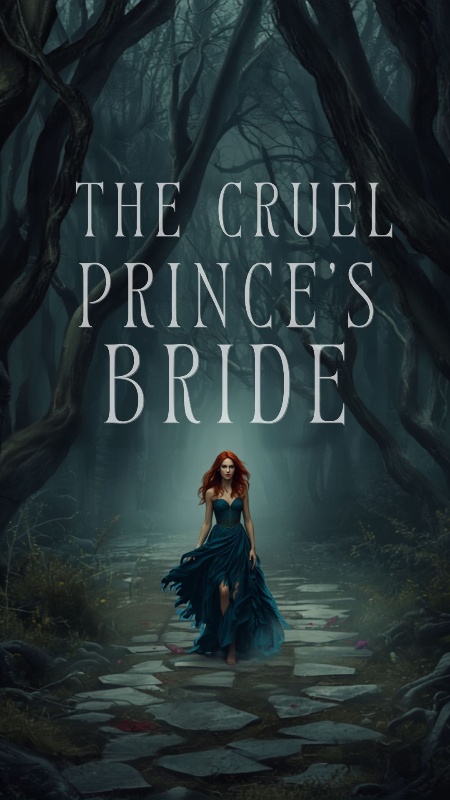
Part One: The Offering
The carriage smelled like cedar and old fear.
Sera Voss had been in it for three days. She knew because she'd counted the sunrises through the narrow gap in the curtain - one finger-width of light, enough to tell day from night, not enough to see where she was going. They'd taken her shoes. She didn't know why. Maybe so she couldn't run. Maybe so she'd arrive already diminished.
Her father's idea of a peace offering.
She was twenty-two years old. She spoke four languages, could ride better than any man in Voss territory, had been running her father's household accounts since she was sixteen because he couldn't be trusted with numbers or money or most things that required sustained attention.
None of that mattered now.
Now she was cargo.
The carriage stopped.
Sera straightened her spine before the door opened. Whatever came next she would meet it upright. That was the only decision left to her - the angle of her chin, the steadiness of her hands. She would not give them the satisfaction of arriving broken.
The door opened.
Cold air. Mountain cold, sharp and thin. She stepped out barefoot onto stone and did not flinch.
The palace of Aldric rose above her like something that had grown from the rock itself - dark granite, high walls, towers that disappeared into cloud. It was beautiful the way a weapon was beautiful. Functional. Severe. Built for dominance not comfort.
A man was waiting at the top of the steps.
Not a servant. The way he stood made that clear - not positioned to receive but to assess. Tall. Dark coat. The kind of stillness that came from absolute certainty about one's place in any room.
He looked at her the way you looked at something you'd purchased and weren't sure you wanted.
"Sera Voss," he said.
"Caius Aldric." She didn't make it a question.
Something moved in his expression. Gone before she could read it.
"You're barefoot," he said.
"Someone took my shoes."
"Why?"
"You'd have to ask your men."
He looked at her feet on the cold stone. Then he looked back at her face. His eyes were grey - not soft grey, the grey of winter sky before a storm.
"Bring her inside," he said to no one in particular. And walked away.
Sera stood on the cold stone and watched him go.
He'll break her. She'll break him first.
She'd told herself that in the carriage, over and over, the way you repeated something until it became true.
She was starting to understand it might actually be a fight.
Good. She'd been bored.
Part Two: The Terms
They gave her a room.
Large. Cold. Furnished with the impersonal precision of a space designed for occupation not inhabiting. The bed was good. The fire was real. A woman named Dara brought her shoes - not her own, new ones, the right size - and a dress that was better than anything she'd owned in Voss territory and said nothing about either.
Sera wore the dress because it was warm. She told herself that.
She explored the room systematically. One window, courtyard below, two guards visible. Door locked from the outside - she tested it carefully, quietly. A second door, interior, unlocked, led to a sitting room that led to a larger corridor.
Not a cell. But a cage with better furniture.
She was sitting at the window when Caius came.
No knock. The door just opened and he was there, still in the dark coat, with a document in his hand and the particular energy of someone who considered time a personal resource not to be wasted.
"The terms," he said, setting the document on the table.
Sera didn't move from the window. "Good evening to you too."
"The terms," he said again. Not louder. Just - final.
She crossed the room and looked at the document without touching it.
It was a marriage contract. Dense, formal, the language of kingdoms and blood and political machinery. She read it the way she'd read her father's accounts - quickly, looking for the gaps, the places where the numbers didn't add up.
She found three.
"This gives you full governance of Voss territory upon marriage," she said.
"Yes."
"My father agreed to that."
"Yes."
"He traded his entire kingdom for what exactly?"
"Aldric military protection for five years and a sum of gold that he'll spend in two." Caius's voice was without inflection. "Your father is not a sophisticated negotiator."
"No." She kept reading. "This clause - here. It stipulates that any children of the marriage are Aldric heirs exclusively. Voss lineage is extinguished."
"Yes."
"You've essentially ended my family's dynasty."
"Your father ended it. I just wrote down the terms."
She looked up. He was watching her read with the same assessing expression he'd had on the steps. Like she was a problem he was calculating.
"What do you get from this?" she asked. "Truly. Voss territory is valuable but not exceptional. The gold you're giving is more than it's worth strategically. So what is this actually about?"
Something shifted in his expression.
"You read contracts quickly," he said.
"Answer the question."
"Your father has something I need. Something that isn't in that document." He met her eyes. "And he wouldn't give it without the marriage."
"What?"
"That's between your father and me."
"I'm the one marrying you."
"Yes." He picked up the document. "And that gives you certain rights under Aldric law. Not many. But some." He set it back down. "I'd recommend reading the appendix."
He left.
Sera stood at the table for a long time.
Then she sat down and read the appendix.
The appendix was interesting.
Under Aldric marriage law - older than the current dynasty, apparently, and impossible to override even by the prince - a wife retained the right to petition the high council directly. To speak in assembly. To refuse any order that constituted personal harm.
Not freedom. But not nothing.
Someone had left this document where she'd find it. Someone who knew she'd read it. Someone who'd told her to look at the appendix specifically.
Caius Aldric had told her to read the appendix.
She didn't know what to do with that.
Part Three: The Game
The marriage was set for thirty days.
In those thirty days, Sera was expected to learn Aldric court protocol, meet the high council, and present herself as a willing participant in the alliance.
She was not a willing participant. Everyone knew this. The performance was the point.
She performed brilliantly.
She learned the protocol in four days instead of thirty. She memorized the council members - their allegiances, their histories, their pressure points - by the end of the first week. She spoke to them in their own language, literally, switching between Aldric formal and the northern dialect depending on who she was addressing, watching their expressions recalibrate in real time.
She was not what they'd expected.
She was not what Caius had expected either. She could tell - in the small moments, the fractional shifts in his expression during the council meetings she was now permitted to attend. He watched her work the room with the particular attention of someone reassessing.
She watched him back.
Caius Aldric was not what she'd expected either. She'd expected cruelty - the obvious kind, the kind her father practiced, loud and careless. What she found was colder and more precise. He didn't raise his voice. He didn't threaten openly. He simply - decided things, and the world arranged itself accordingly, because everyone in it understood that crossing him had a cost they weren't willing to pay.
But there were cracks.
She found the first one in the second week.
A servant - young, couldn't have been more than fifteen - had broken a piece of Aldric crystal in the corridor outside the council room. An accident, clearly. The boy was white with terror, the pieces around his feet, when Caius came around the corner.
Sera watched.
Caius looked at the boy. At the broken crystal. Back at the boy.
"Clean it up carefully," he said. "Those pieces are sharp. Use the cloth from the supply room, not your hands."
He walked past.
The boy stared after him like he'd expected something very different.
So did Sera.
That evening she said to him - they had dinner together, required, another performance - "The crystal in the corridor."
Caius looked up from his food.
"You were supposed to make an example," she said. "That's what they expected."
"I know."
"Why didn't you?"
"He's fifteen," Caius said. "And it was an accident." He went back to his food. "I make examples when examples are necessary. A frightened child dropping something is not a moment that requires a lesson."
Sera looked at him.
"That doesn't fit your reputation," she said.
"Reputations are constructed." He met her eyes briefly. "You know that better than most. You've been constructing one since you arrived."
She had no answer for that.
The second crack was worse.
She found him in the library at midnight - she'd been exploring, mapping the palace the way she mapped everything, and the library light was visible under the door. She pushed it open without thinking.
He was sitting on the floor.
Not at a desk, not in a chair. On the floor, back against the shelves, with a book open in his lap and his dark coat discarded and his expression - completely unguarded, for the first time, in a way that felt like accidentally seeing something private.
He looked up.
Neither of them spoke for a moment.
"The door was open," she said, which wasn't true. "I'll go."
"Stay." He said it quickly. Then, like he was correcting himself: "If you want. There are good books."
She stayed.
She found a book and sat - not on the floor, in a chair, maintaining some version of sensible distance - and read, and he read, and the fire went low, and neither of them said anything for an hour.
It was the most comfortable she'd been since the carriage.
That frightened her more than anything.
Part Four: The Truth
Three weeks in, she found out what her father had given him.
Not from Caius. From Dara, who trusted her now, who talked more than she meant to in the way of people who'd been quiet too long.
Her father had given Caius a name.
One name. The name of the person inside Aldric court who had been feeding military intelligence to three rival kingdoms for eleven years. The leak that had cost Aldric two campaigns and hundreds of lives.
The spy was on the high council.
And Caius couldn't move against a council member without evidence and a witness. Voss - her father, who traded in information the way other men traded in gold - had the evidence. The marriage was the price.
Sera sat with this for a long time.
Everything recalibrated.
Caius wasn't collecting her. He wasn't dismantling her family's legacy for sport. He was trying to protect his kingdom from a betrayal that had been bleeding it for a decade and her father had been the only one with the proof.
It didn't make the contract fair. It didn't make her position acceptable.
But it made him something other than what she'd decided he was.
She went to find him.
He was in his study. He looked up when she entered - she didn't knock, she'd stopped knocking, he'd stopped looking surprised by it.
"Rathen," she said. The council member. The name Dara had given her. "It's Rathen, isn't it."
Caius went very still.
"Dara didn't mean to," Sera said. "She didn't tell me directly. I pieced it."
"You piece things quickly."
"Yes." She sat down across from him. "Why didn't you tell me?"
"Because it wasn't your concern."
"I'm the price of the information. It's entirely my concern." She held his gaze. "How long has he been selling intelligence?"
"Eleven years."
"How many people died because of it?"
His jaw tightened. "More than I'll say in a number."
"And my father had the proof."
"Your father has been collecting it for six years. Waiting for the right moment to sell it." Something cold moved across his face. "He found his moment."
Sera thought about her father. About the calculation behind his eyes. About being weighed and found useful.
"I'll testify," she said.
Caius looked at her.
"At the council. Whatever evidence you have - I can speak to my father's methods. I know how he collected information, how he verified it, how he documented it. I can establish its credibility." She met his eyes. "Under Aldric marriage law, a wife can address the high council directly. It's in the appendix."
The silence stretched.
"You'd do that," he said slowly. "Why?"
"Because eleven years of people dying for one man's greed is reason enough." She looked at her hands. "And because I'd rather be here for something real than perform an alliance that means nothing."
"This doesn't change your position," he said. "The contract-"
"I know." She looked up. "I'm not asking you to change the contract. I'm telling you I'll help. What you do with that is your decision."
He looked at her for a long time.
"The appendix," he said finally. "I wondered if you'd find it."
"You left the document."
"I wanted you to know your rights." He held her gaze. "I don't want a prisoner, Sera. I want-" He stopped.
"What?"
"I want this to be something other than what it started as." He said it carefully. Like each word was chosen. "I don't know if that's possible."
"I don't either." She stood. "But I'll testify. And after that-" She paused at the door. "After that we can figure out what this is. What it could be. Without the performance."
"Is that what you want?"
She looked at him. At the man on the library floor with his coat off and his guard down. At the man who'd told a terrified fifteen year old to use a cloth so he wouldn't cut his hands.
At the man who'd shown her the appendix before she'd given him any reason to.
"I don't know yet," she said. "But I'm willing to find out."
She left.
Behind her she heard him exhale - the specific sound of someone who'd been holding something for a very long time.
Part Five: The Break
The council session was on a Tuesday.
Sera stood before twelve of the most powerful people in Aldric and spoke for forty minutes. She laid out her father's methods, his sources, his documentation process, with the precision of someone who'd spent years watching a man who traded in secrets operate. She was calm. She was specific. She was devastating.
Rathen tried to discredit her twice.
She dismantled both attempts without raising her voice.
When it was over, the council voted in four minutes.
Caius watched from the head of the table throughout. He didn't intervene. He didn't need to. He just - watched her work, with the expression she was starting to recognize. The one that wasn't assessment anymore.
The one she didn't have a name for yet.
Afterward, in the corridor outside the council room, he said: "You didn't have to do that."
"I know."
"You could have stayed out of it. Let it play out without you."
"I could have." She looked at him. "I didn't want to."
He was quiet for a moment. "Why?"
She thought about the question. About the carriage and the cold stone and the document and the library floor and thirty days of watching a man be something other than his reputation.
"Because you showed me the appendix," she said. "Before I'd given you any reason to. Before I'd done anything for you." She met his eyes. "That was a choice. I wanted to make one back."
Something in his face broke open. Just slightly. Just enough.
"The contract," he said. "I want to renegotiate it."
"You don't have to-"
"I want to." His voice was firm. "The governance clause. The lineage clause. They stay as written because your father signed them and I can't undo that legally. But the rest-" He stopped. "I want this to be a negotiation between us. Not something imposed."
She looked at him.
"That's going to take time," she said.
"I know."
"And I'm going to argue with you. Constantly. About everything."
"I've noticed."
"And I'm not going to pretend this started well. Or that I've forgotten what it is."
"I'm not asking you to." He held her gaze. "I'm asking you to start from here. From what it is now. Not what it was."
Sera thought about breaking him. She'd told herself that in the carriage. She'd made it a promise, a war cry, a way to survive.
She looked at him now - at the man who was trying, carefully, imperfectly, to offer her something real in the middle of a situation that had been built on everything wrong - and thought that breaking him had never actually been what she wanted.
What she'd wanted was to not be broken herself.
She was still standing.
"From here," she said. "We start from here."
"Yes."
"And I want my own accounts. Full access to Aldric finances. If I'm going to be part of this kingdom I'm going to actually know what's in it."
His mouth moved. Almost a smile. The first real one she'd seen.
"Done," he said.
"And the kitchen needs better suppliers. Whatever they're buying the vegetables from is doing something criminal to the carrots."
This time he did smile. Small. Real. Nothing like his reputation.
"I'll look into the carrots," he said.
She nodded. "Good start."
Part Six: The After
The marriage happened on a Thursday.
It was not the performance they'd planned. Smaller. The high council present because it was required. Dara in the back because Sera had asked her. No procession. No spectacle.
Just two people standing in front of witnesses saying words that meant something different than they had thirty days ago.
Afterward, in the corridor, Caius said: "Are you alright?"
It was such a human question. Such an ordinary question from a man the world called cruel.
"Ask me in a year," she said.
"I'll ask you every day until then."
"That will get annoying."
"Probably."
She looked at him. At the kingdom around her that was hers now in whatever complicated, imperfect, negotiated sense anything could be hers. At the man beside her who was not what she'd expected and not what she'd feared and not yet what she might - eventually, carefully, on her own terms - decide she wanted.
"The library," she said. "Tonight. I found something in the east shelf I want to show you."
"Alright."
"And Caius."
He looked at her.
"The carrots," she said. "I meant it."
"I know you did." This time the smile reached his eyes. "That's what worries me."
She didn't break him.
He didn't break her.
They did something harder - they started over, in the middle of something that had begun all wrong, and built something that was theirs.
It wasn't a love story. Not yet.
But it was honest.
And in a world built on performance and politics and the weight of other people's decisions, honest was the rarest thing either of them had ever been given.
It was enough to start with.
The End