
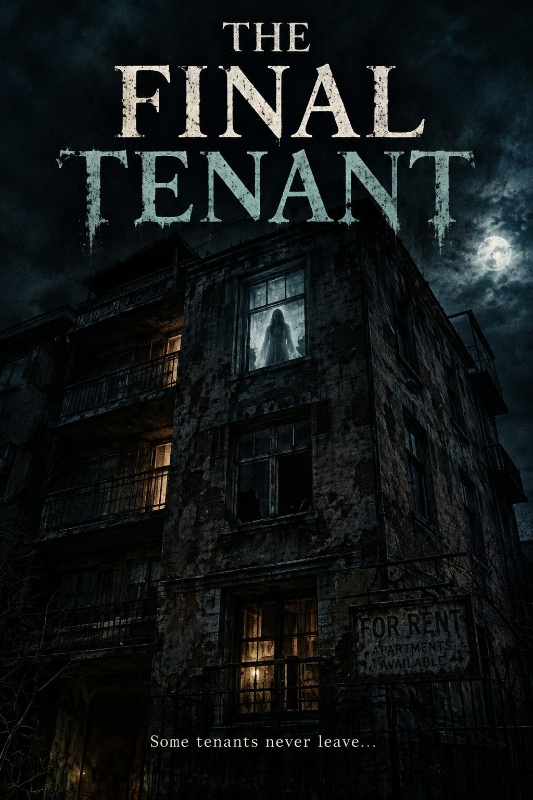
By the time Martin Vale decided to sell Bellwether House, the building had already begun dying.
It was not a dramatic death. There were no collapsing walls or spectacular fires, no sudden explosions that sent tenants running into the street. Bellwether House was dying the way lonely people sometimes did: quietly, gradually, and with the stubborn refusal to admit that anything was wrong.
Paint peeled from its corridors in long, yellow strips. Rainwater gathered beneath the windowsills. The elevator stopped between floors whenever the weather changed, and the pipes knocked throughout the night like someone trapped behind the walls.
The building stood on a narrow street between a closed bakery and an abandoned tailor’s shop. Once, according to the photographs Martin had found in his father’s desk, the street had been lively. Children played beneath the trees. Neighbors sat outside in summer evenings. Bellwether House had possessed polished brass railings, flower boxes, and windows that shone gold after sunset.
Now most of those windows were boarded up.
Only one remained illuminated.
Apartment 4B.
Martin stood across the street on a rainy Thursday evening, looking at its pale yellow glow.
He had checked the electricity himself that morning. The entire fourth floor had been disconnected except for the emergency lights in the stairwell. There was no reason for a lamp to be burning in 4B.
There was also no tenant.
At least, according to the records.
Martin was forty-two, tired in the particular way of a man who had spent too many years repairing things that should have been replaced. He had inherited Bellwether House from his father, along with a stack of unpaid bills, a leaking roof, and the responsibility of managing a property nobody wanted to rent.
For six months, he had been trying to sell it.
The demolition company had agreed to purchase the land. The contract was ready. The city had approved the inspection. If Martin signed the final documents by the end of the month, he could finally walk away.
There was just one problem.
Every time a prospective buyer entered the building, something happened.
One heard a woman crying behind a locked door. Another saw a figure standing at the end of the fourth-floor corridor. A third refused to return after finding wet footprints leading from an empty apartment to the elevator.
Martin had dismissed the stories as tricks of the light, bad plumbing, or the imagination of people who wanted an excuse to withdraw their offers.
He was a practical man.
Practical men did not believe in ghosts.
Then he noticed the curtain in 4B move.
Someone stood behind the window.
A woman, judging by the outline.
She raised one hand and pressed it against the glass.
Martin could not see her face, but he felt an inexplicable certainty that she was looking directly at him.
Then the light went out.
He crossed the street.
The main entrance resisted his key before opening with a long, tired groan. Inside, the lobby smelled of damp plaster, dust, and something faintly floral, like roses left too long in a vase.
He checked the electricity panel. Nothing had changed.
He climbed the stairs.
On the fourth floor, the corridor was dark except for the emergency lamp near the fire exit. The door to 4B stood at the very end, beneath a small brass number that had darkened with age.
Martin had never been inside that apartment.
His father had kept the door locked for as long as Martin could remember. When Martin was a boy, he had once asked why.
His father had answered, “Some rooms are better left alone.”
At the time, Martin had assumed the apartment was full of broken furniture.
Now he stood before it, listening.
Something moved on the other side.
A chair scraped across the floor.
Then came three gentle knocks.
Martin swallowed.
“Hello?”
Silence.
He tried the handle.
The door opened.
Inside, a small table stood beneath a lace-covered lamp. A pair of slippers rested beside an armchair. Curtains framed the window, and a vase of dried roses occupied the mantelpiece.
The apartment was spotless.
It did not look abandoned. It looked as though its occupant had stepped into another room and would return at any moment.
Martin entered.
On the table lay a folded newspaper dated October 17, 1987.
Beside it sat a porcelain cup filled with tea that was still steaming.
Martin stared at the cup.
A voice spoke behind him.
“You're late, Mr. Vale.”
He turned.
An elderly woman sat in the armchair, her hands folded neatly in her lap. She wore a faded blue dress with a white collar. Her silver hair was pinned into a careful bun, and a thin blue ribbon circled her left wrist.
Her face was pale, almost translucent, but her eyes were perfectly clear.
She looked more disappointed than frightening.
“I've been expecting you for some time,” she said.
Martin backed toward the door.
“Who are you?”
The woman glanced at the newspaper.
“Agnes Bell.”
“Are you living here?”
She looked around the apartment as though the question were absurd.
“Of course.”
“This building is empty.”
“Not entirely.”
“You're not on the tenant register.”
Agnes considered that.
“Then your records are mistaken.”
Martin reached for the door handle.
Agnes's expression changed.
For the first time, she looked afraid.
“Please don't lock me in again.”
Martin froze.
“What?”
She rose from the chair. The movement was slow and delicate, like a paper figure unfolding.
“Your father used to lock the door whenever he visited. He said it was for my own good.”
“My father is dead.”
“I know.”
“How?”
Agnes looked toward the window.
“Because he stopped coming.”
For a moment, the apartment seemed to grow colder.
Then Agnes smiled, a small, apologetic smile.
“Would you like some tea, Mr. Vale?”
Martin ran.
He did not stop until he reached the street.
Behind him, on the fourth floor of Bellwether House, a single lamp switched on.
And in the window, the old woman waited.