
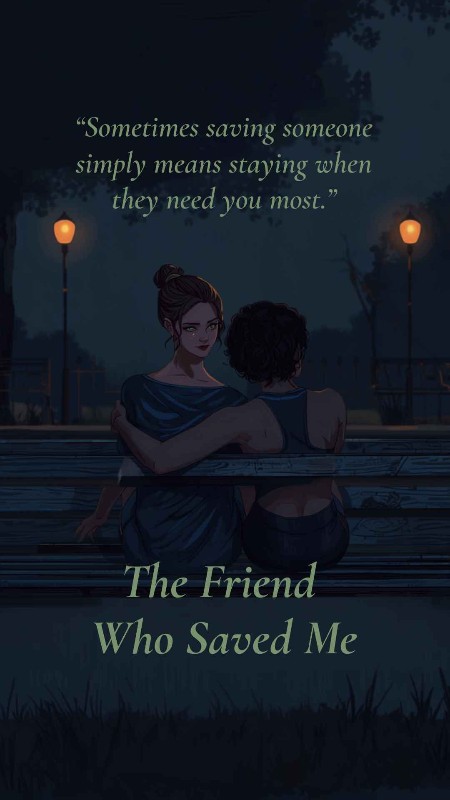
People always wanted to know what saved Emily Carter.
When they asked, she usually gave them the same answer.
“Her.”
She would point across the room at Sarah Bennett, wherever Sarah happened to be. Sometimes Sarah would be holding a glass of wine at a wedding. Sometimes a paper cup of coffee at the hospital cafeteria. Sometimes a plate at a birthday party, looking mildly annoyed because Emily had once again told the story in front of everyone.
Her.
That was the answer.
Sarah hated it.
“You make it sound like I performed some heroic rescue,” she would say.
“You did.”
“I didn't.”
“You did.”
“I answered my phone.”
Emily would smile.
“You answered your phone when nobody else did.”
And that was usually where the conversation ended.
But there was a much longer story behind those three words.
It had started twelve years earlier, on a Tuesday in November, when Emily was twenty-four years old and had become very good at pretending she was fine.
She had always been good at it.
As a child, Emily had been the sort of girl teachers described as cheerful. She laughed easily, finished her homework, remembered birthdays, and volunteered for school plays even though she hated standing in front of crowds.
At university, she became the friend who remembered everyone's deadlines.
At work, she was dependable.
In photographs, she smiled.
When people asked how she was, she said, “Good.”
Eventually, “good” became a reflex.
Even when it wasn't true.
Especially when it wasn't true.
Sarah had known Emily since university.
They met because Sarah accidentally spilled coffee on Emily's notes five minutes before an economics exam.
Emily had stared at the brown stain spreading across three pages.
Sarah had gone pale.
“Oh my God.”
Emily looked at her.
“You've killed me.”
“I am so sorry.”
“I hope you know this means I have to fail.”
“You're joking.”
“No.”
Sarah stared at her.
Emily stared back.
Then Emily started laughing.
Sarah laughed too.
Neither of them knew it at the time, but that ridiculous moment would become the beginning of the most important friendship of their lives.
They were different in almost every way.
Emily planned everything.
Sarah forgot everything.
Emily arrived fifteen minutes early.
Sarah arrived fifteen minutes late and somehow blamed traffic even when they had walked there.
Emily hated confrontation.
Sarah considered confrontation a recreational activity.
Emily thought carefully before speaking.
Sarah often spoke and then thought, usually several minutes later.
But they worked.
They became inseparable.
They studied together, traveled together, survived terrible university apartments together, celebrated birthdays together, and spent countless nights sitting on Sarah's kitchen floor eating cereal because neither of them could afford proper dinner.
After graduation, they moved to different parts of the city but refused to admit that adulthood might make their friendship harder.
They promised nothing would change.
Of course, everything changed.
Emily got a job at a publishing company.
Sarah became a primary-school teacher.
They dated different people.
They developed different routines.
They made new friends.
They got busy.
But they remained Sarah and Emily.
There were still Sunday phone calls.
Still birthday traditions.
Still the occasional emergency message that began with:
Are you awake?
Usually followed by:
I need you.
And then came the year Emily stopped asking.
It happened slowly.
That was the dangerous part.
There was no single morning when she woke up and decided she didn't want to live anymore.
There was no dramatic announcement.
There was simply a gradual shrinking of her world.
First, she stopped enjoying things.
Then she stopped looking forward to things.
Then she stopped telling people she wasn't enjoying things.
Work became exhausting.
Her apartment became messy.
Phone calls became difficult.
Messages sat unanswered for days.
She began turning down invitations.
She stopped going to Sarah's apartment on Sundays.
“I'm tired,” she would say.
Sarah believed her.
Everyone did.
Emily was tired.
That was true.
She just wasn't tired in the way they thought.
She was tired of pretending that getting through the day was the same thing as living it.
One evening, Sarah called.
Emily watched the phone vibrate on the kitchen counter.
She didn't answer.
Sarah called again.
Emily still didn't answer.
Then came a message.
Call me when you're free. Nothing urgent. I just miss you.
Emily read it.
She placed the phone face down.
She cried for twenty minutes.
Then she went to bed.
The next morning, she went to work.
She answered emails.
She attended meetings.
She smiled at a joke.
Nobody noticed.
Except Sarah.
Sarah noticed everything.
She just didn't understand what she was noticing yet.
A week later, Sarah showed up at Emily's apartment without warning.
Emily opened the door wearing an old sweatshirt.
Sarah looked past her.
The apartment was dark.
“Have you been sleeping?”
“Yeah.”
“Eating?”
“Obviously.”
“That's not an answer.”
Emily smiled weakly.
“I'm fine, Sarah.”
Sarah looked at her for a long moment.
“You keep saying that.”
“Because it's true.”
Sarah didn't argue.
That was unusual.
Instead, she held up a grocery bag.
“I brought food.”
“You didn't have to.”
“I know.”
Sarah stepped inside.
They ate pasta at the small kitchen table.
Sarah talked about one of her students who had apparently decided that dinosaurs were a reasonable solution to every classroom problem.
Emily laughed.
For the first time in several days, she laughed properly.
Sarah smiled.
There.
That was better.
She thought maybe that was enough.
She didn't know it wasn't.
Over the next month, Sarah began checking in more often.
Not dramatically.
Not with questions that felt like interrogation.
Just small things.
Have you eaten?
Want coffee?
I'm nearby. Open the door.
Send me a picture of something blue. I have a very important scientific experiment.
Emily sometimes answered.
Sometimes she didn't.
Sarah never stopped trying.
But Emily became increasingly distant.
She felt guilty about it.
That guilt made everything worse.
She knew Sarah cared.
She knew people loved her.
That was part of what made her feel so broken.
There was no obvious reason she should feel the way she did.
She had a job.
She had friends.
She had family.
She had Sarah.
And still, some mornings, getting out of bed felt like climbing a mountain.
She began thinking that everyone would eventually become tired of her.
That one day Sarah would stop calling.
That one day her family would realize she wasn't worth the effort.
That one day people would be relieved if she disappeared.
The thoughts frightened her.
So she hid them.
She became even better at pretending.
Until one November evening, she couldn't pretend anymore.
It was raining.
Emily sat alone in her apartment with the lights off.
Her phone was beside her.
There were six unread messages.
One from her mother.
Two from work.
Three from Sarah.
She didn't open any of them.
She felt completely exhausted.
Not sad.
Not angry.
Just empty.
She thought about the future and couldn't see one.
She thought about tomorrow and felt nothing.
Then she thought about how much easier it would be if she didn't have to keep fighting her own mind.
The thought scared her.
But not enough.
She picked up her phone.
Her thumb hovered over Sarah's name.
She almost called.
Instead, she put the phone down.
A minute passed.
Then two.
Then five.
The phone rang.
Sarah.
Emily stared at it.
She didn't know why she answered.
Maybe some part of her still wanted someone to find her.
Maybe she had hoped Sarah would call.
Maybe there was no explanation.
She picked up.
“Hello?”
Sarah's voice was immediately cheerful.
“Hi. Don't be mad.”
Emily closed her eyes.
“Why would I be mad?”
“I accidentally bought two birthday cakes.”
“Your birthday isn't for another month.”
“Exactly. I'm planning ahead.”
Emily almost laughed.
Then Sarah stopped.
“Em?”
“Yeah?”
“You sound strange.”
“I'm tired.”
There was silence.
Sarah knew that answer.
She had heard it too many times.
“Are you alone?”
Emily didn't answer.
“Emily.”
“Yes.”
“Are you safe?”
Emily's throat tightened.
She didn't say anything.
Sarah's voice changed.
It became quieter.
“Okay. You don't have to explain anything. Just stay on the phone with me.”
Emily stared at the rain running down the window.
“I don't know what's wrong with me.”
“Nothing is wrong with you.”
“There is.”
“No.”
“I can't do this anymore.”
Sarah breathed in slowly.
“Okay.”
Emily expected panic.
Instead, Sarah sounded calm.
“Then don't do everything tonight.”
“What?”
“Don't solve your whole life tonight. Don't decide what next year looks like. Don't decide what tomorrow looks like. Just stay with me for the next ten minutes.”
Emily cried.
Sarah stayed on the phone.
She talked.
About school.
About coffee.
About the ridiculous birthday cake.
About the time Emily accidentally walked into the wrong university lecture and stayed for forty minutes because she was too embarrassed to leave.
Emily laughed through her tears.
Sarah stayed.
At some point, Sarah said, “I'm coming over.”
Emily said, “You don't have to.”
“I know.”
“Sarah—”
“I know.”
Twenty minutes later, someone knocked on the door.
Emily opened it.
Sarah stood there soaked from the rain, holding an umbrella in one hand and a bag of groceries in the other.
She didn't hug Emily immediately.
She simply looked at her.
Then she said, “Hi.”
Emily nodded.
“Hi.”
Sarah stepped inside.
That night, they sat on the floor.
They didn't solve anything.
Sarah didn't give Emily a speech.
She didn't tell her to think positively.
She didn't tell her that everything would be fine.
She simply said, “I think we need more help than I can give you.”
Emily cried harder.
Because she knew Sarah was right.
The next morning, Sarah helped her find a doctor.
Emily hated the appointment.
She hated admitting that she was struggling.
She hated saying the words out loud.
She hated feeling like she had failed at something everyone else seemed to know how to do naturally.
But she went.
Then she went again.
She began therapy.
She learned that recovery wasn't a straight road.
Some days were good.
Some days were awful.
Some days were ordinary.
Sarah remained nearby.
Not always physically.
Sometimes she sent stupid photographs.
Sometimes she dropped soup at the door.
Sometimes she said nothing.
Once, Emily called her at two in the morning.
“Are you awake?”
“No.”
Emily paused.
“Oh.”
Sarah sighed.
“But now I am.”
Emily smiled.
They talked until three.
Over time, Emily began getting better.
Not magically.
Not quickly.
But slowly.
She returned to work.
She cleaned her apartment.
She started walking again.
She began meeting friends.
She learned to say, “I'm having a bad day,” without feeling ashamed.
And every time someone asked what had happened, Emily gave them a simplified answer.
“I was struggling.”
But Sarah knew the full truth.
Or thought she did.
Years passed.
Emily became stronger.
She eventually moved to a larger apartment.
She started dating again.
She got promoted.
She traveled.
She laughed more.
She still had difficult days.
But difficult days no longer frightened her in the same way.
And Sarah?
Sarah continued to insist she hadn't saved Emily.
Whenever Emily thanked her, Sarah became uncomfortable.
“You went to therapy,” she would say.
“You called me.”
“You made the appointments.”
“You stayed.”
“So did you.”
“You were the one who needed help.”
“I couldn't have done it without you.”
Sarah would shake her head.
“You could have.”
Emily disagreed.
They had this argument for years.
Until one evening, twelve years after that rainy night, they were sitting on Emily's balcony.
Emily was thirty-six.
Sarah was thirty-seven.
The city glittered below them.
Emily had invited Sarah over for dinner.
They had eaten too much.
There was a half-empty bottle of wine on the table.
Sarah was complaining about her students.
Emily was laughing.
Then, without warning, Emily became quiet.
Sarah looked at her.
“What?”
“Do you remember that night?”
Sarah didn't need to ask which night.
“Yes.”
“I think about it sometimes.”
Sarah nodded.
“So do I.”
Emily looked down at her hands.
“I still think you saved my life.”
Sarah sighed.
“Emily.”
“I know what you're going to say.”
“Then why are you starting this argument again?”
“Because I've never explained what I mean.”
Sarah waited.
Emily took a breath.
“You didn't cure me.”
“I know.”
“You didn't fix me.”
“I definitely didn't.”
“You didn't know exactly what to say.”
Sarah smiled.
“I said some incredibly stupid things.”
“You did.”
“And you still think I saved you?”
“Yes.”
Sarah looked away.
Emily continued.
“You answered the phone.”
Sarah shrugged.
“I was your best friend.”
“You stayed.”
“I wasn't going to leave you alone.”
“You came to my apartment.”
“You needed someone.”
“You helped me get help.”
“You let me.”
“You kept calling.”
Sarah looked at her.
“I was worried.”
“I know.”
Emily's eyes filled with tears.
“You say you didn't save me because you think I did all the work.”
“You did.”
“I did.”
“You fought.”
“I did.”
“You went to therapy.”
“I did.”
“You learned how to live again.”
Emily nodded.
“But you were there while I learned.”
Sarah looked down.
“I don't know if that counts as saving someone.”
Emily smiled sadly.
“Maybe saving someone doesn't always mean pulling them out of a burning building.”
Sarah didn't answer.
“Maybe sometimes,” Emily continued, “it means sitting outside the building and telling them they don't have to walk through the fire alone.”
Sarah's eyes became wet.
Emily reached across the table and took her hand.
“You don't have to call yourself my hero.”
“I don't.”
“But you're part of the reason I'm here.”
Sarah squeezed her hand.
“You're here because you chose to stay.”
Emily smiled.
“And I stayed because you gave me someone to stay for.”
They sat quietly.
The city moved around them.
Cars passed.
Someone laughed on the street below.
A dog barked in the distance.
Nothing about the moment looked extraordinary.
That was the strange thing.
The most important moments in Emily's life had rarely looked important while they were happening.
There had been no music.
No dramatic rescue.
No perfect words.
Just a ringing phone.
A wet umbrella.
A grocery bag.
Two women sitting on a kitchen floor.
One refusing to leave.
The other deciding, somehow, to stay.
After a while, Sarah spoke.
“You know something?”
“What?”
“I think we're both right.”
Emily smiled.
“About what?”
“You say I saved you.”
“And you say I saved myself.”
“Yes.”
Emily waited.
Sarah squeezed her hand.
“Maybe you did.”
“And maybe you did too.”
Emily nodded.
Neither of them argued.
Because sometimes two truths could exist at the same time.
Emily had done the difficult work.
She had asked for help.
She had endured the worst days.
She had learned to live with the parts of herself she once feared.
She had chosen, again and again, to keep going.
But Sarah had been there.
She had answered the phone.
She had knocked on the door.
She had stayed when staying was inconvenient.
She had never pretended she could fix everything.
She had simply refused to let Emily believe she had to face everything alone.
Years later, Emily would still tell people that Sarah saved her life.
Sarah would still roll her eyes.
“You make me sound much more impressive than I am.”
“You are impressive.”
“No.”
“Yes.”
“I once microwaved a metal spoon.”
“You did.”
“I also forgot your birthday three years in a row.”
“You did.”
“I sent you a birthday card six months late.”
“It was very nice.”
“It had a Christmas tree on it.”
“It was still nice.”
Sarah would laugh.
Emily would laugh too.
And that laughter was part of the answer.
Because the woman Sarah had once found sitting alone in a dark apartment was still there somewhere.
Not as a ghost.
Not as a wound.
As a memory.
A reminder.
A version of Emily who had once believed her story was ending.
She had been wrong.
Her story had continued.
There had been difficult chapters.
There had been ordinary ones.
There had been chapters she never expected.
There had been love.
Friendship.
Failure.
Recovery.
Morning coffees.
Bad dates.
Promotion celebrations.
Funerals.
Birthdays.
Rainy afternoons.
Long drives.
Quiet Sundays.
Life.
All of it.
And Sarah had been there for much of it.
Not as a savior.
Not as a miracle.
Just as a friend.
Sometimes that was enough to change everything.
Years later, when Emily was asked again what saved her, she gave the same answer.
“My best friend.”
And somewhere nearby, Sarah would inevitably say,
“I did not save you.”
Emily would turn toward her.
Smile.
And answer,
“I know.”
Then she would take Sarah's hand.
“But you stayed.”
And Sarah, after all those years, finally stopped arguing.
Because perhaps that was what saving someone really meant.
Not carrying them out of the darkness.
Not fixing what was broken.
Not becoming responsible for their survival.
Just standing beside them long enough for them to remember that there was a way back.
And sometimes, when someone cannot yet see the road ahead, having one person willing to sit beside them until morning can be the difference between believing the night will last forever and discovering that, eventually, the sun does come up.
Emily knew that now.
She knew something else too.
She had saved herself.
Sarah had saved her too.
Both things were true.
And neither truth made the other smaller.