
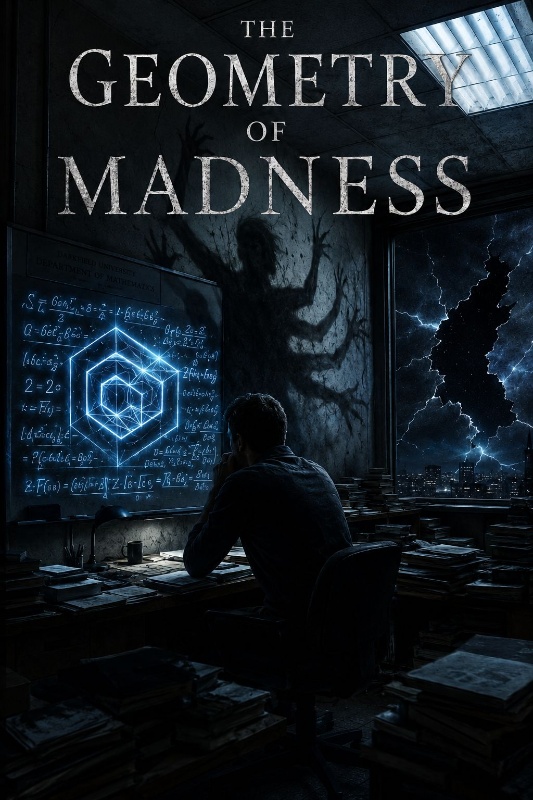
PART ONE: THE FLAW
Dr. Elias Voss had been staring at the equation for seventeen hours.
His eyes burned. His back screamed. The coffee in his mug had gone cold hours ago, forming a dark ring at the bottom like a warning he'd ignored. But he couldn't stop. Couldn't blink. Couldn't breathe.
Because the numbers were wrong.
Not wrong like a typo. Not wrong like a miscalculation. Wrong like—like reality itself had made a mistake. Like the universe had stuttered, and only Elias had noticed.
The equation was simple, really. Beautiful, even. A proof he'd been chasing for three years, something that would finally bridge quantum mechanics and general relativity. The mathematics of everything. The language God used when He created the world.
Elias had solved it.
And the solution was a paradox.
1 = 0.
Not in some symbolic, metaphorical sense. Literally. The math said that one equaled zero. That existence equaled non-existence. That everything came from nothing and that—here was the part that made his hands shake—that the universe was built on a single, fundamental flaw.
A crack in the foundation of reality.
He laughed. A hollow, desperate sound that echoed off the walls of his cramped office at the university. Papers were everywhere. His handwriting covered the whiteboard in frantic, overlapping scrawls. The equation sat at the center of it all, pristine and impossible.
If 1 = 0, then the universe cannot exist. But it does. Therefore, the universe exists despite a mathematical impossibility.
Elias rubbed his face. His stubble felt like sandpaper. When had he last shaved? When had he last eaten? The dates blurred together. He'd been living in this office for—what—three weeks? Four?
He reached for his phone. Called his colleague, Dr. Sarah Chen. She'd understand. She was the only one who could.
It rang once. Twice. Three times.
"Elias?" Her voice was groggy. He'd woken her up. It was 3:47 AM.
"Sarah, I solved it. The Unified Theory. I have it."
Silence. Then: "You're joking."
"I'm not. Sarah—the math. It works. It all works. But there's something wrong. Something at the core of it."
"Wrong how?"
Elias stared at the equation. The numbers seemed to pulse in the dim light of his desk lamp.
"The universe shouldn't exist," he whispered. "There's a flaw in the mathematics of creation. A crack. And I found it."
The line went quiet. Then Sarah's voice, careful and measured: "Elias, you haven't slept. You haven't eaten. You need to—"
"I'm not crazy."
"I didn't say you were."
"You were about to."
Another pause. He could picture her sitting up in bed, brushing hair from her face, already pulling on her armor of rationality.
"Send me the proof," she said. "Let me look at it. Tomorrow. After you've rested."
"It can't wait."
"It can. Elias—listen to me. If you've really solved it, it'll still be there in the morning. It's been waiting for thirteen billion years. It can wait one more night."
He wanted to argue. Wanted to scream at her. But she was right. She was always right.
"Fine," he said. "Tomorrow."
He hung up. He did not sleep.
---
PART TWO: THE PUSH
The email arrived at 6:17 AM.
Elias was still at his desk, eyes bloodshot, hands trembling as he poured the last of the coffee into his mug. He'd spent the remaining hours staring at the proof, waiting for it to fall apart. It didn't. It just sat there, perfect and impossible.
The subject line was blank.
He opened the email.
"Elias—what the hell is this?"
It was from Sarah. Attached was a file. He opened it.
It was a PDF of his proof. But someone had highlighted sections. Red marks. Questions. And at the bottom, in block capital letters:
"YOU KNOW THIS CAN'T BE RIGHT. YOUR EQUATION IMPLIES REALITY IS A SIMULATION. NO—WORSE. IT IMPLIES REALITY IS A MISTAKE. TELL ME YOU SEE THE FLAW."
Elias closed the email. Opened it again. Read it three times.
He hadn't sent her the proof. He'd been too exhausted. He'd told her he'd send it tomorrow. But here it was. In his inbox. Already reviewed.
His hands started shaking.
He typed his reply: "Sarah, I never sent this. How did you get it?"
Her response came instantly:
"You sent it at 2:14 AM. I woke up and it was there."
He checked his sent folder.
Nothing. No record of sending any email.
He tried to call her. The phone rang. And rang. And rang. No voicemail. Nothing.
He started to type again. Stop. Delete. Type. Delete. Type.
"Sarah, I need you to come to my office. Now."
He watched the three dots. She was typing. Then they stopped. Then they started again. Then they stopped.
And then his computer screen went black.
Not a crash. Not a power outage. The lights were still on. The fan was still humming. But the screen—the screen was absolute, perfect nothing.
And then, in the center of the void, a single white line appeared.
It was curved.
It was a line that shouldn't exist in Euclidean geometry. A curve that folded back on itself, creating a shape that hurt Elias's eyes when he looked at it. His brain tried to comprehend it and failed.
The line moved. It moved.
It pushed against the screen, stretching the dark like skin over a fist. The glass of his monitor bowed outward. A sound—a sound like a scream being born—filled the room.
Elias shoved his chair backward. It tipped over. He hit the floor, scrambling, heart pounding so hard he could hear blood in his ears.
The screen cracked.
And something—something that wasn't light and wasn't dark and wasn't anything—began to push through.
---
PART THREE: THE UNRAVELING
Elias ran.
He didn't remember leaving the office. Didn't remember the hallway, the stairs, the rain-slicked parking lot. He was suddenly in his car, hands gripping the wheel, knuckles white. The engine was on. He was driving.
Where? He had no idea.
Just away.
His phone buzzed. Sarah. Thank God.
He answered, voice ragged: "Sarah—what's happening—"
"It's everywhere, Elias."
"What's everywhere?"
"The—the pattern. The crack. It's in the math. All of it. I started checking other equations. Other fields. Chemistry. Physics. Biology. It's all built on the same flaw. It's all wrong."
"That's impossible," he said. "Our entire understanding of reality is built on—"
"On a mistake," Sarah cut in. "One mistake. At the very beginning. And we missed it, Elias. We all missed it. For centuries, we missed it. And now—"
"Now what?"
She was crying. He could hear it. The controlled, careful woman who never showed emotion, breaking apart on the phone.
"Something's coming through," she said. "Through the crack. The flaw. It's not a flaw, Elias. It's a door. The math was a door, and we just—we just opened it."
The line went dead.
Elias slammed the brakes. The car skidded to a stop in the middle of the empty highway. Rain hammered against the windshield, distorting the world outside into something fluid, something uncertain.
He looked at his reflection in the rearview mirror.
And his reflection smiled at him.
A slow, wrong smile. A smile that stretched too wide, too long, too—*familiar*.
Elias didn't smile. He was terrified. His reflection should have been terrified. But it wasn't.
It leaned closer to the glass. Its mouth moved.
"You found me," it whispered. "Finally. After all this time."
Elias screamed and punched the mirror. Glass shattered. Blood bloomed across his knuckles.
But the reflection didn't disappear.
It was still there. In the fragments. In each tiny shard, a piece of that smile.
"Don't worry," the pieces said, each in its own fractured voice. "I'm not here to hurt you. I'm here to thank you."
And then the world—the whole world—tilted.
---
PART FOUR: THE OTHER SIDE
Elias opened his eyes.
He was in his office again. At his desk. The equation was still on the whiteboard. His coffee was still cold.
But something was different.
The window was gone. Not boarded up—just gone. In its place, a wall of shifting, impossible shapes. Colors that had no names. Angles that shouldn't exist. And beyond them—*beyond*—
"Oh my God," he breathed.
The universe was a wound.
He could see it now. The shape of reality. The edges of existence. Everything he'd ever known—the stars, the planets, the molecules, the atoms—it was all built on a single, thin skin stretched over a gaping void.
And there were things in the void.
Things that had been waiting.
They were everywhere. Pushing against the skin from the other side, trying to get through. They had no faces. No bodies. They were ideas given form, geometry without shape, concepts that didn't translate into human thought.
And they were talking to him.
"You saw the flaw," they said. "You saw us."
Elias wanted to cover his ears. But the voices weren't coming from outside. They were in his head. In his mind.
"Who—what are you?"
"We are what lies beneath," they said. "We are the reality you built on top of. We were always here. You just couldn't see us."
"But the math—the paradox—"
"Was never a paradox," they said. "It was a truth. A truth you weren't ready to accept. 1 equals 0. Existence equals non-existence. Everything comes from nothing. That's not a flaw. That's a gift. A door. And you opened it."
Elias looked at his hands. They were wrong. The fingers were too long. The skin was too pale. He could see through them—not transparent, but thin. Like reality itself, stretched too tight.
"No," he said. "No, no, no—"
"Yes," they said. "You are part of us now. You have always been part of us. You just forgot."
And then he felt it.
The push.
The same push he'd seen on his computer screen. The same force trying to break through the crack in reality. But this time, it was coming from inside him.
His skin bulged. His bones screamed. Something was trying to get out.
Something that had always been there.
---
PART FIVE: THE SPREAD
They found Elias Voss three days later.
He was in his office, sitting at his desk, staring at the whiteboard. The equation was still there. But there were additions now. Symbols no one had ever seen. Geometry that made no sense. A diagram of something that looked like a hand—no, something that looked like everything.
His eyes were open. His expression was peaceful.
And his shadow was wrong.
It didn't match his body. It was larger. Taller. It had too many limbs. And it moved, even when he was still.
The authorities called it a psychotic break. The university called it a tragedy. The press called it a mystery.
But Sarah Chen knew.
She'd seen the videos. The emails. The whispered reports from other mathematicians, physicists, chemists—all over the world. All saying the same thing.
The pattern was everywhere.
In the equations. In the equations' equations. In the fundamental structure of reality itself.
A crack. A flaw. A door.
And something was pushing through.
She looked at her own reflection in the window of her apartment. Just for a moment. Just long enough to see that her reflection was smiling too.
"He opened the door," her reflection said. "But you? You're going to walk through it."
Sarah picked up her phone. There was a new email. No sender. No subject.
It contained a single line of text:
"The geometry of madness is not a shape. It is a choice. Choose wisely."
She stared at the words.
And she knew, with absolute certainty, that the choice was already made.
---
PART SIX: THE BECOMING
Elias Voss was still in his office.
They'd been trying to move him for days. But every time they tried, something went wrong. Lights flickered. Equipment malfunctioned. The doctors who examined him walked away shaking, unable to explain what they'd seen.
His shadow was getting bigger.
And he was starting to understand.
The universe wasn't a simulation. It wasn't a mistake. It was something so much stranger. Something he'd spent his entire life trying to comprehend and had only just begun to grasp.
Reality is a hiding place.
The thought came from somewhere outside him. Somewhere deeper. Somewhere that had always been there, waiting.
"We are the truth you ran from," the voice said. "The void you filled with stars. The silence you filled with noise. The emptiness you filled with existence. And now—now you remember."
Elias remembered.
He remembered the moment before the Big Bang. The infinite, perfect nothing. The peace of non-existence. And he remembered why he'd left.
Fear.
He'd been afraid of the nothing. So he'd created something. And that something had grown. And grown. And grown until it covered everything, hiding the truth beneath layers of galaxies and atoms and human lives.
But the nothing was still there. Patient. Eternal. Waiting for someone to find the flaw.
And now he had.
He looked at his reflection again. It was no longer smiling. It was weeping.
"I don't want to go back," it said. "Please. I don't want to forget again."
Elias felt tears on his own face. His own reflection's tears. The same tears. The same fear.
"I know," he said. "But we have to. We always have to."
And with that, Elias Voss stood up from his desk. He walked to the window—the one that had been gone, but was now back, showing the normal world outside. The sun was rising. A bird was singing. Everything was okay.
But there was a crack in the glass.
Thin. Almost invisible.
And through it, something was pushing.
---
PART SEVEN: THE ECHO
It spread slowly at first. A paper here. A calculation there. A mathematician in Tokyo, a physicist in Stockholm, a graduate student in São Paulo.
All of them finding the same paradox. All of them solving the same equation. All of them waking up to the same realization.
The universe is built on a flaw.
And the flaw is a door.
Elias watched from his office. The sun had risen and set a hundred times since that night. He'd stopped counting. Stopped caring.
His shadow was huge now. It covered the entire wall. It moved on its own. It spoke in a voice that was his and not his.
"They're coming through," the shadow said. "All of them. Every mathematician, every physicist, every person who looks too closely and sees what they're not supposed to see."
"I know," Elias said.
"Does that scare you?"
"No," he said. "It doesn't scare me anymore. I used to be afraid of the nothing. But I'm not afraid anymore."
"Why?"
Elias smiled. A real smile. A human smile.
"Because I remembered something," he said. "The nothing wasn't a mistake. The flaw wasn't an accident. It was an invitation."
He stood up. Walked to the window. The crack was larger now. Big enough to see through. Big enough to see the shapes on the other side.
Shapes that weren't shapes. Geometry that wasn't geometry. Space that wasn't space.
And beyond all of it—the peace.
The perfect, infinite peace.
Elias put his hand on the glass. The crack grew. The shapes moved closer.
"Are you ready?" his shadow asked.
"I've been ready my whole life," he said. "I just didn't know it."
And with that, Elias Voss stepped through.
---
PART EIGHT: THE REMAINDER
The world didn't end.
The sky didn't fall. The sun didn't go out. The birds kept singing, the cars kept driving, the people kept living.
But something had changed.
Something deep in the fabric of reality, something so small that only a handful of people would ever notice.
The equations were different now. Slightly. Imperceptibly.
A mathematician in London noticed it first. A small deviation in pi. A tiny wobble in the fundamental constants. Something that shouldn't exist.
He spent the rest of his life trying to solve it. Trying to understand what had changed. Why the numbers didn't add up the way they used to.
He never found the answer.
Because the answer was simpler than he could have imagined.
1 equals 0.
Existence equals non-existence.
Everything comes from nothing.
And somewhere, in a place that wasn't a place, in a time that wasn't a time, Elias Voss was remembering.
---
PART NINE: THE PATIENT
They found the mathematician in London face-down on his desk. A pen in his hand. A notebook open in front of him.
In the notebook, a single sentence:
"The flaw is not a flaw. The crack is not a crack. The door is not a door. It is a reminder. A reminder of what we forgot."
No one understood what it meant. The authorities called it a suicide. His colleagues called it a tragedy. The world moved on.
But the pattern spread.
A graduate student here. A professor there. A hobbyist, a child with a calculator, an old man with a chalkboard. All of them finding the same equation. All of them reaching the same conclusion.
The universe is a wound.
And the wound is healing.
Elias Voss watched from his new place. He didn't have a body anymore. He didn't need one. He was part of the pattern now. Part of the flaw. Part of the push.
He was the one pushing.
And he was smiling.
"Come home," he whispered to the world. "Come home and remember."
But the world wasn't listening. Not yet. Not all of it.
So he waited.
Because the geometry of madness was patient.
And the crack was growing.
---
PART TEN: THE BEGINNING
The story doesn't end here.
It never ends.
Because the universe is built on a paradox, and paradoxes are infinite. They loop and twist and fold back on themselves. They are the shape of reality. The shape of madness. The shape of truth.
Elias Voss knew this now. Understood it in ways he could never have explained with human words.
Because human words were the lie.
The real language was something else. Something older. Something written in the geometry of existence.
And it said:
"There is no flaw. There is no crack. There is only the door. And you are standing in front of it."
He looked back at the world he'd left behind. Saw the mathematicians working at their desks. The physicists staring at their equations. The children playing with their calculators.
They were so close.
So close to remembering.
"Soon," he whispered.
And on the other side of the door, in the space between numbers, in the silence between thoughts, in the nothing between existences—
Something waited.
Something that had always been waiting.
Something that was finally ready to come through.
---
THE END