
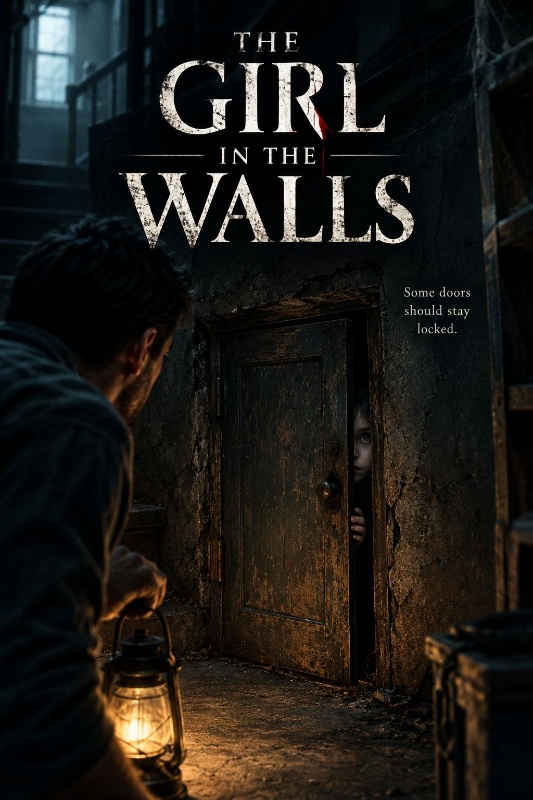
The first time Daniel heard the little girl behind the basement wall, she asked him a question that made him laugh.
The second time, she knew his name.
The third time, she spoke in his dead mother's voice.
And by the fourth night, Daniel understood why the previous owners had sold the house for less than the price of a used car.
They hadn't been trying to get rid of a haunted house.
They had been trying to keep something inside it.
Daniel Mercer had never believed in ghosts. He believed in faulty wiring, settling foundations, old plumbing, and the sort of nonsense people invented when they couldn't afford to explain a strange noise. His mother had believed in ghosts, though, and she had spent the last three years of her life insisting that something lived in the walls of her childhood home.
She had called it the little girl.
When Daniel was twelve, he remembered sitting at the kitchen table while his mother stood at the sink, staring at the empty hallway. The house had been quiet except for the refrigerator humming and the rain tapping against the windows.
"She's playing again," his mother had whispered.
Daniel had followed her gaze. There was nothing in the hallway except an old coat hanging from a hook.
"Who's playing?"
His mother had turned toward him so quickly that the glass in her hand slipped and shattered against the floor.
"No one," she said.
She had never spoken of it again.
Years later, when she died, Daniel found a box of her belongings in the attic. Inside were photographs, faded letters, a silver necklace, and a small brass key tied to a piece of paper.
On the paper, in his mother's unmistakable handwriting, were six words.
If you hear her, don't play.
Daniel had assumed it was some private joke or a strange childhood memory. He had put the key and the note back in the box, carried everything to his apartment, and eventually forgotten about them.
Then he bought the house on Briar Lane.
It was an old two-story property at the end of a quiet street, with peeling white paint, a narrow porch, and a garden so overgrown that the previous owner's roses had become a tangled wall of thorns. The roof needed repairs. The kitchen was outdated. The upstairs windows stuck in their frames.
But the price was astonishingly low, and Daniel had spent most of his savings renting a small apartment in the city.
He needed somewhere permanent. Somewhere he could repair, improve, and eventually call home.
The estate agent, a nervous woman named Mrs. Bell, had handed him the keys without quite meeting his eyes.
"There's one thing you should know," she said.
Daniel looked up from the paperwork. "What?"
"The basement door. It sticks sometimes. The previous owners kept it locked."
"Why?"
"Storage, I suppose."
She had smiled, but it was the sort of smile people wore when they hoped a conversation would end.
Daniel signed the papers anyway.
The first week passed without incident. He painted the bedrooms, replaced two broken light fixtures, and threw away several boxes of damp newspapers left in the attic. He discovered a bricked-up fireplace in the sitting room and a small door beneath the basement stairs, no taller than a child's shoulder.
It was painted the same dull gray as the surrounding wall.
There was no handle. No visible hinges. Only a small keyhole in the center and a thin line around the edges, as though the door had been fitted into the plaster and then carefully concealed.
Daniel crouched in front of it, running his fingers along the frame.
"Well, that's weird."
He tried the door. It didn't move.
He knocked twice.
The sound that came back was not the hollow thud of a wooden door.
It sounded as if he had knocked on the inside of a coffin.
He stood up, brushed dust from his trousers, and returned to work.
That evening, while eating a takeaway dinner on the living-room floor, he heard three small knocks.
Knock. Knock. Knock.
They came from beneath the house.
Daniel stopped chewing.
The television was playing quietly in the background. Outside, a car passed on the wet road. He waited, listening.
Nothing.
He turned up the television and finished his meal.
At 11:43 p.m., he went downstairs to turn off the basement light.
The tiny gray door was waiting beneath the stairs.
From somewhere behind it came a soft, childish giggle.
Daniel froze.
Then a little girl's voice spoke through the wood.
"Do you want to play?"
For several seconds, he couldn't move. The voice was so clear, so close, that he could almost imagine a child crouching on the other side with her mouth pressed against the keyhole.
He took a step closer.
"Hello?"
Silence.
He knocked on the door.
"Is somebody in there?"
A pause.
Then the girl whispered, "You're not supposed to answer the door."
Daniel backed away.
He checked the basement windows, the boiler room, and the space behind the washing machine. He searched the garden with a flashlight, expecting to find some neighborhood child hiding nearby.
There was no one.
He told himself the voice had come from outside. Sound carried strangely through old houses. Perhaps someone had been playing a prank. Perhaps he was tired.
He locked the basement door at the top of the stairs and went to bed.
At 2:17 a.m., he woke to the sound of someone running down the upstairs hallway.
Small, quick footsteps.
Bare feet slapping against the floorboards.
He sat upright in bed, his heart pounding.
The footsteps stopped outside his bedroom.
A tiny hand knocked on his door.
"Daniel?"
He stopped breathing.
He had told no one in the neighborhood his name. The estate agent knew it, of course, and so did the lawyers. But there was no reasonable explanation for a child wandering through his locked house in the middle of the night and calling to him.
"Daniel," the voice repeated. "I know you're awake."
He reached for his phone and switched on the flashlight.
The bedroom door stood a few feet away.
He waited.
Then the little girl began to cry.
Not loudly. Not hysterically. She cried with the quiet, exhausted sadness of someone who had been crying for a very long time.
"Please," she whispered. "It's dark in here."
Daniel walked toward the door.
He was halfway across the room when he remembered his mother's note.
If you hear her, don't play.
He stopped.
The crying ceased instantly.
Something on the other side of the door giggled.
"Good," said the girl. "You remembered."
Daniel spent the rest of the night sitting against his bedroom wall with the lights on.
In the morning, he called a locksmith.
The man arrived shortly before noon, carrying a toolbox and a paper cup of coffee. Daniel showed him the tiny door beneath the basement stairs and explained that he wanted it opened.
The locksmith studied the frame.
"That's strange," he muttered.
"What is?"
"There's no visible hinge. No proper frame, either. Looks like somebody built the wall around the door."
"Can you open it?"
"Of course."
He examined the lock, inserted a thin metal tool, and worked for nearly ten minutes. Finally, there was a small click.
The locksmith pulled the door.
It didn't move.
He frowned, pushed harder, and tried again.
The door remained completely still.
"Something's blocking it," he said.
"From the other side?"
The locksmith gave him a puzzled look. "That's what I'd assume."
He tapped the wood with his knuckles.
The sound was dull and heavy.
Then, from behind the door, something tapped back.
Once.
The locksmith stepped away so quickly that his coffee spilled across the floor.
"What the hell was that?"
Daniel couldn't answer.
The locksmith packed his tools without asking for payment. At the basement stairs, he turned around.
"Listen, I've been doing this for twenty-six years. I've seen concealed rooms, false walls, all kinds of things. But if I were you, I'd get a builder to inspect this place before I started knocking holes in it."
He left.
Daniel watched his van disappear down the street.
Then he went upstairs, took his mother's box out of the cupboard, and searched through it until he found the brass key.
He had almost forgotten about the note.
If you hear her, don't play.
He held the key in his palm for a long time.
That evening, he tried it in the lock.
It turned effortlessly.
A soft click came from inside the door.
Daniel gripped the little brass handle he hadn't noticed before. It was cold enough to hurt his fingers.
He pulled.
The door opened inward by less than an inch.
A breath of air escaped through the gap.
It smelled of wet earth, old plaster, and something faintly sweet, like flowers left too long in a vase.
Daniel widened the opening.
Beyond the door was a narrow passage.
Not a cupboard. Not a storage room.
A passage.
It stretched into darkness between the walls of the house, barely wide enough for a grown man to turn his shoulders. The interior was lined with old wooden boards, their surfaces marked by scratches and dark stains. Thin pipes ran overhead. The ceiling sloped so low that Daniel had to bend his head.
He pointed his flashlight inside.
The beam traveled several feet before disappearing around a bend.
There was no dust on the floor.
Someone-or something-had been walking there.
Daniel stood at the entrance, telling himself that old houses sometimes contained service passages. The builders might have used the space for pipes, repairs, or access to the chimney.
He could explain that.
What he couldn't explain was the small red ball sitting in the center of the passage.
It was a child's rubber ball, faded and cracked with age.
As Daniel watched, it rolled toward him.
Slowly.
It stopped against the threshold.
From the darkness came the girl's voice.
"You took long enough."
Daniel slammed the door shut.
The brass key slipped from his fingers and struck the concrete.
For the next hour, he sat in his car outside the house, staring at the basement window. He considered driving to a hotel, calling the police, or contacting a psychiatrist. None of those choices made much sense, and the fact that he was trying to choose between them made him feel even worse.
Finally, he called his older sister, Rebecca.
He hadn't spoken to her properly in almost a year. They had drifted apart after their mother's death, each blaming the other for things neither had been brave enough to discuss.
She answered on the fourth ring.
"Daniel? Is everything okay?"
He told her about the house, the door, and the voice.
He expected laughter.
Instead, Rebecca went silent.
"Did you say the door was gray?"
"Yes."
"And there's a brass key?"
Daniel looked at the key lying on the passenger seat.
"Yes."
He heard her take a sharp breath.
"Get out of that house."
"Rebecca, what is this?"
"Daniel, listen to me. Do not open that door again."
"How do you know about it?"
She didn't answer.
"Rebecca!"
When she finally spoke, her voice had changed.
"When we were little, Mum used to take us to her childhood home. The house on Briar Lane."
Daniel felt the blood drain from his face.
"What?"
"She grew up there. She never wanted to talk about it, but I found some of her old letters after she died. There were photographs, too. Pictures of her as a child. Pictures of a little girl standing beside her."
"Who was the girl?"
"I don't know. Every photograph had the girl's face scratched out."
Daniel stared through the windshield at the dark windows of his new home.
"Did Mum ever say anything about a door?"
Rebecca began to cry.
"She said her sister was still in the walls."
The silence that followed seemed to swallow every sound around him.
Their mother had never mentioned having a sister. Daniel had never seen an aunt in any family photograph. There had been no second set of birthday cards, no stories about cousins, no childhood memories shared over dinner.
"That's impossible," he whispered.
"I know."
"Why didn't you tell me?"
"Because I thought Mum was ill. I thought the letters were part of whatever she believed when she was young. And then, after she died, I found something else."
"What?"
Rebecca hesitated.
"A drawing."
She described it carefully: a little girl holding a red ball, standing in front of a gray door. Beneath the drawing were two names, written in a child's handwriting.
MARGARET AND ELEANOR.
Their mother had been Margaret.
"Eleanor was her sister," Rebecca whispered. "And Daniel, according to one of the letters, Eleanor disappeared when she was six."
Daniel looked toward the basement window.
A small figure stood behind the glass.
A little girl in a white dress.
Her face was turned toward him.
Even from the car, he could see that she was smiling.
He dropped the phone.
When he looked again, the window was empty.
That night, Daniel did not go back inside the house. He slept in his car in the driveway, waking every few minutes to check the windows.
At 3:06 a.m., the basement light switched on.
At 3:07, a shadow passed behind the ground-floor curtains.
At 3:08, something knocked on the driver's window.
Daniel jerked awake.
The glass had fogged from the cold. A small handprint appeared on the outside, five tiny fingers pressing against the pane.
Then another handprint appeared.
And another.
Soon, the entire window was covered in small, damp handprints.
Daniel tried to start the engine.
The car wouldn't turn over.
A child's voice spoke from the back seat.
"You're being rude."
He twisted around.
No one was there.
But in the rear-view mirror, he saw a little girl sitting behind him.
She wore an old-fashioned white dress. Her dark hair hung in tangled strands around her face. Her feet didn't touch the floor.
In her lap rested a red rubber ball.
"Do you want to play now?" she asked.
Daniel screamed and scrambled out of the car.
He ran to the front door, fumbled with the keys, and rushed inside. He locked every bolt, dragged a chair beneath the handle, and switched on every light.
He told himself he was exhausted. He had been under too much stress. The mind could produce extraordinary things when it was frightened.
Then he heard a voice from the basement.
His mother's voice.
"Daniel, darling?"
He froze at the top of the stairs.
His mother had been dead for eleven months.
"Please come down," she called. "I need your help."
He gripped the railing until his fingers hurt.
"Daniel?"
The voice sounded exactly as he remembered it: warm, tired, gently impatient. He could almost picture her standing at the bottom of the stairs in her old blue cardigan.
"I can't find Eleanor."
Something inside him broke.
He descended three steps.
Then four.
The basement light flickered.
At the bottom, the little gray door stood open.
Beyond it, the narrow passage was illuminated by a warm yellow glow, as though a lamp burned somewhere deep inside the walls.
His mother's voice came from within.
"Come and get me, darling."
Daniel took another step.
A second voice whispered from the darkness.
"Don't listen to her."
The two voices sounded identical.
"Daniel," said the first.
"Daniel," said the second.
Then both spoke together.
"Which one of us is your mother?"
He stumbled backward and struck the wall.
The yellow light vanished.
The little door slammed shut.
Daniel fled upstairs and locked himself in the bathroom until sunrise.
When morning came, he called Rebecca again.
He told her everything.
This time, she didn't tell him he was imagining it.
"I found the address of the house in one of Mum's letters," she said. "I didn't realize it was the same one you bought until you told me. I'm coming over."
"Don't."
"I'll be there in two hours."
"Rebecca, you don't understand what's happening here."
"I understand more than you think."
She arrived just after ten, carrying a canvas bag and a thick envelope of old photographs. She looked pale and exhausted, as though she hadn't slept.
Daniel showed her the basement.
The tiny door was closed. The brass key lay on the floor where he had dropped it the previous evening.
Rebecca wouldn't go near it.
Instead, she spread the photographs across the kitchen table.
The first showed their mother at about seven years old, standing beside a woman Daniel didn't recognize. The second showed the same little girl in a garden, holding a red ball. The third was a family portrait taken in front of the house on Briar Lane.
There were three children in the photograph.
Their mother stood on the left.
A boy stood on the right.
Between them was a little girl whose face had been scratched away.
Daniel stared at the boy.
He recognized the face.
It was his own.
But he was wearing clothes from a time before he had been born.
"That's impossible," he said.
Rebecca turned over the photograph.
On the back, someone had written a date from forty years earlier.
Beneath it were the words:
Margaret, Eleanor, and Daniel. The last day before the game.
Rebecca looked at her brother.
"Daniel, this is why Mum never talked about her childhood. I think something happened in this house before either of us was born. And I think she spent the rest of her life trying to make sure it never happened again."
Daniel picked up another letter.
It was addressed to Margaret and written in a cramped, shaky hand.
You must never answer when she calls from inside the walls. You must never accept her invitation. She will use the voices of those you love. She will promise to let you out. She will tell you that only one game remains.
But Eleanor did not come back when we called her.
And something wearing her face has been calling us ever since.
The letter ended there.
Daniel read it twice.
Then he looked at Rebecca.
"Who wrote this?"
She turned the envelope over.
There was no signature.
Only a single word, written on the flap.
Eleanor.
A sound came from the basement.
Three soft knocks.
Rebecca dropped the letter.
A little girl's voice drifted up the stairs.
"Mummy?"
Neither of them moved.
"Is Mummy there?"
The voice trembled.
"I'm scared."
Rebecca pressed both hands over her mouth.
Daniel reached for her arm.
The girl began to sob.
"Please. It's cold. I've been here all alone."
Rebecca shook her head violently, tears running down her cheeks.
The voice changed.
It became older, weaker, more familiar.
"Rebecca, sweetheart?"
Their mother's voice.
"Please help me."
Rebecca stood.
Daniel grabbed her wrist.
"No."
"That's Mum."
"No, it isn't."
"Daniel, let go."
The voice from the basement began to cry harder.
"Please, darling. Please don't leave me here."
Rebecca pulled free.
She reached the top of the basement stairs before Daniel caught her again.
Then the crying stopped.
A small, delighted giggle rose from below.
"Found you."
The basement door slammed.
Rebecca collapsed onto the floor.
Daniel dragged her away from the stairs, and together they locked themselves in the kitchen. They didn't speak for nearly an hour.
Finally, Rebecca wiped her face.
"There's something else I found."
From her bag, she took a small notebook with a cracked leather cover. Its pages were filled with their mother's handwriting.
The first several pages contained ordinary childhood memories: school, summer holidays, family dinners. Then the entries grew shorter and more frantic.
Eleanor says the walls are bigger on the inside.
Father says there is no space behind the nursery wall.
Eleanor says she has found a room where the house keeps all the things it forgets.
She says the little girl in the room looks exactly like her.
Daniel turned the page.
Eleanor has started talking to someone behind the basement door. She says the girl is her friend. She says they play a game where one of them hides and the other must find her.
Father has forbidden us from going downstairs.
Another page.
Eleanor says she won.
Then, in a different hand, the writing continued.
Eleanor says I have to hide now.
She says the girl wants to play with me.
She says if I don't play, the girl will come looking for me.
The next pages had been torn out.
Daniel felt a cold pressure behind his eyes.
"Where's the rest?"
Rebecca shook her head. "I don't know."
He turned to the final entry.
It was dated the day before their mother's death.
I heard her again last night.
She used my father's voice. Then my mother's. Then Eleanor's.
She told me that the game was nearly over.
I am so tired.
If she ever finds the house again, I hope my children will never have to hear her.
Daniel slowly closed the notebook.
Their mother hadn't been imagining ghosts.
She had been hiding from one.
And somehow, it had found them.
That afternoon, they drove to the local records office. Rebecca had already researched the family name and found an old newspaper article about a missing child.
SIX-YEAR-OLD GIRL DISAPPEARS FROM BRIAR LANE HOME
The article was dated forty years earlier.
Eleanor Mercer had vanished from her bedroom without leaving any sign of how she had escaped. The family had searched the house and surrounding gardens. Police had questioned neighbors. No body had ever been found.
Daniel read the article in silence.
There was a photograph of Eleanor beneath the headline.
She had dark hair, a narrow face, and a small gap between her front teeth.
She was the girl in the basement window.
But something else caught Daniel's attention.
The article named their maternal grandparents as the owners of the house.
Their grandfather had died in 1986.
Their grandmother had moved away shortly afterward.
Neither had ever mentioned Eleanor.
At the bottom of the article, a handwritten note had been added decades later by an archivist.
House searched again in 1994 after reports of a child crying inside the walls. No child found.
Daniel checked the date.
1994.
The year he was born.
His stomach tightened.
He remembered the photograph: the boy who looked like him, standing beside his mother and a girl whose face had been scratched out.
He had been born after Eleanor disappeared.
So why had he appeared in a photograph taken decades before his birth?
They returned to Briar Lane shortly before sunset.
Daniel wanted to leave. He wanted to pack a bag, abandon the house, and never look back. But Rebecca insisted that they couldn't simply walk away without understanding what was happening.
"What if it follows us?" she asked.
He had no answer.
They began searching the house for anything that might explain the hidden passage. In the attic, behind a stack of old suitcases, Rebecca found a wooden box containing house plans.
The drawings showed the basement, the ground floor, and the upper bedrooms.
But there was something wrong with them.
The measurements didn't match the house.
According to the plans, the basement should have been nearly twelve feet wider than it was. The missing space ran directly behind the foundation wall, beneath the kitchen, and up through the center of the house.
A space that shouldn't exist.
Daniel spread the plans across the floor.
"Maybe there's another room."
Rebecca traced the blank area with her finger.
"Then why didn't the builders mark it?"
A note had been written in the corner of the oldest drawing.
Do not remove the inner wall. The space is not part of the house.
Daniel read it aloud.
The attic seemed to grow colder.
From somewhere beneath their feet came the sound of a ball bouncing.
Once.
Twice.
Three times.
Then a child's voice rose through the floorboards.
"You're getting closer."
Rebecca grabbed Daniel's hand.
They ran downstairs.
The little gray door was open.
This time, the passage beyond it was brightly lit. Yellow wallpaper covered the walls. A small wooden chair stood beside a dollhouse. Children's drawings were pinned to the boards.
At the far end, a little girl sat with her back to them, rolling a red ball between her hands.
Daniel could see the white dress, the dark hair, and the small bare feet.
"Hello, Eleanor," Rebecca whispered.
The girl stopped moving.
Slowly, she turned her head.
Her face was pale and delicate. Her eyes were dark, but not like ordinary dark eyes. They seemed to contain a depth that made Daniel think of a window looking into a room with no lights.
She smiled at Rebecca.
"You're late."
Rebecca took a step forward.
"Eleanor?"
The girl tilted her head.
"That's what Mummy called me."
"Are you really Eleanor?"
The girl's smile widened.
"Do you remember the rules?"
Rebecca's face crumpled.
Daniel pulled her back.
"No. We aren't playing anything."
The girl pouted.
"But you came all this way."
"We're leaving."
"You can't leave yet."
"Why not?"
She pointed to the walls.
"Because it's your turn."
The yellow wallpaper began to ripple.
The passage stretched.
The far end seemed to move away from them, growing longer and narrower until the little girl was only a tiny white shape in the distance.
Then the walls began whispering.
Hundreds of voices, overlapping and indistinct.
Find me.
Find me.
Find me.
Daniel seized Rebecca's hand and pulled her toward the door.
They ran.
The passage twisted to the left, though Daniel knew it had been straight. The wooden boards flexed beneath their feet like the ribs of something breathing. Pictures appeared along the walls: family portraits, birthday photographs, school pictures, images of people Daniel recognized from his life.
His childhood friends.
His teachers.
His mother.
And himself, standing in front of the house as an old man.
In the final photograph, Daniel was sitting alone in a dark room.
A little girl stood behind him, her hands resting on his shoulders.
He didn't stop to look.
They reached the doorway and stumbled into the basement.
Daniel slammed the door shut.
For a moment, everything was silent.
Then Rebecca began screaming.
Daniel turned.
She was staring at her left hand.
Her fingers were covered in tiny scratches.
Fresh scratches.
The kind a child might make with a fingernail.
Beneath the marks, words had appeared on her skin.
YOUR TURN.
They left the house immediately.
They drove to a hotel on the other side of town and spent the night with the television on, neither willing to sleep. Rebecca wanted to call the police, but Daniel couldn't imagine explaining what had happened.
A hidden passage that grew longer when you entered it.
Photographs of people who hadn't yet been born.
A little girl who might have been their aunt, or something that had learned to imitate her.
By morning, he had convinced himself they needed to burn the house down.
It was the only solution that made sense.
They returned to Briar Lane with two cans of petrol and a plan neither of them wanted to discuss. They would pour it around the basement, set the building alight, and watch from the street.
But when they arrived, they found the front door standing open.
Inside, the house was spotless.
The paint was fresh. The floorboards shone. The windows were clear. Every room looked as though it had been prepared for a family moving in.
In the sitting room stood a Christmas tree decorated with silver ornaments.
On the mantelpiece rested a photograph of their mother.
She looked young, perhaps seven or eight years old, and was smiling at someone outside the frame.
Daniel approached the photograph.
Beside it lay a small birthday cake with six candles.
A card rested against the cake.
HAPPY BIRTHDAY, ELEANOR.
The house was not simply showing them memories.
It was rebuilding the day Eleanor had disappeared.
A faint melody drifted from upstairs. Someone was singing a birthday song in a child's voice.
Rebecca whispered, "We have to go."
Daniel agreed.
They turned toward the front door.
It had vanished.
Where the entrance had been was now a stretch of yellow wallpaper, decorated with children's drawings. A drawing of the house. A drawing of a red ball. A drawing of two little girls holding hands.
And beneath them, written in red crayon:
MARGARET IS HIDING. ELEANOR IS SEEKING. DANIEL IS NEXT.
A door appeared in the wallpaper.
Tiny.
Gray.
With a brass keyhole.
Daniel stared at it.
"No," he whispered.
The door opened by itself.
Beyond it was a nursery.
A wooden bed stood against one wall. A rocking horse sat in the corner. A row of dolls watched from a shelf.
On the bed sat their mother.
Not the old woman they remembered from the final years of her life, but the young mother from their childhood photographs. She wore a blue cardigan and held a little girl's hand.
"Daniel," she said gently. "You've come home."
He couldn't move.
His mother smiled.
"I need you to do something for me."
Rebecca began shaking her head.
"Don't listen."
Their mother looked at her with sad eyes.
"Rebecca, darling, you know how frightened Eleanor gets when she's alone."
The little girl beside her looked up.
"Please, Daniel," she whispered. "You promised."
He felt something inside him shift.
A memory rose from somewhere deep in his mind, vivid and impossible.
He was five years old.
He was standing in this very nursery, holding a red ball.
A little girl had taken his hand.
She had led him toward a small door in the wall.
"Mummy says I have to hide," she had told him.
He had laughed.
"Why?"
"Because the game has started."
Then she had pressed the ball into his hands.
"You're going to find me, aren't you?"
The memory vanished.
Daniel staggered backward.
He had never been here as a child.
He had never visited Briar Lane before buying the house.
And yet he remembered the nursery.
He remembered the ball.
He remembered the girl.
His mother stood and approached him.
"There's something you need to understand, darling. Eleanor didn't disappear because she lost the game."
The room grew quiet.
"She disappeared because she won."
Rebecca's voice was barely audible.
"What does that mean?"
Their mother looked toward the little door.
"She found the place where the house keeps the things it forgets. She went inside, and something followed her out."
The little girl began to smile.
Their mother continued.
"I tried to bring her back. I thought if I played the game again, I could find her. But every time I searched, the house took a little more of me. A memory. A face. A year of my life."
She looked at Daniel.
"When you were born, it began using you. It made me remember a son I had never had. It placed you in photographs. It gave you memories that weren't yours. It wanted you to believe that you belonged here."
Daniel shook his head.
"That's impossible."
"I know."
His mother reached for his face.
Her fingers were cold.
"I spent your whole life trying to keep you away from this house. I thought if I never spoke of Eleanor, the game would end."
A tear rolled down her cheek.
"But it never ends, darling. It only waits for another player."
The little girl stood from the bed.
The room's wallpaper began to peel.
"That's enough, Mummy," she said.
Their mother's expression changed.
For the first time, she looked afraid.
The little girl took another step.
"You said you wouldn't tell them."
"I had to."
"You promised."
The girl's voice deepened, becoming a strange chorus of overlapping voices: a child, an old woman, a man, a woman sobbing in the dark.
"You promised."
The nursery lights went out.
Daniel heard his mother cry out.
Rebecca screamed his name.
Then something seized his ankle.
He fell hard against the floor.
A small hand had emerged from a crack in the wall, its fingers wrapped around his leg. He kicked, but the hand tightened.
The wall opened like a mouth.
Inside was darkness, and beyond the darkness, a thousand tiny doors.
Each door had a name written above it.
Some were old names, faded and barely legible.
Some were new.
Daniel saw his own name on a door at the very end of the passage.
Beneath it was a date.
The date of his death.
He tried to pull free.
The hand dragged him forward.
Rebecca grabbed his arms, bracing her feet against the floor.
Their mother stood in the darkness, crying.
"Don't let her take him!"
The little girl laughed.
"He's already mine."
The floor cracked.
The room tilted.
And Daniel was pulled through the wall.
He fell into a narrow passage lined with wooden boards. His shoulder struck the floor. His head hit something hard, and for several seconds he saw nothing but white sparks.
When he opened his eyes, he was lying beneath the house.
Not in the basement.
Beneath the house.
The passage was so low that he could barely lift his head. The walls were covered with children's drawings, hundreds of them, layered over one another until the paper had become thick and soft.
Every drawing showed the same thing.
A little girl standing beside a door.
Some drawings were in crayon. Others were in pencil. Some had been made with what looked like blood.
In every picture, the girl's face was scratched out.
Daniel crawled forward.
He had to get back to Rebecca. He had to find the nursery again. He had to escape.
The passage divided into three tunnels.
A small wooden sign hung above each entrance.
PAST.
PRESENT.
FUTURE.
From the tunnel marked PAST came the sound of his mother's laughter.
From PRESENT came Rebecca calling his name.
From FUTURE came the sound of someone knocking.
Daniel crawled toward Rebecca's voice.
It grew louder.
"Daniel! Please!"
He reached the tunnel's entrance and looked inside.
Rebecca stood at the far end, pounding on a gray door.
"Daniel!"
He rushed toward her.
Then he stopped.
Rebecca was wearing the same clothes she had worn that morning.
But her hair was longer.
Her face was older.
There were deep lines around her eyes, and her hands trembled as she struck the door.
She turned toward him.
"Oh, thank God."
Daniel took a step forward.
"Rebecca?"
She looked at him strangely.
"Why are you so young?"
He stopped.
She began to cry.
"Daniel, I've been here for thirty years."
He backed away.
"No."
"I tried to find you. I've been searching every room, every passage. I thought you were dead."
"You're lying."
Rebecca shook her head.
"The game doesn't let us leave. It makes us search for each other. It makes us believe that if we find the right door, we can go home."
She pointed toward the gray door.
"I found Mum."
Daniel felt his chest tighten.
"Where is she?"
"Behind that door."
"Then open it!"
"I can't."
"Why?"
Rebecca looked at him.
"Because she's the one who's knocking."
From the other side of the door came three soft taps.
Then their mother's voice.
"Daniel, darling?"
He turned toward the door.
"Please," she whispered. "Let me out."
Rebecca seized his arm.
"Don't answer her."
The voice came again.
"Daniel, it's cold in here."
He closed his eyes.
"Daniel, please."
Then, in a tiny, broken voice, she said something that made his heart stop.
"I never told you what happened to Eleanor."
The knocking ceased.
Daniel opened his eyes.
His mother had never told him what happened to Eleanor.
She had never spoken of Eleanor at all.
The voice continued.
"Your sister didn't disappear. She was never born."
The passage trembled.
"She was the first thing the house forgot. I tried to remember her. I gave her a name, a face, a childhood. I loved her so much that I made her real."
Rebecca let go of Daniel's arm.
The voice grew louder.
"But the house wanted something in return."
A long, scraping sound came from behind the door.
"It wanted someone who could remember her."
Daniel stared at the door.
The photographs. The letters. The memories that didn't belong to him.
He understood.
He had not been born before Eleanor disappeared.
He had not been part of the family photographs.
The house had placed him in them.
It had built a life for him out of forgotten memories, borrowed voices, and the love of a woman who had desperately wanted her lost sister back.
And now it wanted him to finish the game.
The door began to open.
A pale hand slipped through the gap.
Daniel ran.
He ran past the three tunnels, past the drawings, past the tiny doors with their names. He crawled through passages that narrowed until the boards scraped his shoulders. Behind him, he heard the sound of something following him on hands and knees.
It laughed as it crawled.
Sometimes it sounded like a child.
Sometimes it sounded like his mother.
Sometimes it sounded exactly like Daniel himself.
He reached a small opening and pushed through it.
He emerged in the basement.
Rebecca was standing beside the washing machine, holding a flashlight.
She looked exactly as she had that morning.
"Daniel!"
He staggered toward her.
"Get out!"
They ran up the stairs and burst through the front door.
The street was quiet.
The afternoon sun shone over the neighboring houses. A dog barked somewhere nearby. A delivery van rolled past.
For the first time in days, the world looked ordinary.
They ran to Rebecca's car.
Daniel climbed into the passenger seat and slammed the door. She started the engine and drove without looking back.
They didn't stop until they reached the motorway.
For twenty minutes, neither of them spoke.
Then Rebecca glanced at him.
"How long were you down there?"
Daniel swallowed.
"I don't know."
She gripped the steering wheel.
"You disappeared for three minutes."
He turned toward her.
"What?"
"I watched you get pulled through the wall. Then the house went quiet. The nursery disappeared, and I found myself standing in the basement."
She took a shaky breath.
"I opened the door. There was nothing behind it. Just a brick wall."
Daniel stared at her.
"But I was down there for hours."
Rebecca didn't answer.
He looked at his hands.
They were covered in scratches.
On his left palm, written in small, red letters, were two words.
YOUR TURN.
They never returned to Briar Lane.
Rebecca helped Daniel rent an apartment in another city. He abandoned the house, left the keys with a solicitor, and refused to answer any calls from the estate agent.
He never told anyone what had happened.
Not the police. Not his friends. Not the doctor he visited after several nights without sleep.
He told himself the house had been a mistake. A terrible, impossible mistake that he would never have to think about again.
For a while, that worked.
He moved into a small flat on the fourth floor of a modern building. The walls were thin, but the neighbors were friendly. The plumbing made ordinary noises. The heating clicked at night.
There were no hidden passages.
No locked doors.
No childhood drawings.
He slept with the lights off.
He began to feel normal again.
Then, three weeks after leaving Briar Lane, he received a package.
It was a small cardboard box with no return address.
Inside lay a red rubber ball.
It was cracked with age.
A note had been taped to it.
The handwriting was small and childish.
I found you.
Daniel dropped the box.
He called Rebecca immediately.
She arrived within an hour and searched the apartment from top to bottom. She checked the windows, the cupboards, the closets, and every inch of the hallway.
There was no sign of anyone.
They threw the ball away in a public rubbish bin several streets from the building.
They watched a garbage truck collect the bin the following morning.
Daniel began sleeping with a chair beneath his bedroom door.
For several nights, nothing happened.
Then, one evening, while brushing his teeth, he heard a soft knock from behind the bathroom mirror.
He froze.
Another knock.
He slowly turned off the tap.
The bathroom was silent.
He leaned toward the mirror.
His reflection stared back at him.
Pale. Tired. Frightened.
He raised one hand.
His reflection raised its hand.
He stepped backward.
His reflection did not.
It remained standing close to the glass, smiling faintly.
Daniel stumbled into the hallway.
The mirror cracked.
From somewhere inside the wall came the sound of a little girl laughing.
He moved out the next morning.
He left his furniture, his clothes, and nearly everything he owned. He rented a room in a building with exposed brick walls and no basement. He told himself that if he could see every wall in a room, nothing could hide inside it.
For a month, he lived quietly.
He avoided mirrors.
He avoided children's voices.
He never played music at night.
And he never, under any circumstances, knocked on a wall.
Then winter arrived.
On a freezing Thursday evening, Daniel returned from work to find a small gray door standing in the middle of his bedroom wall.
It was no taller than a child's shoulder.
There was no frame around it. No hinges. No handle.
Only a small brass keyhole.
Daniel stood in the doorway, unable to breathe.
He had checked this room that morning.
The wall had been bare.
Now the paint around the door was fresh, and a thin line of yellow light glowed beneath it.
He backed away.
A little girl's voice whispered from behind the wood.
"Daniel?"
He ran into the hallway.
The building was quiet. His neighbors' doors were shut. Somewhere downstairs, a television played a game show.
He rushed toward the stairs.
Three knocks sounded behind him.
He didn't stop.
Then the voice changed.
It became his mother's.
"Darling, please."
He gripped the railing.
"Please don't leave me here."
He squeezed his eyes shut.
He remembered his mother's blue cardigan. Her warm hands. The smell of tea in the kitchen. The way she used to kiss his forehead when he was frightened by thunderstorms.
He wanted to answer.
He wanted to believe it was her.
But he remembered the letter.
She will use the voices of those you love.
Daniel continued down the stairs.
Behind him, the little girl began to laugh.
"You know the rules," she called.
He reached the building's front door.
It wouldn't open.
He pulled the handle.
Nothing.
The corridor stretched ahead of him, longer than it had been a moment earlier. The stairs continued upward into darkness. The apartment doors had vanished.
He turned around.
At the far end of the corridor stood the little gray door.
It was no longer on his bedroom wall.
It was standing upright in the middle of the hallway.
The door slowly opened.
Beyond it lay the nursery.
Yellow wallpaper. Wooden bed. Rocking horse. Dollhouse.
And a little girl sitting on the floor, rolling a red ball between her hands.
She looked up at him.
"You're getting better at hiding," she said.
Daniel backed away.
"Leave me alone."
The girl tilted her head.
"Why?"
"Because I won't play."
She smiled.
"Everyone plays eventually."
Daniel shook his head.
The girl bounced the ball once.
It struck the floor with a soft, hollow thump.
"Do you know what happens when you refuse to play?"
He said nothing.
She bounced the ball again.
"The house gets lonely."
The walls began to whisper.
Play with us.
Play with us.
Play with us.
The girl rose to her feet.
"Your mother played. Rebecca played. Eleanor played."
She took one small step toward him.
"And now it's your turn."
Daniel ran.
He ran toward the stairs, toward the vanished exit, toward anything that looked like a way out. The corridor stretched and twisted around him. The doors on either side opened into rooms he had never seen.
A kitchen where his mother stood washing dishes.
A bedroom where Rebecca sat crying.
A garden where a little girl played with a red ball.
A room filled with photographs of Daniel at every age, including ages he had not yet reached.
In the final room, an old man sat at a desk.
He looked exactly like Daniel.
His hair was white. His hands trembled. His face was covered in deep wrinkles.
He was writing in a notebook.
When Daniel entered, the old man looked up.
"You're late," he said.
Daniel backed toward the door.
"Who are you?"
The old man smiled sadly.
"I'm what happens when you keep hiding."
He turned the notebook around.
On the page was a single sentence.
The game ends when someone remembers the girl.
Daniel stared at the words.
The old man nodded.
"That's the trick. The house doesn't want you to find her. It wants you to forget her. Every time you forget, it starts again."
"Who is she?"
"The first girl. The one before Eleanor. The one whose name was erased."
The old man leaned forward.
"Your mother gave Eleanor a name because she couldn't bear to forget her sister. But the house was already full of forgotten things. Lost children. Lost memories. People who had been left behind."
He tapped the notebook.
"Every family that lived here left something in the walls. Every person who listened to the little girl gave her a little more of themselves. Eventually, she became something that could wear any face, speak in any voice, and make anyone believe they had known her all their life."
Daniel swallowed.
"How do I stop it?"
The old man looked toward the hallway.
"You have to remember the girl."
"What does that mean?"
"It means you have to find her real name."
A child's laughter drifted through the walls.
The old man closed the notebook.
"But be careful, Daniel. The house doesn't want to be remembered. And the girl doesn't want to be found."
The room began to darken.
Daniel reached for the old man's hand.
"Wait!"
The old man looked at him one last time.
"Whatever you do, don't ask her if she wants to play."
Then he vanished.
The door behind Daniel slammed shut.
He was alone in the room.
On the desk lay the notebook.
He opened it.
Every page was filled with names.
Hundreds of names.
Some had been crossed out. Others had been scratched away so violently that the paper had torn.
At the very back was a blank page.
Daniel picked up the pen.
He knew, suddenly, what he had to do.
He had to remember the girl.
Not the child in the white dress. Not the thing behind the door. Not the voice that had borrowed his mother's words.
The real girl.
The one who had existed before the house forgot her.
He closed his eyes.
He thought of his mother as a child.
He thought of the old photographs.
He thought of the three children standing in front of Briar Lane, their faces bright with sunlight.
He thought of the name written on the back of the drawing.
Margaret and Eleanor.
But there had been another name.
A name his mother had never spoken.
A name that had been scratched away in every photograph.
Daniel opened his eyes.
He wrote the name on the blank page.
LUCY.
The house stopped moving.
The whispers fell silent.
For the first time since he had entered the house, Daniel heard nothing at all.
Then, from somewhere far below, a little girl began to cry.
Not the imitation of a child.
Not the cruel laughter of the thing behind the walls.
A real child, frightened and alone.
"Is someone there?" she whispered.
Daniel stood.
He walked toward the door.
He did not run.
He did not hide.
He opened it.
Beyond it was a long passage lined with wooden boards. At the far end stood a little girl in a pale dress, her dark hair tied with a blue ribbon.
She looked no older than six.
Her face was not scratched out.
Her eyes were full of tears.
"What's your name?" Daniel asked.
The girl stared at him.
Then she smiled.
"Lucy."
Daniel felt the house shudder around him.
The walls cracked. The yellow wallpaper peeled away in long strips. Every hidden door in the passage flew open, revealing rooms filled with toys, photographs, letters, and forgotten memories.
A thousand voices cried out at once.
Some were frightened.
Some were angry.
Some were relieved.
The girl reached for Daniel's hand.
"Can you help me get out?"
He took her hand.
The passage began to collapse.
The boards splintered. The ceiling groaned. Doors slammed one after another as the house seemed to fold inward, swallowing its own rooms.
Daniel ran with Lucy toward a bright opening at the end of the corridor.
They reached it just as the floor disappeared beneath their feet.
He threw himself forward.
For one impossible moment, he was falling through darkness.
Then he struck the ground.
Cold grass pressed against his cheek.
Morning sunlight warmed his face.
He was lying in the garden of Briar Lane.
The house stood behind him, its windows dark and empty. The front door hung crookedly from one hinge. The roof had partially collapsed, and weeds grew through the broken path.
Lucy was gone.
Daniel pushed himself upright.
In the garden, beneath an old rosebush, lay a small brass nameplate.
He picked it up.
The metal was tarnished, but the engraved letters were still visible.
LUCY MERCER.
Beneath the name was a date.
A date from more than a century earlier.
Daniel stared at it, unable to understand.
Then he heard footsteps behind him.
Rebecca stood at the garden gate.
She looked frightened, exhausted, and very much alive.
"Daniel?"
He walked toward her.
She wrapped her arms around him and held him so tightly that he could barely breathe.
For a long time, neither of them spoke.
Finally, Rebecca pulled away.
"What happened?"
Daniel looked back at the house.
"I think we found her."
"Who?"
He held out the nameplate.
Rebecca read it.
Her expression changed.
"Lucy?"
Daniel nodded.
Rebecca stared at the house.
Then she began to cry.
"I remember her," she whispered.
Daniel looked at her.
"What?"
"I don't know how. I don't know why. But I remember a little girl named Lucy. Mum used to sing a song about her when we were young."
She wiped her face.
"I thought it was just a nursery rhyme."
"What song?"
Rebecca began to hum.
It was a simple melody, soft and sad.
Daniel recognized it.
He had heard it as a child, though he had not remembered it until that moment.
Their mother used to sing it whenever thunderstorms frightened them.
A song about a little girl who lived in the walls.
A girl who waited for someone to remember her.
As Rebecca hummed, the house gave a deep, creaking groan.
The front door slowly swung shut.
For a moment, Daniel saw a small figure standing behind the upstairs window.
A little girl with a blue ribbon in her hair.
She raised one hand.
Then she disappeared.
The house fell silent.
For the first time in more than a hundred years, the walls had nothing left to say.
Daniel sold what remained of the property to the council, and the house was demolished before the end of winter. The workers found no hidden passages, no secret rooms, and no evidence that anyone had ever lived behind the walls.
They found only old pipes, rotting wood, and the ordinary bones of a house that had stood too long.
Daniel never returned to Briar Lane.
He and Rebecca grew close again. They spoke about their mother, shared childhood memories, and slowly began to recover the parts of their family that grief had buried.
Sometimes, Daniel wondered whether Lucy had truly existed.
He wondered whether the house had finally released her, or whether he had simply found a way to escape its influence.
Then, six months later, Rebecca called him.
She had been sorting through their mother's last belongings when she found a photograph tucked inside the back cover of the old notebook.
It showed their mother standing in front of a house Daniel had never seen before.
She was smiling, her hand resting on the shoulder of a little girl.
A blue ribbon was tied in the girl's dark hair.
On the back of the photograph, in their mother's handwriting, were the words:
Lucy, at last.
Rebecca sent him the photograph.
Daniel kept it beside his bed.
For a while, he slept peacefully.
Then, one night, he woke to the sound of three soft knocks.
Knock. Knock. Knock.
He sat upright.
His apartment was dark.
The window was closed. The hallway was empty. The walls were bare.
He waited.
Nothing happened.
He lay back down and closed his eyes.
Then a child's voice whispered from somewhere inside the wall beside his bed.
"Daniel?"
His whole body went cold.
The voice was small, frightened, and terribly familiar.
"Daniel, I can't find the door."
He didn't move.
He didn't answer.
For a long time, there was only silence.
Then the voice spoke again.
"It's okay. I remember your name now."
A tiny giggle followed.
And somewhere deep inside the wall, something began to knock.
Not from the other side.
From within.
Knock. Knock. Knock.
Daniel stared into the darkness until dawn.
Because now he understood the last rule of the game.
The house had never needed to follow him.
It had only needed someone to remember the way in.