
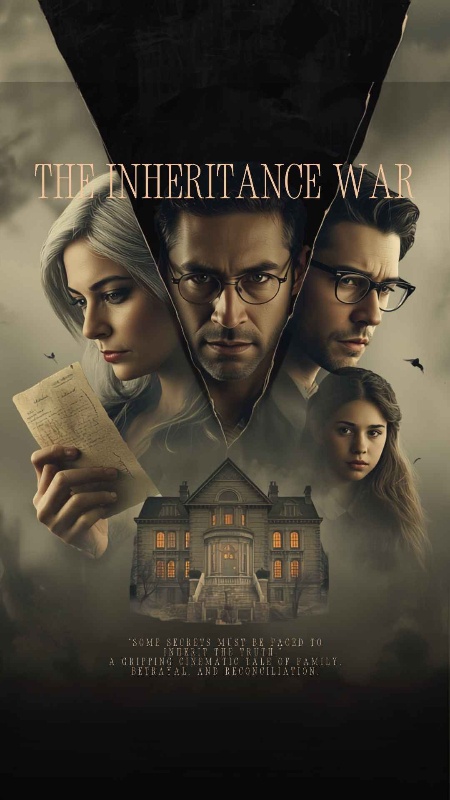
The three siblings had not stood together in the same room for eleven years when their father died. They arrived at the funeral separately, as if even grief had become something they could no longer share. Daniel came first, stepping out of a black sedan in a charcoal suit that looked too expensive for the small church where their mother had once taken them every Sunday. He stood beside the entrance with his hands in his pockets, staring at the rain falling over the cemetery. At thirty-eight, he had the polished appearance of a man who had learned how to hide exhaustion behind success. He had built a career in London, owned an apartment overlooking the Thames, and rarely spoke about the town where he had grown up. Ten minutes later, Sophie arrived carrying a broken umbrella and looking as though she had forgotten to sleep for several nights. She was thirty-four, a school counselor, divorced, and still living only twenty minutes from their father's house. She had been the one who took him to hospital appointments, argued with doctors, collected his prescriptions, and listened to him complain about food he had once loved. She had also been the one he called when he couldn't find his glasses, when the television stopped working, when loneliness became louder than pride. Their younger brother, Michael, arrived last. Twenty-nine, restless, angry, and carrying a history of unfinished plans behind tired eyes. He parked an old motorcycle near the church and walked in without looking at either of them. Daniel watched him pass. Sophie looked down. Michael kept walking. They had once been inseparable. As children, they had built forts from blankets in the living room, stolen peaches from their father's garden, fought over the last piece of cake, and slept in the same room during thunderstorms because Michael was terrified of lightning. Their father used to call them his three legs of a stool. "Take one away," he would say, "and the whole thing falls." Somewhere along the way, they had forgotten how to hold each other up.
The funeral itself passed like a dream. Their father's coffin was lowered into the ground beneath a gray sky, and when the priest asked if anyone wished to say a few words, nobody moved. Daniel thought Sophie would speak because she had always been the closest to him. Sophie thought Daniel would speak because he had been the favorite. Michael thought neither of them deserved to. So they stood in silence while rain darkened the flowers on the grave. When it was over, Daniel shook hands with people he barely remembered. Sophie hugged neighbors and accepted condolences she didn't know how to answer. Michael disappeared before anyone could stop him. They did not speak until the following Monday, when the three of them received the same letter from their father's lawyer.
The reading of the will will take place at ten o'clock Saturday morning. All three beneficiaries must be present.
Daniel almost laughed when he read it.
Their father had always been stubborn.
Even in death, he was still finding reasons to put his children in the same room.
Saturday arrived.
They sat around a long wooden table in the lawyer's office, separated by enough empty chairs to make the distance between them feel deliberate. Their father's lawyer, Mr. Bennett, placed a thick envelope on the table. "Before I begin," he said, "your father left specific instructions."
Michael leaned back.
"Of course he did."
Mr. Bennett ignored the comment.
"He requested that I read the letter addressed to the three of you before discussing the estate."
He opened the envelope.
"My children," he read, "if you're hearing this, then I have finally run out of time. I wish I could say I am sorry for bringing you together this way. I am not. Some things are worth forcing."
Sophie closed her eyes.
Daniel stared at the table.
Michael muttered, "Typical."
The lawyer continued.
"You have spent eleven years blaming one another for what happened to this family. You have each carried your own version of the truth. None of you has the whole story."
Daniel looked up.
"What does that mean?"
Mr. Bennett continued.
"I am leaving the house on Willow Street to Sophie. I am leaving my company, Ashford Hardware, to Daniel. I am leaving my savings and investment accounts to Michael."
Michael's head snapped up.
"How much?"
"Approximately three hundred and twenty thousand pounds."
Silence.
Daniel frowned.
Sophie looked confused.
Michael stared at the lawyer.
Then Mr. Bennett said the words that changed everything.
"There is one condition."
He placed three sealed envelopes on the table.
"None of you receives your inheritance until you have opened these together."
Daniel's face hardened.
"What is inside them?"
"Your father instructed me not to tell you."
Michael laughed bitterly.
"So he couldn't even die without making us fight."
Mr. Bennett looked at him.
"Your father specifically said, and I quote, 'They will call it a war. Let them. Maybe war is what it takes to make them remember they are family.'"
Nobody spoke.
Then Sophie picked up her envelope.
Her hands were shaking.
Daniel picked up his.
Michael stared at his for almost a minute before taking it.
Three envelopes.
Three secrets.
One dead father.
And a family that had already spent eleven years breaking apart.
They opened them at the same time.
Sophie pulled out a photograph.
It showed the three of them as children, sitting on the hood of their father's old blue truck.
Daniel was twelve.
Sophie was eight.
Michael was three.
Their father stood behind them, one hand resting on Daniel's shoulder.
On the back, written in their mother's handwriting, were four words.
Don't let them know.
Sophie looked at Daniel.
"Know what?"
Daniel shook his head.
"I don't know."
Michael unfolded a letter.
His face changed.
"What?"
He didn't answer.
Sophie reached for it.
Michael pulled it away.
"No."
"Michael."
"No."
"What does it say?"
He looked at both of them.
"Our father didn't abandon us."
Daniel froze.
"What?"
Michael's voice cracked.
"He didn't leave because he wanted to."
Nobody breathed.
Michael placed the letter on the table.
Their father's handwriting filled the page.
Your mother asked me to take the blame.
Sophie stared.
Daniel read the next line.
She was sick, and we were afraid you children would blame her.
The room suddenly felt too small.
Their mother had died twelve years earlier.
A year before Daniel stopped speaking to Michael.
Two years before Sophie stopped answering Daniel's calls.
They had always believed their father had abandoned their mother emotionally after her illness became difficult.
They had believed he had spent years working late, staying away from home, avoiding the family because he couldn't cope.
But the letter told a different story.
Their mother had been diagnosed with a degenerative neurological disease.
She knew she was dying.
She had also known that her children would blame themselves.
So she asked their father to tell them nothing.
She wanted them to remember her as she had been.
Their father had agreed.
But there was more.
Daniel read aloud.
"Your mother asked me to send Daniel away."
His voice stopped.
Sophie looked at him.
"Why?"
Daniel stared at the page.
"I don't know."
Michael took the letter.
"It says because you were fighting with her."
Daniel's expression tightened.
"I was sixteen."
"You told her you hated her."
"I was sixteen!"
"You told her you'd never forgive her."
Daniel stood.
"Because she wouldn't let me go to university!"
Sophie looked between them.
"Wait."
She took the letter.
Her eyes moved across the page.
Then she whispered, "She was afraid you would stay."
Daniel stared.
"What?"
"She didn't want you to give up your future to take care of her."
He sat down slowly.
Their mother had forced him away.
Not because she didn't love him.
Because she loved him enough to make him believe she didn't need him.
For eleven years, Daniel had carried the belief that his mother had chosen illness over him.
For eleven years, he had blamed his father for allowing it.
He suddenly understood why his father had never defended himself.
He had promised.
And promises were sometimes cruel things.
The second envelope contained hospital records.
The third contained a letter addressed to all three children.
They read it together.
Their mother had written it three weeks before her death.
She knew Daniel would hate her.
She knew Sophie would blame herself.
She knew Michael was too young to understand.
But she believed one thing above everything else.
That one day, if they knew the truth, they would forgive one another.
Not her.
One another.
Because she knew what they had done after she died.
Daniel had blamed their father.
Michael had blamed Daniel.
Sophie had tried to keep everyone together until she couldn't anymore.
And eventually, each of them had walked away.
The inheritance was suddenly irrelevant.
The war had never been about money.
It had always been about who was guilty.
And their father had spent his final months trying to make them understand that grief had made them enemies when they should have been holding each other.
But there was still one secret.
At the bottom of the third envelope was a handwritten note.
There is one more thing you must know. Ask Daniel what happened the night I died.
Everyone looked at Daniel.
He went pale.
"What?"
Sophie stared at him.
"What happened that night?"
Daniel shook his head.
"Nothing."
Michael stood.
"You know something."
"No."
"You do."
"I said no."
But his voice had changed.
Sophie recognized it.
She had heard that voice once before.
At their mother's funeral.
When Daniel had refused to look at their father.
"Daniel."
He closed his eyes.
"I was there."
Michael went still.
"What?"
"I was there when Dad died."
Sophie stared at him.
"You said you were in London."
"I lied."
"Why?"
Daniel looked at the floor.
"Because he asked me to."
Michael's anger returned instantly.
"Why would he ask you to lie?"
Daniel's voice broke.
"Because I was the last person he spoke to."
The room went silent.
Their father had died alone.
At least, that was what they had believed.
Daniel had been there.
He had held his father's hand.
He had listened to his final words.
And he had carried them alone for two years.
"Why didn't you tell us?"
"Because he made me promise."
Michael slammed his hand onto the table.
"Another promise!"
Daniel flinched.
"He told me you weren't ready."
"You're not our father!"
"I KNOW!"
Daniel shouted it so loudly that everyone fell silent.
His face crumpled.
"I know."
He sat down.
And for the first time in eleven years, Daniel cried in front of his siblings.
Not quietly.
Not elegantly.
He cried the way children cry when they finally realize nobody is coming to fix things.
Sophie moved first.
She crossed the room and put her hand on his shoulder.
Daniel didn't pull away.
Michael stood there for several seconds.
Then he sat beside them.
Their shoulders touched.
Three adults.
Three broken pieces of the same family.
Their father's final words were simple.
Tell them I wasn't afraid.
Daniel looked at them.
"He wasn't afraid of dying."
Sophie whispered, "What was he afraid of?"
Daniel looked at Michael.
"That you would spend your whole life thinking he didn't love you."
Michael's face collapsed.
He looked down.
Their father had left him the savings.
But suddenly Michael understood.
It wasn't payment.
It was an apology.
Their father knew Michael had spent years believing he had been forgotten.
He wanted to give him something that said, I remembered you.
The house went to Sophie because she had cared for it.
The company went to Daniel because he had spent his life building businesses.
The money went to Michael because their father knew he needed a second chance.
But none of those things mattered as much as the final instruction.
Before you take anything, eat dinner together in the house.
They almost refused.
Then Sophie laughed.
It was the first time any of them had laughed together in years.
So that evening, they went to Willow Street.
The house looked smaller than they remembered.
The kitchen still had the same cracked blue tiles.
The hallway still had the mark where Michael had once crashed his bicycle into the wall.
There were pencil lines on the doorframe marking their heights.
Daniel found his name.
Sophie found hers.
Michael found his.
The last mark had been made by their father.
It was dated three months before his death.
Michael stared at it.
"He was still measuring us."
Sophie smiled through tears.
"Apparently."
They cooked dinner together.
Badly.
Daniel burned the bread.
Sophie over-salted the soup.
Michael dropped an entire bowl of potatoes.
They laughed until their stomachs hurt.
And for a few hours, they were children again.
Not completely.
They still had scars.
Daniel still carried resentment.
Sophie still carried guilt.
Michael still carried anger.
Forgiveness didn't erase any of it.
But forgiveness wasn't erasure.
It was deciding that the past no longer deserved to control the future.
Later that night, they sat on the back steps beneath the same tree where they had built their childhood fort.
Michael looked at his brother.
"You know I hated you."
Daniel nodded.
"I know."
"I thought you didn't care."
"I thought you hated me."
"I did."
"I know."
Sophie looked between them.
"You two are terrible at this."
Michael laughed.
Daniel smiled.
Then Sophie said quietly, "I thought if I kept everyone together, none of us would fall apart."
Daniel looked at her.
"You were a kid too."
She looked away.
"I know that now."
The three of them sat in silence.
Then Michael reached into his pocket.
He pulled out the photograph from the will.
He turned it over.
Don't let them know.
He smiled sadly.
"She wanted to protect us."
Daniel looked at the photograph.
"She did."
Sophie took it.
"But she didn't understand something."
"What?"
"We needed the truth."
They sat there until midnight.
No grand promises.
No dramatic declarations.
Just three siblings sitting together beneath an old tree, finally speaking honestly after eleven years of silence.
In the morning, Daniel called London and told his company he would be staying longer.
Sophie began cleaning the house.
Michael repaired the broken fence.
Nobody asked what would happen next.
Maybe the house would be sold.
Maybe Daniel would move back.
Maybe Michael would use the inheritance to start the workshop he had always dreamed about.
Maybe they would still fight.
They probably would.
Families did.
But when Daniel left the house that afternoon, he stopped at the gate.
He looked back.
Sophie was standing in the doorway.
Michael was beside her.
For a moment, Daniel saw them as they had been years ago.
Three children.
Three impossible dreams.
One family.
He smiled.
Then he walked back.
Not because he had forgotten what happened.
Not because everything had been fixed.
He walked back because, finally, he understood what his father had been trying to teach them.
An inheritance was never just a house.
It wasn't money.
It wasn't a company.
It wasn't something written on paper and divided between names.
The greatest inheritance their parents had left them was the chance to decide what kind of family they would become after everything had gone wrong.
And this time, they chose each other.