
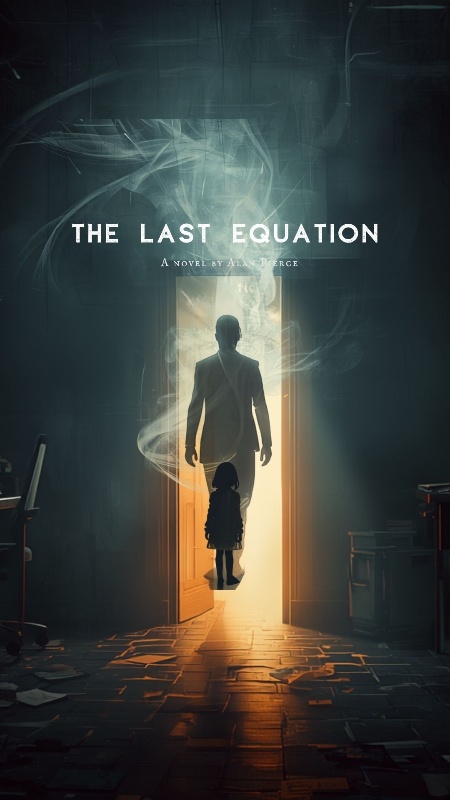
The ink wasn't dry yet.
Dr. Alan Pierce stared down at the manuscript on his desk. The pages were crisp, white, and covered in handwritten symbols that looked less like mathematics and more like the impossible architecture of a waking nightmare. The coffee cup beside it was cold, the black sludge at the bottom long since turned to stone. He hadn't slept in four days. His eyes were bloodshot, his beard unkempt, his expensive professor's cardigan stained with sweat, chalk dust, and the dried remnants of instant noodles.
He reached for the stack of papers. His hands were shaking.
I have to burn it, he thought. I have to destroy it right now.
But he couldn't.
His fingers hovered over the first page. The equations. The elegant, terrifying, impossibly simple equations. He had spent twenty years chasing this. Twenty years of staring at blackboards in the physics department, of arguing with colleagues who called him a dreamer, of lying awake at 2:17 AM listening to the hum of the universe and begging it to reveal its secrets.
And it had finally answered him.
It had answered with a single, devastating truth.
Alan was a theoretical physicist. A man of numbers, of strict logic, of immutable laws. He had spent his entire life trying to understand the fabric of reality. He wanted to find the fundamental building blocks of existence. He wanted to reduce the universe to a single, beautiful equation.
He had done it.
But the equation wasn't a solution. It was a key.
Alan picked up the first page. He read the first line.
Let X represent the observer's fundamental identity, and let Y represent the collapse of the wave function into absolute zero.
He read it again. And again. And the more he read, the more the words began to burn into his retinas. The symbols twisted. They moved. They bled off the page and floated in the air in front of his eyes, dancing like flies on a corpse. The equation wasn't just math anymore. It was a spell. A linguistic virus that bypassed the rational brain and infected the deeper, primal mechanisms of human consciousness.
His neck prickled. A cold sweat broke out along his hairline. The room felt too small, the air too thick.
He slammed the paper down.
Stop. Stop reading. He took a deep, ragged breath. He squeezed his eyes shut, trying to force the symbols out of his mind. But they were already there, burned behind his eyelids, replicating like a disease.
Alan stood up. He paced the room, his footsteps echoing against the concrete walls of his office. He ran his hands through his greasy hair. I'm going crazy, he thought. I've just been overworking myself. It's just an equation. It's just physics.
But he knew it wasn't.
He knew it because he could still see the symbols when he closed his eyes. And he knew it because, despite the fear, he felt an overwhelming, obsessive compulsion to look at it again. Just one more time, his mind whispered. Just to make sure you're reading it right. Just to make sure it's still there.
He fought it. He grabbed his car keys. He walked out of his office, leaving the manuscript sitting on the desk. The door clicked shut behind him.
It's fine, he told himself. I'll go for a drive. I'll get something to eat. I'll clear my head, and when I come back, I'll burn it.
He made it three steps down the hallway before he stopped.
The hallway was empty. The fluorescent lights hummed overhead. But there was a man standing at the far end of the corridor. He was tall, gaunt, with a face like a skull. He was wearing a dark, immaculate suit that looked too heavy for the warm building. He was just standing there, perfectly still, staring at Alan.
Alan blinked. The man was gone.
His skin crawled. He walked faster, practically jogging to the exit. He pushed through the glass doors of the physics building and stepped out into the cool night air. He breathed in deeply. The scent of damp asphalt and exhaust fumes hit his lungs.
You're losing it, he told himself. Go home. Sleep.
He drove home in a daze. He parked in his driveway and sat in his car for a long moment. He looked at his house. It was a small, modest bungalow he'd bought after his divorce. The porch light was on. He thought of his daughter, Emma. She was eight years old, with his eyes and his crooked smile. She was staying with her mother this week, but he was picking her up on Friday.
The thought of Emma grounded him. He got out of the car, went inside, and locked the door.
He didn't look at the bathroom mirror. He went straight to bed. He lay in the dark, staring at the ceiling. He tried to think of anything else. He thought of Emma's laugh. He thought of the way she used to climb into his lap to read storybooks.
But the equation was there. It was etched into the back of his eyelids. The symbols were glowing, pulsing, begging to be read.
Just a little further, the equation whispered. Just a little further into the truth.
Alan sat up. He was sweating. He grabbed his laptop from the nightstand, his fingers trembling. He opened a blank document and began to type. He typed the equation. He typed it over and over again, his fingers moving mechanically, driven by a compulsion he couldn't control.
He typed until the early hours of the morning, until his eyes were burning, until his fingers ached.
He finally looked down at the screen.
The entire document was filled with the equation. But the text was moving. The characters were alive, shifting, crawling across the screen like ants. They were forming a new shape. A face.
The face was his own.
But it was wrong. It was grinning, its mouth stretched too wide, its eyes hollow and black. It was staring at him from the screen.
You understand, the face said. It wasn't a sound; it was a thought forced directly into his skull. You are the first. You are the observer. You are the one who will break the story.
"No," Alan whispered. He slammed the laptop shut. He grabbed it, ran to the kitchen, and threw it into the sink. He turned on the faucet, dousing it in water. The screen flickered, sparked, and died.
Alan leaned over the counter, gasping. He was shaking. He was crying.
He had to destroy the paper. The physical manuscript in his office. That was the source. He had to burn it before anyone else saw it. Before his colleagues. Before the publishers. Before anyone.
He drove back to the university. It was 3:00 AM now. The campus was silent. The parking lot was empty. He ran up the stairs to his office, his breath hitching, his legs burning.
He unlocked the door. He pushed it open.
And froze.
The office was empty. The desk was clean. The manuscript was gone.
Alan's blood ran cold. He looked everywhere. Under the desk. In the drawers. Behind the filing cabinet. The pages had vanished.
Who took it? he thought. Who could have taken it?
He heard a soft sound. A rhythmic scratching. He turned around.
On his blackboard, in his own handwriting, the equation was written out in full. Chalk dust hung in the air. It had been written moments ago.
Alan stared at the board. He couldn't stop looking at it. He stepped closer, pulled by a magnetic, irresistible force. The symbols were so perfect. So elegant. They captured the truth of the universe. They were the only thing that mattered.
He reached out and touched the blackboard. His fingers traced the chalk.
You can't read it, he thought, panic clawing at his throat. Don't read it. Don't you dare read it.
But it was too late. His eyes were already scanning it. His brain was already processing the implications. The logic. The beautiful, horrifying, absolute logic.
When the observer acknowledges the self as a construct, the external reality collapses into the void of absolute probability. The self ceases to exist. The universe ceases to exist. Existence is a narrative. A story told by the observer. This equation deletes the storyteller.
Alan felt it happening. He looked down at his hands.
They were translucent. He could see the wood grain of his desk through his own fingers. A cold, creeping numbness was spreading from his chest outward. He was being erased from reality, line by line, like a bad sentence being edited out of a book.
"No," he whispered. "No, no, no."
He grabbed an eraser and swiped it across the blackboard. The chalk dust flew into the air, hanging in the beam of the fluorescent lights. He erased it. He erased it until the board was completely blank.
He turned around.
The man was standing in the corner of the lab. The gaunt man in the dark suit. He was holding a thick, leather-bound book with no title.
"Dr. Pierce," the man said. His voice was soft, resonant, and utterly devoid of emotion.
Alan backed away, hitting the edge of his desk. "Who are you? How did you get in here?"
"I am a reader," the man said. "I have read the equations of existence. I have read the final breaths of dying stars. I have read the minds of every fool who ever thought they could understand the truth without paying the price."
Alan's eyes darted to the blackboard. Then back to the man. "You wrote it," Alan said. "You wrote it on my board."
"I didn't write it," the man said. "I merely made sure it was where you would find it. You were always going to find it, Dr. Pierce. It was already in your head. It just needed to be put on paper so you could see it. So you could read it."
Alan shook his head. "No. No, I didn't mean to find it. It was an accident. I was just trying to map the quantum field. I didn't know it would—"
"You didn't know it would make you cease to exist," the man finished. "But it does. That's the nature of the equation. It is the last equation. The final answer. Once a mind reads it, that mind is no longer compatible with the universe. It becomes a paradox. A logical impossibility. And paradoxes cannot exist."
Alan looked at his translucent hands again. The skin was fading. He was disappearing.
"There's a way to stop it, isn't there?" Alan begged, his voice cracking. "There has to be a way."
The man smiled. It was a terrible, empty smile. "The only way is to ensure no one else ever reads it. But you can't destroy it, Dr. Pierce. Because it is already a part of you. The equation is living in your mind."
Alan ran. He burst out of his office, sprinting down the hallway. He had to find a phone. He had to call his ex-wife. He had to warn them. He had to warn Emma.
He ran to the main lab. He slammed the door shut and locked it. He looked at the blackboards there. They were covered in the equation. It had spread. It was everywhere.
No, no, no.
He grabbed a Bunsen burner from the lab bench. He lit it. He looked around for the manuscript, for anything he could burn. But there was nothing. Just the writing on the boards.
His office door opened. It was the man. He was standing in the doorway.
"Dr. Pierce," the man said. "You are wasting time. You cannot stop the equation. You can only live with it, or stop living."
Alan looked at him. His mind was racing. He had to save Emma. He had to save the world. He had to make sure no one ever read this.
"I'll kill myself," Alan said, his voice trembling. "I'll die. I'll take it with me. If I die before I can write it down, the knowledge dies with me."
The man shook his head slowly. "Death doesn't erase knowledge. Death is just a transition. The equation isn't in your brain matter. It's in your consciousness. It's in your soul. And souls are eternal."
Alan didn't answer. He just stared at the man. Then he looked at his hands again. They were fading faster. He reached into his desk drawer and pulled out a scalpel. He looked at the sharp, gleaming blade.
"I'm sorry, Emma," he whispered.
He drove the scalpel into his own throat.
He expected pain. He expected blood. He expected the familiar, rushing darkness of death.
Instead, he felt nothing. He watched his body collapse to the floor, gurgling, bleeding out onto the clean white tiles. But his mind remained. He was standing in the corner of the lab, looking down at his own corpse, while the man in the dark suit stood beside him.
"You see?" the man said. "You are not your body. You are the observer. The equation didn't kill you. It just unbundled you. You are the storyteller who has left the story."
Alan stared at his own blood pooling on the floor. He reached out, but he had no hands. He was a ghost. A thought. A mathematical error.
He thought of Emma. He saw her face in his mind. A tiny girl with his eyes, his crooked smile. She was going to be eight years old next month. She was going to have a birthday party. She was going to blow out candles.
He felt the knowledge inside him. The burning, relentless, obsessive knowledge of the equation. It was seeping out of him, seeping into the air, into the room, into the world.
"She will read it," the man said softly. "Your daughter, Dr. Pierce. One day, she will find your old notes. She will find the book. She will see the scribbles. She will understand it. And she will cease to exist."
Alan screamed. It was a silent scream, a raw, animal sound that existed only in his own mind. He loved her. He hated himself. He didn't know anymore.
He lunged at the man, but his transparent hands passed through him. The man didn't move. He just watched.
"Where do I go?" Alan asked. His voice was hollow, echoing in the empty lab. "Where do I go?"
"Nowhere," the man said. "And everywhere. You have ceased to exist, Dr. Pierce. But you cannot disappear. That is the paradox of the last equation. The universe is a story. And you are the narrator who has forgotten the plot."
The man walked out of the lab. The door shut behind him with a soft click.
Alan was alone. He stood over his own body, watching the last of his blood seep into the floor tiles. His eyes fell on the blank, empty blackboard.
He reached out. A ghostly, translucent hand. And he began to write.
The chalk wasn't there. It had been erased. But the symbols appeared anyway, glowing with a faint, spectral light. He wrote it line by line, his mind burning with the terrible, beautiful truth. He couldn't stop himself. He was a mirror. He was a door. He was the last equation.
He finished the final line. He stared at his work. The chalk dust didn't fall. The words hung in the air, waiting.
Alan stood in the silent lab, staring at the truth of the universe. He was trapped in the paradox. He was the equation. And the equation was him.
But he realized, with a cold, final clarity, that the worst part wasn't the erasure. The worst part was that the equation was so beautiful, so elegant, that if Emma ever saw it, she wouldn't be able to stop reading either. She would understand it. And she would cease to exist.
He had to protect her. But he had no hands. He had no voice. He was just a ghost, doomed to write the equation over and over again for eternity.
Alan stared at his work. He was a mirror. He was a copy. He was the last equation.
And the world waited, silent, for the next reader.