
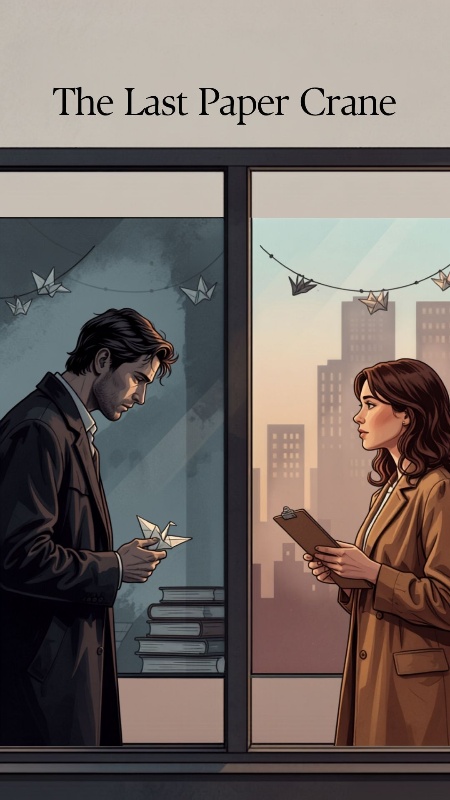
Part One: The Notice
The sign in the window said "EVERYTHING MUST GO" in hand-painted letters that had started to peel.
Theo looked at it every morning from his stool behind the counter. Today, he noticed the "E" was almost gone. He should fix it. He had paint in the back. He'd bought it six months ago when the landlord first posted the eviction notice. It was still unopened.
He didn't fix things anymore.
The bell above the door chimed. Theo didn't look up. He was reading - a dog-eared copy of a book no one had bought in two years. The pages were soft from use, the spine cracked.
"Hi!" A voice too bright for 8 AM. Too bright for a bookstore that smelled like dust and old paper and resignation. "I'm Clara. I'm from the city planning office. I was hoping to talk to you about - "
"I know what you're here about."
Theo closed his book. He finally looked up.
She was wearing a yellow coat. The color hit him somewhere in his chest before he could stop it. It was the same yellow as the origami paper he bought in bulk from the art supply store three blocks away. The same yellow his wife had worn the day they met.
"You're Theo Kim?" She was still smiling. Still bright. "I've read so much about this store. You've been here for almost thirty years?"
"Thirty-three."
"Thirty-three years." She looked around, and Theo watched her take it in - the shelves that were too full, the stacks of books on the floor, the comfortable chaos of a place that had grown organically over decades. "It's beautiful."
"It's closing."
"I know." Her smile dimmed, just slightly. "That's actually why I'm here. The redevelopment proposal includes a community space. I've been looking at the plans, and -"
"Look." Theo stood up. He was taller than her, which he hadn't expected. She was compact, all energy and movement. He felt heavy next to her. "I've been through this with your predecessors. Three of them. Different departments. Same result. I'm not interested in more meetings that go nowhere."
Clara didn't flinch.
"Your lease ends in four months," she said. "The building is being sold to a developer. The developer is going to tear it down and put up a twenty-story luxury condo. I can't stop that."
"Then why are you here?"
She reached into her bag and pulled out a folder. "Because I read your proposal. The one you sent to the city three years ago. About turning this place into a nonprofit literary center. It was a good proposal, Theo. You just got lost in the bureaucracy."
Three years ago.
Theo's jaw tightened. Three years ago, he'd been married. Three years ago, he'd believed the future was something worth planning for.
"That proposal was a waste of time," he said.
"It wasn't." Clara set the folder on the counter. "I think we can make it work. Not the whole building, but a part of it. A permanent space in the new development, rent-controlled, dedicated to independent literature. I've been talking to the developer, and they're open to -"
"Open to what?" Theo heard his voice rising. He couldn't stop it. "They're open to pretending they care about the neighborhood while they pave over every piece of it? This isn't a community, Miss Vance. It's a balance sheet."
Clara's smile finally disappeared.
"Theo." She said his name like she'd known him for years. "I grew up here. I watched my grandmother's bakery get torn down when I was twelve. I know exactly what this feels like. But I'm trying to offer you something."
"Then offer me something real."
He was breathing too hard. He could feel it - the anger that lived just beneath his skin, always ready. He'd been carrying it for three years. He'd stopped trying to let it go.
Clara looked at him for a long moment. Then she looked past him, toward the back of the store.
"The paper cranes," she said. "How long have you been folding them?"
Theo went still.
"I've seen them," Clara continued. "Through the window. I've walked by this store every morning for two weeks, and every morning there's a new one. Same spot, same hand. I don't know much about origami, but I know a ritual when I see one."
His hands were shaking. He shoved them into his pockets.
"It's nothing."
"It's not nothing." She took a step closer. "You fold one every night. That's not nothing, Theo. That's something."
He couldn't look at her. If he looked at her, he'd say something he'd regret. He'd tell her about the hospital room. He'd tell her about the color yellow. He'd tell her everything, and she'd look at him with pity and he couldn't - he couldn't -
"It's a habit," he said. "I don't have an explanation."
"Okay." Clara nodded slowly. "That's fine. You don't have to explain anything." She picked up her folder. "I'll come back tomorrow. Same time. We can talk about the proposal when you're ready."
"I'm not going to be ready."
She smiled again, but it was different now. Smaller. More real.
"I'll come back anyway," she said. "I've been told I'm annoyingly persistent."
The bell chimed. The door closed.
Theo stood alone in his empty bookstore, staring at the door she'd walked through. His hands were still shaking.
He went to the back room and found the origami paper. Yellow.
He folded a crane.
---
Part Two: The Questions
She came back the next day.
And the day after that.
And the day after that.
Clara Vance didn't take no for an answer. She also didn't push. She just showed up, sat in the back of his bookstore with a notebook and a cup of tea, and read through his old proposal.
"I don't understand," Theo said finally. It was the fifth day. Or the sixth. He'd lost count. "Why do you care?"
Clara looked up from her notebook. "About the store?"
"About anything."
She set down her pen. "Because I believe in places that matter. And this place matters." She gestured around them. "You've been here for thirty-three years. You've sold books to three generations of families. You've been a landmark. You can't just - "
"Landmarks get torn down every day."
"I know." Her voice was quiet. "That doesn't mean I have to stop fighting."
Theo looked at her. Really looked. She had messy hair, pulled back with a pencil. A small chip in her front tooth. A scar on her thumb from a paper cut. She was impossible, and she was persistent, and she was the most alive person he'd met in three years.
"I don't know how to fight anymore," he said.
"I know." She smiled. "That's why I'm doing it for you."
---
They started meeting after the store closed.
Theo would lock the door, turn off the neon sign, and Clara would still be there, sitting on the floor between the stacks, surrounded by open books.
"I used to come here with my grandmother," she said one night. "She'd buy me poetry collections. I didn't understand most of them. I just liked the way the words sounded."
Theo stopped what he was doing. He had a pile of books in his arms, destined for the donation bin.
"Your grandmother's bakery," he said slowly. "The one that got torn down."
"Yeah." Clara's voice was soft. "She opened it in 1972. She couldn't read or write, so my mother used to do the signs. She was so proud of those signs."
"What happened to her?"
Clara was quiet for a moment. "She died. About a year after the bakery closed. I think losing it broke something in her."
Theo set the books down. He sat across from her, cross-legged on the dusty floor.
"I'm sorry," he said.
"Me too." Clara looked at him. "You know the worst part? Nobody remembered it. The bakery was there for forty years, and after it was gone, people just... forgot. Like it had never existed."
"They didn't forget. They just didn't know how to hold onto it."
"Is there a difference?"
Theo thought about his wife. About the three years of cranes. About the way her face was starting to blur in his memory, no matter how hard he tried to hold on.
"No," he said. "There's not."
---
Part Three: The Cranes
It was a Thursday.
Theo had been folding cranes for 1,075 nights. He knew because he kept count. Every night, one crane. Every night, a piece of himself folded into paper.
Clara had noticed. She didn't mention it again, but he caught her looking sometimes. Looking at the windowsill. Looking at the stack of origami paper he'd started leaving by the register.
"You know," she said one evening, "my grandmother used to fold these. Paper cranes. She said they were for good luck."
Theo's hands stilled over the crane he was folding.
"Your grandmother?"
"She was from Japan. Well, her parents were." Clara was watching him carefully. "She used to fold them for my mother when she was sick. She said each crane held a wish."
"Did it work?"
Clara's smile was sad. "My mother died when I was nine. So I guess not."
Theo's hands were shaking again. He set down the crane.
"I'm sorry," he said. "I didn't -"
"It's okay." Clara waved a hand. "It was a long time ago. But I remember the cranes. She used to say that folding them was a way of talking to someone you couldn't reach anymore. Like a letter you folded into paper."
There was a silence.
Then Theo reached into his pocket.
He pulled out a crane. This one was different from the others. It was smaller, more delicate. The paper was yellow. Not bright, but faded. Like it had been carried for a long time.
"This one," he said, "was the first."
Clara looked at the crane. Then she looked at him.
"Theo -"
"My wife. Her name was Soo-jin." He couldn't stop. The words were pouring out. "She was diagnosed three years ago. Stage four. It took six months. One hundred and eighty-four days."
Clara's face had gone pale. "Theo."
"I started folding cranes in the hospital. I don't know why. I just needed something to do with my hands. Something that wasn't holding her." He was shaking now. "She died on a Tuesday. I had folded one that morning. I put it in her hand. She couldn't hold it, but I put it there anyway."
Clara was crying. He hadn't noticed at first - she was crying silently, tears running down her cheeks.
"Theo," she said again. "I'm so sorry."
"It's been three years." His voice cracked. "And I can't - I can't stop. I can't stop folding them. I can't stop thinking about her. I can't stop -" He stopped. Breathed. "I don't know how to let go."
Clara reached out. She took his hand.
"Maybe you don't have to," she said. "Maybe you just have to learn how to hold something else too."
---
Part Four: The Almost
The city planning committee approved the proposal.
Clara called him from her office, and he could hear her laughing through the phone.
"They approved it! They approved the whole thing! Well, not the whole thing. They cut the budget by forty percent. But the space is secured. You're going to have a permanent home, Theo."
Theo sat on his stool. The sign in the window said "EVERYTHING MUST GO." He still hadn't fixed the "E."
"Clara."
"I know. I know it's not perfect. But it's a start. And I've been talking to some people, and I think I can get more funding. We just need to -"
"Clara."
She stopped talking.
"What is it?"
Theo stood up. He walked to the window. The crane from last night was still there, folded from a page of a book about butterflies.
"Come over," he said. "Please. I need to show you something."
---
She arrived twenty minutes later.
Clara was still wearing her yellow coat. She was still bright, still impossible, still the most alive person he'd ever met.
"Theo," she said. "What's going on?"
He led her to the back of the store. To the room he never showed anyone. The room where he kept the cranes.
One thousand ninety-five of them.
They were everywhere - hung from the ceiling, lined up on shelves, stacked in boxes. Every color of the rainbow. Every page of every book he'd never sell.
Clara walked through the room slowly. Her hands covered her mouth.
"Theo," she whispered. "You kept them all."
"One for every day," he said. "One for every day I've been without her."
She turned to face him. Her eyes were shining with tears.
"Why are you showing me this?"
He took a breath. He'd never done this before. Never said it out loud. But she was looking at him with those eyes, with that impossible hope, and he couldn't keep it inside anymore.
"Because I think I'm starting to want something else," he said. "Something new. And I don't know how to want it without feeling like I'm betraying her."
Clara stepped closer.
"You're not betraying her," she said. "You're just... learning how to keep living."
"I don't know how." His voice was barely a whisper. "I've been frozen for three years. I don't know how to move again."
She reached up. Her hand touched his cheek. It was warm. Alive. So different from the cold he'd been carrying.
"Maybe you don't have to move all at once," she said. "Maybe you just have to try."
He leaned into her touch. He closed his eyes.
"Clara."
"Come here."
She kissed him.
It was brief. Closed. And he could feel her tears against his cheek. But it was the first time he'd felt anything in three years.
---
Part Five: The Leaving
She pulled back.
"I'm sorry," she said. "I shouldn't have done that."
"Theo." He reached for her. "Clara, wait."
"No." She shook her head. "I have to go. I'm sorry."
She left.
He stood alone in the room with the cranes.
He called her. She didn't answer.
He called again. Voicemail.
He waited.
---
She came back the next morning.
She didn't look like herself. Her eyes were red, her hair messy, her yellow coat rumpled.
"I lied to you," she said. "About the redevelopment."
Theo's heart stopped. "What?"
"The developer. They're not going to approve the community space. They were never going to approve it. I just - I wanted to give you hope. I wanted to make you believe something." She was crying now. "I thought if I could get them to see what I see, they'd change their minds. But they won't. And I should have told you the truth."
Theo felt the floor drop out from under him.
"So the proposal -"
"It was real. I thought it was real. But I knew there was a chance it wouldn't work. And I kept it from you." She wiped her eyes. "I'm not the person you think I am. I'm not some hero. I'm just - I'm just someone who wanted to help, and I made it worse."
He looked at her. At the woman who'd come into his store with impossible hope and stubborn persistence.
He didn't feel angry.
"Clara." He walked to her. "You came here every day. You fought for me. You fought for a bookstore you'd never even been inside before this."
"Because I could see it." She looked at him. "I could see what it meant. And I could see you. The real you. And I just - I wanted to be someone who mattered to you."
"You do matter."
"I lied to you."
"You were trying to protect me." He took her hands. "That's not the same as lying."
She was crying again. "I'm so sorry. I'm so sorry."
"I don't care about the bookstore." He squeezed her hands. "I mean, I do care about the bookstore. But that's not why I wanted you to come over. I wanted you to come over because I needed to tell you -" He stopped. Breathed. "I need you, Clara. Not because of what you can do for me. Because of who you are."
"Who I am?"
"Someone who shows up. Someone who fights. Someone who doesn't let me stay frozen." His voice broke. "I don't want to be frozen anymore. And I think you're the only person who can help me thaw."
---
Part Six: The Turning
They did get the space. Eventually.
It took six more months of meetings, petitions, community organizing. Clara didn't give up. And for the first time, Theo didn't give up either.
The day the final approval came through, Clara showed up at the bookstore with a bottle of champagne and a box of yellow origami paper.
"Celebration," she said. "And also -" She held up the paper. "I got you something."
"More paper?"
"Read the label."
He turned the box over. In careful handwriting, Clara had written: "For the next thousand cranes. Fold them for something new."
Theo looked at her.
"I don't know what to say," he said.
"You don't have to say anything." She smiled. "Just promise me you'll keep folding."
---
Part Seven: The Last Crane
The new space opened on a Thursday.
It wasn't a bookstore anymore. It was a literary center - a place for readings, workshops, community events. Theo was still the owner, but he was something else now too. A curator. A caretaker.
A man who was learning to live again.
Clara came to the opening. She wore her yellow coat, and she stood in the middle of the room, surrounded by books and people and hope.
Theo found her by the window.
"Thank you," he said. "For not giving up on me."
"Thank you for letting me help."
He reached into his pocket. He pulled out a crane.
This one was different. It was larger, more intricate. Folded from yellow paper.
"I made this for you," he said. "The first one I folded for something new."
Clara took the crane carefully. Her fingers touched the edges.
"What did you wish for?" she asked.
Theo stepped closer.
"I wished that I could learn how to let myself want again," he said. "And I think I'm getting there."
Clara looked at him. Her eyes were warm, golden, full of something that made his chest ache.
"One crane at a time," she said.
"One crane at a time." He took her hand. "Clara. I think I'm falling in love with you."
Her smile was like the first day of spring. "I think I'm falling in love with you too."
They stood in the window, hands clasped, the yellow crane between them. Around them, the new center was full of people, full of life.
But in that moment, it was just them.
And the crane.
And the future they were both finally ready to hold.
---
Every night for three years, he folded a crane. Every night, he said goodbye.
And then she came - the woman in the yellow coat - and for the first time, he folded one for hello.
The last crane was the first one that mattered.
The End