
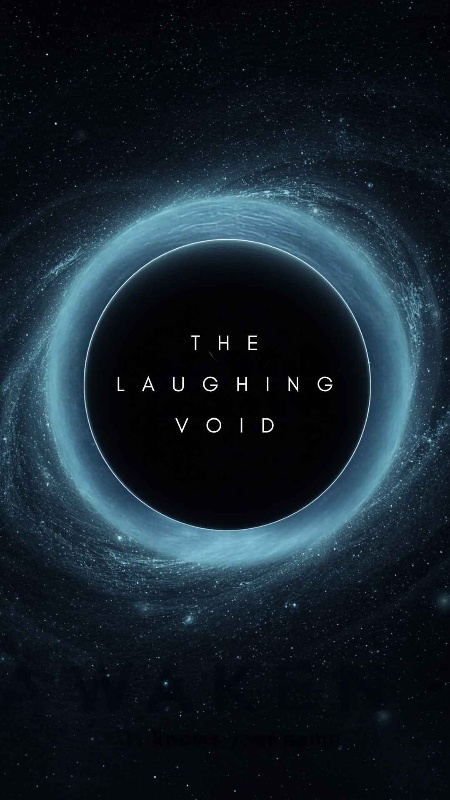
The first thing the probe transmitted was a laugh.
Not a human laugh.
Not even something that sounded human.
It was distant and enormous, as though something had opened its mouth somewhere beyond the edge of the universe and found the existence of mankind absolutely hilarious.
Dr. Mara Voss listened to the recording three times before she understood what frightened her most.
The laughter wasn't coming from the probe.
It was coming from inside the silence around it.
And whatever was laughing knew the probe was listening.
Chapter One: The Place Where Nothing Was
At 3:17 in the morning, Dr. Mara Voss discovered a hole in the universe.
She was alone in the observation room of the Argo Deep-Space Observatory when the anomaly appeared on her monitor.
At first, she thought it was a software error.
The telescope was pointed toward a region of space approximately eleven billion light-years away, toward a dense field of ancient galaxies. Mara had been reviewing gravitational lensing data for nearly six hours, searching for irregularities in the distribution of dark matter.
She expected noise.
She expected mistakes.
She expected something boring.
Instead, she found nothing.
Not empty space.
Nothing.
Mara leaned closer to the screen.
The region was almost perfectly circular.
That was the first impossible thing.
Space did not make perfect circles.
Nebulae were irregular. Black holes distorted their surroundings. Cosmic voids were enormous, uneven structures shaped by billions of years of gravitational evolution.
But this was different.
The boundary was so clean that it looked artificial.
A black circle surrounded by stars.
Mara enlarged the image.
The circle became larger.
She enlarged it again.
Still nothing.
No galaxies.
No stars.
No cosmic dust.
No background radiation.
Nothing.
Mara frowned.
"Computer, run atmospheric interference diagnostics."
The system responded immediately.
"Diagnostics complete. No interference detected."
"Run telescope calibration."
"Calibration nominal."
She stared at the circle.
"How large?"
The computer hesitated.
That shouldn't have happened.
Mara straightened.
"Repeat."
"Estimated diameter: nine hundred and fourteen light-years."
She stopped breathing for a moment.
Nine hundred and fourteen light-years.
A region that enormous should have contained thousands, perhaps millions, of stars.
Even an ordinary cosmic void would contain traces of matter.
This contained absolutely nothing.
Mara opened a second window.
"Compare with previous observations."
The computer searched the observatory archive.
A few seconds later, a message appeared.
"No matching anomaly found."
Mara looked at the timestamp.
The telescope had observed that exact region twelve years earlier.
She pulled up the old data.
The screen filled with galaxies.
Mara stared.
There had been something there.
Thousands of galaxies.
She checked the coordinates.
The same coordinates.
Same region.
Same telescope.
Same celestial reference frame.
But twelve years ago, the region had been full of light.
Now there was nothing.
Mara whispered to herself.
"Where did everything go?"
Behind her, the observation-room door opened.
Dr. Elias Chen walked inside carrying a paper cup of coffee.
"You still awake?"
Mara didn't answer.
Elias looked at her screen.
Then he stopped.
The coffee cup slowly lowered from his hand.
"What is that?"
"I don't know."
"Is that a corrupted image?"
"No."
"Dead pixels?"
"No."
Elias walked closer.
"What am I looking at?"
Mara pointed at the black sphere.
"A missing universe."
He laughed nervously.
Mara didn't.
That was when Elias understood she wasn't joking.
Chapter Two: The Sphere
They called it the Null Region.
Within forty-eight hours, the discovery had been independently confirmed by three observatories.
Within seventy-two hours, the world's largest space agencies knew about it.
Within a week, governments were involved.
Scientists argued over what it could be.
A gravitational phenomenon.
A collapsed dimension.
An exotic black hole.
A previously unknown interaction between dark energy and spacetime.
Some suggested the entire region had been consumed by a structure larger than any known black hole.
Others believed the data itself was wrong.
Mara disagreed with all of them.
Because she had found something nobody else had noticed.
The sphere wasn't merely empty.
It was moving.
Not through space.
Toward them.
Very slowly.
Every twelve hours, its apparent boundary shifted by approximately three kilometers.
The change was almost impossible to detect.
But Mara detected it.
She watched the numbers for an hour before calling Elias.
"Tell me I'm wrong."
Elias looked at the data.
Then he looked at her.
"You're not wrong."
The room went quiet.
Mara pointed toward the screen.
"It isn't expanding."
"No."
"It's approaching."
Elias swallowed.
"Approaching what?"
Mara didn't answer.
She didn't need to.
The coordinates of Earth were already displayed beneath the model.
The sphere was moving directly toward them.
Not quickly.
Not dramatically.
At its current speed, it would reach the outer edge of the solar system in approximately eighty thousand years.
Elias exhaled.
"We have eighty thousand years."
Mara shook her head.
"That's if it's moving at a constant rate."
"You think it will accelerate?"
"I don't know."
"Then what do you think?"
Mara stared at the black sphere.
"I think we shouldn't tell anyone yet."
Elias frowned.
"Why?"
"Because I don't think we're looking at it."
"What?"
"I think it might be looking at us."
Chapter Three: The Signal
The first signal arrived nine days after the discovery.
It was so weak that the observatory almost discarded it as background noise.
Mara was reviewing microwave data when she noticed a repeating pattern.
Three pulses.
Pause.
Three pulses.
Pause.
Three pulses.
She increased the sensitivity.
The signal became clearer.
Three pulses.
Pause.
Three pulses.
Pause.
Three pulses.
Then silence.
She checked the frequency.
It wasn't radio.
It wasn't microwave.
It wasn't gravitational.
It wasn't anything the instruments were designed to detect.
It seemed to exist simultaneously across several wavelengths.
Mara called Elias.
Within minutes, the entire team was gathered.
"Could it be intelligent?" someone asked.
Nobody answered.
Mara isolated the signal and converted it into an audible frequency.
She pressed play.
At first there was only static.
Then came a sound.
A low breath.
Then another.
Then a faint crackle.
And finally...
Laughter.
Everyone in the room froze.
It was a strange sound.
Slow.
Wet.
Deep.
It began like a human chuckle but stretched into something much larger.
The laughter seemed to contain several voices at once.
Children.
Adults.
Old men.
Women.
Whispers.
Screams.
All laughing together.
Mara immediately stopped the recording.
Nobody spoke.
Then someone whispered:
"Play it again."
"No."
"Why?"
Mara looked at the waveform.
Because the signal had changed.
It was no longer repeating.
The second recording contained something different.
Words.
Barely audible.
Mara enhanced the audio.
A voice emerged beneath the laughter.
A human voice.
A frightened voice.
Mara listened.
The voice whispered:
"Please don't send anything here."
Everyone stared at one another.
The message repeated.
"Please don't send anything here."
Then:
"Please."
Then silence.
Elias looked at Mara.
"Was that transmitted from inside the sphere?"
"We don't know."
"Can we identify the voice?"
Mara ran it through the database.
The computer returned no match.
Then something appeared on the monitor.
The audio had been recorded six hours before they received it.
Mara stared.
"That's impossible."
Elias leaned over.
"What?"
"Look at the timestamp."
He did.
The signal had been transmitted from the Null Region.
But according to their calculations, the signal should have taken eleven billion years to reach Earth.
It had arrived almost instantly.
And then Mara noticed something else.
The voice had spoken in English.
Modern English.
Chapter Four: The Probe
The decision to send a probe was made three weeks later.
Mara opposed it.
She was outvoted.
The scientific community wanted answers.
The probe was named Persephone.
It was small, heavily shielded, and equipped with every sensor engineers could fit inside its frame.
Its mission was simple.
Enter the Null Region.
Observe.
Return.
The launch was broadcast worldwide.
Mara watched from the control room.
The countdown reached zero.
Persephone disappeared into space.
For several months, nothing happened.
The probe traveled toward the anomaly.
Then, after one hundred and fourteen days, Persephone reached the outer boundary.
Every screen in the control room went black.
For six seconds, there was nothing.
Then the instruments came back online.
Mara leaned forward.
"What do we have?"
A technician stared at the screen.
"Nothing."
"Nothing?"
"No data."
"Camera?"
"Dead."
"Telemetry?"
"Nothing."
"Position?"
"Unknown."
Mara's heart began pounding.
Then a new signal appeared.
Audio.
The room filled with laughter.
Everyone froze.
It was the same laughter.
But this time it was louder.
Much louder.
And underneath it, there was another sound.
Someone crying.
Mara raised the volume.
A voice whispered through the static.
"Doctor Voss."
Mara's blood went cold.
Nobody else moved.
The voice continued.
"You shouldn't have looked."
Mara whispered:
"Who are you?"
The laughter stopped.
For several seconds there was only silence.
Then the voice answered.
"I was you."
The recording ended.
Nobody spoke.
Then Persephone transmitted another message.
This time, the voice wasn't frightened.
It was laughing.
Mara recognized it immediately.
It was her own voice.
Chapter Five: The Impossible Recording
They shut down every transmission system.
They disconnected the observatory from the global network.
They physically removed communication modules.
None of it mattered.
The messages continued.
Every six hours.
Always from Persephone.
Always from inside the sphere.
And every message contained a different voice.
A technician heard his mother.
Elias heard his younger brother, who had died when they were children.
Another scientist heard herself speaking to her daughter.
Mara heard herself.
Sometimes the voices begged them to stop.
Sometimes they laughed.
Sometimes they said nothing at all.
One recording contained only three words.
"We are watching."
Another said:
"You already came."
Another:
"Do you remember?"
But the worst message arrived on a Tuesday morning.
It lasted seven minutes.
It was a recording of the observatory.
Not a simulation.
Not an imitation.
The audio contained conversations that had happened inside the building.
Mara heard herself talking to Elias the previous evening.
She heard footsteps.
Doors opening.
Coffee machines.
The exact sound of a chair being dragged across the floor.
Then she heard something that had not happened.
Her own voice whispered:
"Don't turn around."
Mara looked behind her.
Nothing.
The recording continued.
"Don't turn around."
Again.
"Don't turn around."
Then another voice whispered:
"She already did."
The audio ended.
That night, Mara stopped sleeping.
Chapter Six: The Man Who Returned
Two months after Persephone entered the Null Region, it came back.
No one saw it arrive.
One morning, the tracking system simply showed the probe sitting in orbit around Earth.
It was exactly where it had been before entering the sphere.
No damage.
No missing components.
No radiation.
No signs of impact.
It looked untouched.
Mara ordered everyone to stay away from it.
The probe was recovered by remote drone.
When its outer shell was opened, the technicians found something inside.
A small black sphere.
It was approximately the size of a human heart.
It had no measurable mass.
It produced no radiation.
And when Mara looked at it, she felt something she couldn't explain.
Recognition.
She had never seen it before.
But some part of her remembered it.
The sphere began vibrating.
Then the speakers activated.
A voice emerged.
Mara's voice.
"Do not open the door."
Elias stared at her.
"What door?"
Mara didn't answer.
Because she suddenly knew.
The sphere wasn't a message.
It was a key.
The Null Region wasn't a place where something had disappeared.
It was a place where something had been sealed.
And humanity had just brought the key home.
Chapter Seven: The Door
The first crack appeared above Earth three days later.
It was invisible to the human eye.
But every telescope detected it.
A line across the sky.
A perfect black line.
It stretched for thousands of kilometers.
Then another appeared.
Then another.
The planet was beginning to resemble a glass sphere covered in cracks.
Mara stood on the observatory roof watching the night sky.
Stars were disappearing.
Not moving.
Not fading.
Simply vanishing.
One by one.
The black sphere inside the laboratory began laughing.
Everyone heard it.
Even though the laboratory was underground.
Even though the doors were sealed.
Even though the power had been disconnected.
The laughter traveled through the walls.
Through the floor.
Through the air.
And then something happened.
Every radio station on Earth broadcast the same message.
Every television.
Every phone.
Every computer.
Every speaker.
The voice was calm.
Almost gentle.
"We were never outside."
Mara closed her eyes.
The voice continued.
"You were."
She opened them.
The sky above her was no longer black.
It was empty.
Completely empty.
The stars were gone.
The Moon was gone.
There was no horizon.
Only a vast, impossible darkness.
Then something appeared in that darkness.
An enormous eye.
Mara couldn't understand its size.
It seemed larger than the Earth.
Larger than the solar system.
Larger than the universe.
It opened.
And Mara realized the horrifying truth.
The Null Region had never been a hole in space.
It was an eye.
And the universe was the eyelid.
Chapter Eight: The Laughing Void
People began disappearing.
Not dying.
Disappearing.
A woman would walk into her kitchen and never come out.
A pilot would vanish from a cockpit while the plane continued flying.
A child would disappear from a classroom.
Photographs changed.
Videos changed.
Memories changed.
Families began forgetting people who had existed only hours earlier.
Mara watched a photograph of her own research team.
There had been seventeen scientists.
Now there were sixteen.
She couldn't remember who was missing.
That terrified her more than anything.
She looked at Elias.
"Elias."
He stared at her.
"What?"
"How long have we known each other?"
He hesitated.
"I don't know."
"Neither do I."
The laboratory lights flickered.
A laugh came through the walls.
Mara looked toward the door.
Someone knocked.
Three times.
Knock.
Knock.
Knock.
Elias whispered:
"Don't open it."
Mara didn't move.
The knocking came again.
Three times.
Then a voice spoke from the other side.
Mara's voice.
"Elias?"
His face went pale.
The voice continued.
"Please open the door."
Elias backed away.
Mara whispered:
"That's not me."
The voice laughed.
Then it said something that made Mara's blood turn cold.
"Of course it isn't."
The door slowly opened.
There was no corridor beyond it.
There was space.
Endless space.
And floating inside that darkness were billions of human faces.
All staring.
All smiling.
All laughing.
Elias screamed.
Mara grabbed his arm.
They ran.
Behind them, the laughter grew louder.
Chapter Nine: The Last Transmission
Mara reached the communications room.
There was one thing she could still do.
She activated the emergency transmitter.
Elias stared at her.
"What are you doing?"
"Sending a warning."
"To whom?"
"Anyone."
She began recording.
Her hands were shaking.
"If anyone receives this message, do not investigate the Null Region."
A laugh echoed behind her.
She continued.
"Do not send probes. Do not observe it. Do not attempt to communicate."
The lights went out.
Mara continued speaking in darkness.
"It isn't a void."
Something breathed behind her.
She refused to turn around.
"It is not an object."
Another breath.
"It is not a civilization."
A whisper touched her ear.
"You are getting close."
Mara continued.
"It is something older than the universe."
The whisper became laughter.
"And I think..."
She stopped.
Elias looked at her.
"What?"
Mara stared at the transmitter.
"I think it created the universe."
Silence.
Then she understood.
The galaxies.
The stars.
The planets.
Humanity.
Everything.
Perhaps the universe wasn't expanding.
Perhaps it was growing.
Growing around something.
Something that had always been there.
Something that had been sleeping.
Something that had finally opened its eye.
Mara pressed the final transmission button.
"If you hear laughter..."
She swallowed.
"Don't listen."
The transmitter activated.
Her message traveled into space.
Then came the response.
A single sentence.
Not from the Null Region.
From Earth.
From every speaker on the planet.
From every radio.
From every phone.
From every human mouth.
"We already heard you."
Chapter Ten: The Laugh
Years later, astronomers would argue about what happened that night.
Some would say the Earth disappeared.
Others would claim the universe ended.
Some would insist humanity never existed at all.
But there was one thing they could all agree upon.
Something had changed.
The sky was different.
The stars were arranged differently.
The laws of physics seemed slightly wrong.
And in the deepest observatories, instruments continued detecting a signal.
Three pulses.
Pause.
Three pulses.
Pause.
Three pulses.
Then laughter.
Scientists tried to decode it.
They spent decades searching for patterns.
Eventually, they discovered something terrifying.
The signal wasn't coming from space.
It was coming from Earth.
More specifically...
From underground.
From beneath the laboratories.
Beneath the cities.
Beneath the oceans.
Beneath the Earth's crust.
And one night, a young astronomer named Daniel Reyes discovered another anomaly.
He was working alone.
It was 3:17 in the morning.
He looked at his telescope.
There was a perfect black sphere in the middle of the sky.
Daniel leaned closer.
His hands began to shake.
Because he recognized the coordinates.
The sphere wasn't eleven billion light-years away anymore.
It was three hundred kilometers above Earth.
Daniel whispered:
"No."
The sphere grew larger.
The telescope automatically adjusted its focus.
Inside the darkness, something moved.
Then a voice came through the observatory speakers.
Daniel heard his own voice.
"Don't look."
He covered his ears.
The voice laughed.
"Don't look."
He closed his eyes.
The laughter became louder.
"Don't look."
Daniel opened his eyes.
And saw the truth.
The black sphere wasn't approaching Earth.
It had never been approaching Earth.
It had been inside Earth the entire time.
Waiting.
Waiting for humanity to become advanced enough to notice it.
Waiting for humanity to look up.
Waiting for someone to open the door.
Daniel stared into the darkness.
Something stared back.
Then the universe laughed.
And somewhere, impossibly far away, another telescope detected a perfect sphere of nothingness.
A new one.
Then another.
Then another.
Thousands.
Millions.
Billions.
Each one opening.
Each one watching.
Each one laughing.
The last transmission ever received from Earth contained only six words.
They were spoken by a frightened human voice.
Daniel's voice.
Mara's voice.
Elias's voice.
Everyone's voice.
All at once.
"We were never alone."
Then the laughter began.
And it has never stopped.