
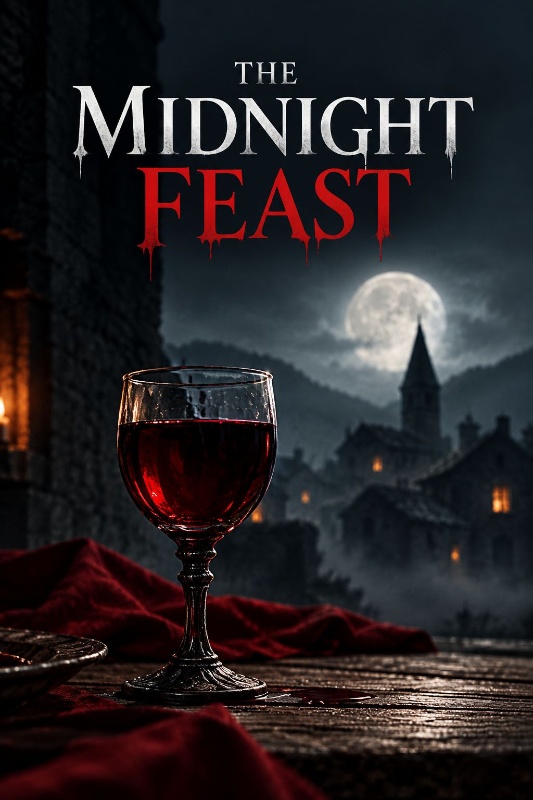
Chapter One: The Invitation
The invitation arrived on a Tuesday, folded inside a letter that had no return address.
Daniel Mercer found it beneath his apartment door when he returned from work, lying on the hallway carpet like something someone had slipped there in a hurry. The envelope was thick, cream-colored, and sealed with a circle of dark red wax. His name had been written across the front in elegant black ink.
Not printed. Written.
The handwriting looked strangely familiar.
He opened it with his keys.
Mr. Daniel Mercer,
You are cordially invited to attend the annual Midnight Feast at the village of Vesper's Hollow, on the final Saturday of October.
Your accommodation and transportation will be provided. Dinner will be served at precisely midnight.
Come hungry. Come thirsty.
And, above all, come prepared to stay until the last bell.
Your hosts await you.
There was no signature.
Daniel read it twice, then laughed.
He was thirty-four, a travel journalist who made a living visiting places that other people had forgotten. He had slept in abandoned railway stations, interviewed smugglers on frozen coastlines, and spent three miserable nights in a monastery where the monks insisted that the basement was not haunted.
A mysterious invitation to a remote village was practically a professional opportunity.
He photographed the letter and posted it to his editor.
Possible feature: The village that hosts a secret midnight feast. Investigating next weekend.
His editor replied almost immediately.
Sounds wonderfully creepy. Get photographs. Don't get murdered.
Daniel grinned.
He should have paid more attention to that last sentence.
That evening, he searched for Vesper's Hollow.
Nothing.
No village on any map. No tourist listings. No photographs. Not even an abandoned settlement with a similar name.
He tried variations. Vesper Hollow. Vesper's Hollow village. Midnight Feast Vesper.
Nothing.
At eleven that night, just as he was about to give up, an email appeared in his inbox.
Subject: Your journey to Vesper's Hollow
Your driver will collect you from the north entrance of Blackwood Station at 4:30 p.m. on Saturday.
Please bring no food or drink.
The village provides everything.
Kindly refrain from consuming any alcohol before your arrival.
We look forward to welcoming you, Daniel.
He stared at the screen.
He had never given these people his email address.
Then he noticed the final line.
We have been expecting you for a very long time.
The message vanished.
Not closed. Not moved to trash.
Vanished.
Daniel refreshed his inbox. Nothing. He checked the spam folder. Nothing.
He sat back in his chair, his amusement fading into something colder.
For several minutes, he considered deleting the photograph of the invitation and forgetting the whole thing.
Then his phone buzzed.
An unknown number.
One message.
Don't drink the wine.
Daniel stared at it until the screen dimmed.
A second message arrived.
If they pour you a glass, pretend to drink.
He typed a reply.
Who is this?
The response came almost instantly.
Someone who attended last year.
Then another.
Please. Whatever you do, don't let them hear your heart beating.
The number disconnected.
Daniel spent the rest of the night searching for the sender. The number was unregistered. The message could not be traced to any known contact. He even called it, but heard only a low, rhythmic sound before the line went dead.
Three slow knocks.
A pause.
Three more.
Like someone knocking on a coffin lid.
He barely slept.
On Saturday afternoon, he packed his camera, two spare batteries, a notebook, a flashlight, and a small bottle of water. He left his laptop at home and told his editor where he was going, forwarding the invitation and promising to check in the following morning.
At 4:25 p.m., he reached Blackwood Station.
The station had been closed for years.
Its platforms were cracked, the ticket windows boarded up, and weeds grew between the tracks. A rusted sign leaned against the entrance, its letters almost entirely eaten by weather.
No taxis waited outside.
No other passengers stood beneath the broken clock.
At exactly 4:30, a black car emerged from the fog.
It stopped beside him.
The rear window lowered.
The driver was an elderly man wearing a dark suit and white gloves. His skin was so pale that it seemed almost blue beneath the grey afternoon light. He smiled without showing his teeth.
"Mr. Mercer?"
"That's me."
"Welcome. We've been expecting you."
Daniel placed his bag in the trunk and climbed inside.
The car smelled of wet earth, old wood, and something faintly metallic.
As they pulled away, Daniel glanced at the driver's reflection in the mirror.
The old man had no reflection.
Only the empty back seat stared back at him.
Daniel blinked.
The reflection returned.
He told himself it was the strange light.
He told himself a great many things during the next three hours.
By the time he stopped believing them, the village was already waiting.
Chapter Two: The Road That Forgot the World
The road to Vesper's Hollow did not appear on the driver's navigation screen.
Daniel checked twice.
At first, the journey followed ordinary country roads, passing sleepy towns, abandoned farms, and fields silvered by the October mist. Then the driver turned onto a narrow lane bordered by black pine trees.
After that, the world began to change.
The sky darkened although the sun had not yet set. The trees grew taller, their branches twisting over the road until they formed a tunnel of tangled limbs. There were no birds, no insects, and no signs of other vehicles.
Daniel checked his phone.
No signal.
"How far are we?" he asked.
"Not far."
"You know, I've been looking for information about Vesper's Hollow. I couldn't find anything."
The driver kept his eyes on the road.
"That is intentional."
"Why?"
"People cannot find a place until the place is ready to be found."
Daniel waited for a laugh. It never came.
"So how long has the village been here?"
"Longer than the road. Longer than the kingdom. Longer than the church that now stands in our square."
"And the feast?"
The driver smiled at the windshield.
"Longer than hunger."
Daniel reached for his water bottle. The driver spoke before he could unscrew the cap.
"I would advise you not to drink anything until the feast begins."
Daniel slowly lowered the bottle.
"Why?"
"Your hosts have particular customs."
"Such as?"
"Hospitality."
The old man's voice made the word sound like a threat.
The car continued through the forest. After another twenty minutes, Daniel noticed pale shapes between the trees. At first, he thought they were people standing in the mist. Then he realized they were wooden posts, each carved into the shape of a human figure.
Hundreds of them lined the road.
Every figure had its mouth open.
Every figure had been painted black around the lips.
Daniel turned to watch them disappear behind the car.
"Who made those?"
The driver did not answer.
Eventually, the road descended into a valley.
Vesper's Hollow lay below, its houses clustered around a church whose steeple rose above the rooftops like a blackened finger. Candlelight shone in every window. Smoke drifted from chimneys, although the air was too still for it to rise.
The village was beautiful in the way old photographs could be beautiful: frozen, distant, and faintly mournful.
Stone cottages stood beside narrow lanes. Wooden signs hung over shops. A bakery displayed loaves behind fogged glass. A woman in a long dress swept the steps of a house, her movements slow and repetitive.
At the center of the village stood a fountain.
It contained no water.
Only dark red liquid that moved sluggishly around the stone basin.
Daniel raised his camera.
The driver abruptly stopped the car.
"Please don't photograph the fountain."
"Why not?"
"The villagers dislike being reminded of what it used to contain."
Before Daniel could ask another question, the driver opened his door.
"Your accommodation is ready."
They stopped outside an inn called The Hollow Crown.
A wooden sign creaked above the entrance. Its painted crown had seven points, and a black stain ran from its center to its bottom edge.
The innkeeper waited on the porch.
She was a tall woman in her sixties, dressed in a black gown with a high collar. Her grey hair was pinned neatly behind her head. Her eyes were an unsettling shade of amber.
"Mr. Mercer," she said warmly. "I'm Eleanor Vale. I'll be looking after you."
Her handshake was cold.
Not cool.
Cold, like a hand that had been buried in winter soil.
"Thank you for having me."
"Oh, we've been waiting for you."
Daniel had heard that sentence twice already.
He was beginning to hate it.
Inside, the inn was immaculate. Polished wooden floors reflected the candlelight. Portraits of unsmiling men and women lined the walls, their eyes following him as he crossed the lobby.
There were no electric lights.
No televisions.
No clocks.
A fire burned in the hearth, but the logs inside it were black and wet, releasing no smoke.
Eleanor led him upstairs.
"Your room is number thirteen. Dinner will be served at midnight in the village hall. You must arrive before the first bell."
"Is there a reason for that?"
"Of course."
She smiled.
"But reasons are much less frightening when you don't know them."
His room contained a four-poster bed, a washbasin, a wardrobe, and a narrow window overlooking the village square. The wallpaper was patterned with tiny red flowers. A heavy curtain covered the window, and a brass key hung beside the door.
Daniel put down his bag.
"Can I ask you something?"
"Anything."
"Why invite outsiders to this feast?"
For the first time, Eleanor's smile faded.
"Because every year, the village needs fresh company."
"Company?"
"Guests. Stories. New faces."
She approached the window and drew back the curtain.
Below, villagers were gathering around the fountain. Men, women, and children stood in a perfect circle, all facing inward.
Nobody spoke.
Nobody moved.
"They get lonely here," Eleanor said softly.
Daniel looked at the crowd.
One of the children turned its head.
Even from three floors above, Daniel could see its eyes.
They were entirely black.
"Are they all family?" he asked.
Eleanor released the curtain.
"In a manner of speaking."
She walked to the door.
"One last thing, Mr. Mercer. Whatever you hear tonight, remain in your room until the second bell. If anyone knocks before then, do not open the door."
"Even you?"
Her smile returned.
"Especially me."
She closed the door.
Daniel heard the key turn in the lock from the outside.
For several seconds, he stood motionless.
Then he tried the handle.
Locked.
He took out his phone, opened his camera, and photographed the room, the window, and the locked door. His camera worked perfectly, although the images appeared strangely grainy.
He examined the photograph of the village square.
The crowd stood around the fountain.
But there was something wrong with their shadows.
Every shadow pointed toward Daniel's window.
Every single one.
He zoomed in.
A woman in the circle was looking up at him.
Her mouth was open.
Even through the grainy photograph, he could see that she was smiling.
And in her hands, she held a glass of black wine.
Chapter Three: The First Bell
At eight o'clock, someone began playing a violin in the street.
The tune was slow and mournful, a melody that seemed to repeat the same four notes endlessly. Daniel looked out of the window.
A man stood beneath a streetlamp, wearing an old-fashioned waistcoat and carrying a violin. His face was hidden beneath a wide-brimmed hat.
As he played, villagers emerged from their houses.
They walked toward the square in pairs, holding hands. Some carried candles. Others carried small wooden boxes. A few dragged long sacks that moved as though something inside them were struggling.
The villagers formed a procession around the fountain.
Then they began to sing.
Daniel could not understand the language. It sounded like English spoken backward, every syllable wet and thick, as if the words had to force their way through water.
The violin stopped.
The crowd fell silent.
A little girl stepped forward and climbed onto the fountain's rim. She could not have been older than seven. Her pale hair hung in two braids, and she wore a white dress with a red ribbon tied around her waist.
She held a silver knife.
Daniel leaned closer to the glass.
The girl raised the knife and pressed it against her palm.
A thin line of blood appeared.
The entire village inhaled.
The sound reached Daniel's window: hundreds of people drawing breath at precisely the same moment.
The girl's blood fell into the fountain.
The dark liquid rippled.
Then something beneath the surface moved.
A hand emerged.
It was long and pale, with fingers that bent in too many places. The hand closed around the girl's wrist.
She did not scream.
Instead, she smiled and leaned forward.
The villagers bowed.
The thing in the fountain pulled her down.
For a moment, Daniel saw the white dress floating on the dark liquid.
Then it disappeared.
He stumbled away from the window, his heart hammering.
"No," he whispered. "No, no, no."
He grabbed his bag and searched for his camera, his flashlight, anything that might help him understand what he had just witnessed.
His fingers trembled so badly that he dropped the camera.
When he picked it up, the screen was glowing.
A photograph had appeared that he had not taken.
It showed the fountain from directly above.
The dark liquid had parted to reveal a stone staircase descending beneath the village.
At the bottom stood the little girl.
Her head was tilted backward at an impossible angle.
She was looking straight into the camera.
Beneath the photograph, a message had appeared in small white letters.
SHE WAS NOT THE SACRIFICE. SHE WAS THE DOOR.
A bell rang.
Once.
The sound rolled across the valley, shaking dust from the ceiling and rattling the windowpanes.
The first bell.
Daniel remembered Eleanor's warning.
Stay in the room until the second bell.
He backed away from the door.
A knock sounded from the hallway.
Three slow taps.
He froze.
Another three.
Then a woman's voice spoke through the wood.
"Mr. Mercer? It's Eleanor. I've brought you some refreshments."
He said nothing.
"I thought you might be hungry."
The handle turned.
"Daniel?"
Her voice had changed. It was no longer warm or polite.
It sounded tired.
Almost sad.
"Please open the door."
He moved silently toward the wardrobe.
The handle rattled harder.
"I know you're awake."
A pause.
Then, in a whisper:
"I know you can hear my heart."
Daniel stopped breathing.
Something scraped across the floor outside.
"I know you can hear it," Eleanor repeated. "Because yours is the only one in this house that still beats."
He pressed his back against the wardrobe.
The knocking stopped.
For nearly a minute, there was silence.
Then something began to sniff beneath the door.
A wet, animal sound.
Daniel covered his mouth.
The smell arrived first: spoiled meat, damp earth, and the coppery scent of blood.
A thin black liquid seeped beneath the door.
It spread across the floor in a branching pattern, moving against the slope of the wooden boards.
Daniel watched it reach his shoe.
The liquid recoiled.
Then a voice came from the other side.
Not Eleanor's.
A child's voice.
"Mr. Mercer?"
The little girl.
"Please let me in."
He squeezed his eyes shut.
"Please," she whispered. "It hurts down here."
The liquid slid back beneath the door.
The hallway fell silent.
Daniel did not move until the second bell rang.
When it did, every candle in his room went out.
And from somewhere deep beneath the inn, hundreds of voices began to laugh.
Chapter Four: The Wine That Remembered
The second bell rang at eleven forty-five.
Daniel knew the time because his wristwatch had not stopped.
Everything else in the village seemed to exist outside time, but the cheap digital watch he'd bought at an airport continued counting seconds with stubborn indifference.
The moment the bell faded, the lock on his door clicked.
It opened by itself.
Daniel waited.
Nothing stood in the hallway.
He stepped outside, keeping one hand inside his jacket around the small flashlight he'd brought from home. The portraits on the walls seemed darker than before. Their painted faces had changed.
Every portrait now depicted the same man.
A gaunt figure with hollow cheeks, a high forehead, and a smile that exposed too many teeth.
In one painting, he wore a soldier's uniform. In another, a priest's robes. In a third, a judge's wig.
Beneath each portrait was the same inscription.
GUESTS ARE THE GREATEST GIFT.
Daniel hurried downstairs.
Eleanor stood in the lobby.
She looked perfectly normal again. Her grey hair was neatly arranged, her black dress immaculate. She held a silver tray bearing two glasses and a small decanter filled with dark liquid.
"You're late," she said.
"You locked me in."
"Did I?"
Her expression was genuinely puzzled.
For a moment, Daniel almost believed her.
Then he noticed the tray.
The wine inside the decanter was so dark that it swallowed the candlelight. It had the consistency of oil, yet a thin red line traveled continuously along its surface.
"What's that?" he asked.
"The village wine. Every guest receives a glass before the feast."
"I thought dinner was at midnight."
"The welcome comes first."
She offered him a glass.
Daniel remembered the warning on his phone.
Don't drink the wine.
He accepted it.
The glass was warm.
Something inside it pulsed against the crystal.
"Is there a vineyard nearby?" he asked.
Eleanor's eyes brightened.
"An ancient one."
"What grapes do you grow?"
"We grow no grapes."
"Then what is it made from?"
She leaned toward him.
"Memory."
Daniel forced a laugh.
"That's a poetic answer."
"Is it?"
He raised the glass to his lips, pretending to drink. He allowed a little wine to touch his tongue.
The taste struck him like a fist.
He tasted wet soil.
Then smoke.
Then a woman's perfume that he recognized with sudden, devastating clarity.
His mother's perfume.
She had died when he was sixteen.
For one impossible instant, he was standing in his childhood kitchen again. His mother was at the stove, humming softly while rain tapped against the windows. She turned toward him, smiling, her hands dusted with flour.
"Daniel," she said, "you're home early."
He nearly dropped the glass.
The kitchen vanished.
He stood in the inn's lobby, gasping.
Eleanor watched him with open fascination.
"Whose memory did you taste?"
"Nobody's."
"Ah."
She nodded, as if he had confirmed something.
"Then yours must be particularly strong."
Daniel set the glass down.
"I don't want any more."
"Of course you do."
"No."
Eleanor's smile disappeared.
For the first time, the skin around her eyes seemed to loosen, revealing dark veins beneath it.
"Everyone wants more."
She picked up the glass and poured the wine back into the decanter.
"Some guests taste their first kiss. Some taste their happiest day. Others taste the people they buried."
Her gaze settled on Daniel.
"And some taste the one person they would give anything to see again."
His throat tightened.
"What's the catch?"
Eleanor tilted her head.
"The wine opens a door. Once you've tasted it, the village knows what you love. What you fear. What you cannot bear to lose."
"And then?"
"Then the village decides what to take."
Daniel stepped back.
"You're not human."
For a moment, the only sound was the ticking of his watch.
Then Eleanor laughed.
"Oh, Mr. Mercer. We have been human."
She picked up the decanter.
"That is the tragedy of Vesper's Hollow."
She walked toward the village hall.
"Come. The feast is about to begin."
Daniel followed her because the front door of the inn had disappeared.
Where it should have been stood a stone wall, damp with black moisture. The windows showed only darkness.
There was no road back.
No way out.
Only the feast.
The village hall stood beside the church, a long stone building with narrow windows and a roof covered in dead ivy.
Its doors were open.
Warm golden light spilled onto the street.
Inside, dozens of villagers sat around a table that ran almost the entire length of the hall. The table was covered in white linen, silver cutlery, and tall candles that burned with blue flames.
At the far end stood a chair carved from black wood.
It was empty.
Above it hung a portrait of the gaunt man Daniel had seen in the inn.
A woman with a beautiful face and silver hair approached him.
She wore a deep red gown and a necklace of small, polished teeth.
"Daniel Mercer," she said. "I'm Lady Seraphine Voss, mistress of Vesper's Hollow."
She offered him her hand.
Her fingers were slender and cold.
"Your reputation precedes you. A writer who travels to forgotten places. A man who seeks stories that others fear to tell."
"I didn't know I was famous."
"Not famous."
Her smile widened.
"Interesting."
She led him to a chair near the center of the table.
A place card stood before him.
DANIEL MERCER - THE WITNESS.
He looked at it.
"What does that mean?"
"Every feast has a purpose."
Servants began bringing food.
Roasted birds with blackened skin. Bowls of mushrooms that twitched when the spoons touched them. Loaves of bread whose crusts split open to reveal something glistening beneath.
Daniel did not eat.
The villagers watched him.
Some had pale skin and sharp cheekbones. Others looked almost ordinary, except for their eyes, which reflected the candlelight in tiny red points.
One elderly man sat with his hands folded neatly beside his plate. His mouth had been stitched shut with black thread.
A young woman beside him had a long, narrow scar running from her forehead to her chin. The scar moved when she smiled.
At the opposite end of the table, a boy of perhaps twelve raised his glass.
"To the feast," he said.
The villagers repeated the words.
"To the feast."
They drank.
Daniel watched the black wine disappear down their throats.
For one second, nothing happened.
Then the villagers began to change.
A woman's neck stretched as she swallowed. The skin beneath her jaw split, revealing rows of tiny white teeth. A man's fingers lengthened around his goblet, his nails darkening into curved claws. The old man with the stitched mouth pulled at the thread until it snapped, and something long and red slipped from between his lips.
They continued eating.
They continued drinking.
They continued smiling.
Lady Seraphine rested her elbows on the table.
"Tell me, Daniel. Do you believe in monsters?"
He stared at the villagers.
"I believe in people who do monstrous things."
"An intelligent answer."
She poured herself another glass.
"But you misunderstand the distinction. A monster is not a person who does something terrible. A monster is what remains after the terrible thing has been done often enough that it no longer feels terrible."
She raised the wine to her lips.
"We were ordinary people once. We had children. We buried our parents. We prayed for good harvests and feared bad winters. We were frightened of death."
Her eyes shone.
"Especially death."
She set down her glass.
"Then came the famine."
Chapter Five: The Village That Drank Death
Lady Seraphine told the story as though she were recounting a family holiday.
In 1348, a sickness came to the valley.
It killed the old first, then the young. People coughed blood into their bedsheets. Entire households vanished within days. The church bells rang so often that the villagers stopped noticing them.
By winter, the dead outnumbered the living.
The priest prayed.
The physician bled patients until their arms went cold.
Mothers wrapped their children in blankets and sang them to sleep, knowing they might never wake.
And in the deepest part of the forest, a stranger arrived.
He wore a black coat and carried a silver goblet.
He called himself the King Beneath the Earth.
He offered the village a bargain.
He would end the sickness. He would give them long lives, extraordinary strength, and freedom from the fear of ordinary death.
In exchange, the villagers had to invite strangers into their homes once each year.
The strangers would be given wine made from the blood of the dying and the memories of the dead.
At midnight, the village would drink together.
The guests would become part of the bargain.
Seraphine's expression remained calm as she spoke.
"Our ancestors thought they were saving their children. They believed the price would be small. A few travelers each year, perhaps. People who would have died on the roads anyway."
She lifted her glass.
"They did not understand that a bargain with hunger can never be satisfied."
"What happened to the first guests?" Daniel asked.
"They were offered a choice."
"What choice?"
"To become like us, or to feed what lies beneath us."
"And if they refused?"
Seraphine looked toward the empty chair at the head of the table.
"Refusal was never part of the agreement."
A faint rumble passed through the hall.
The candle flames bent toward the floor.
Daniel felt it then: a rhythmic vibration beneath his feet, like the beating of a colossal heart buried deep underground.
The villagers went silent.
Seraphine listened.
"It is hungry tonight," she whispered.
Daniel stood.
"I'm leaving."
A hundred faces turned toward him.
Lady Seraphine sighed.
"Everyone says that before the final bell."
She nodded to the servants.
They brought forward a small wooden box.
Its lid was carved with the same seven-pointed crown that hung outside the inn.
Seraphine opened it.
Inside lay a silver pocket watch.
Daniel recognized it instantly.
It had belonged to his father.
His father had disappeared when Daniel was nine, leaving behind nothing but a half-finished cup of tea and a coat hanging beside the front door. The police had searched the river, the surrounding woods, and every road out of their town.
They had never found him.
Daniel had spent twenty-five years wondering whether the man had abandoned his family or died somewhere alone.
He reached for the watch.
Seraphine closed the lid.
"Do you remember the last thing your father said to you?"
Daniel could barely speak.
"No."
"You were nine. You had been frightened by a storm. He carried you from your bedroom to the kitchen and told you that the dark was only the world with its eyes closed."
Daniel felt something inside him crack.
He had forgotten that.
He had forgotten the exact words.
He had forgotten the kitchen, the rain, the smell of his father's wool coat.
But now the memory returned with perfect clarity.
Seraphine watched his face.
"The wine remembers everyone who has passed through Vesper's Hollow. Your father came here twenty-five years ago."
Daniel gripped the edge of the table.
"Where is he?"
"Closer than you think."
"Tell me where he is."
She nodded toward the portrait above the empty chair.
"Your father sits with our oldest guests."
Daniel looked up.
The gaunt man in the portrait wore a silver pocket watch on a chain across his waistcoat.
His father's watch.
"No," Daniel whispered.
Seraphine leaned close.
"Your father was offered the same choice you will be offered tonight. He refused to drink. He refused to become one of us."
"What did you do to him?"
"We honored his refusal."
The hall doors slammed shut.
"His body was given to the thing beneath the village. His memories were given to the wine."
Daniel staggered backward.
"You killed him."
"We preserved him."
Seraphine's eyes glowed red.
"Every time a guest drinks, we remember him. Every time we remember him, a little more of him returns. His laughter. His face. His voice."
She smiled gently.
"And now that you are here, we may finally bring him back."
Daniel could hear his own heartbeat.
The sound seemed impossibly loud.
Seraphine closed her eyes and listened.
"There it is," she whispered. "A living heart."
The villagers began turning their chairs toward him.
Their mouths opened.
Their teeth lengthened.
"Do you know what the wine tastes like when it is made from a memory of love?" Seraphine asked.
Daniel backed away.
"It tastes like coming home."
The first scream came from the far end of the hall.
The stitched-mouth man had begun to convulse. His chair toppled backward, and his body struck the stone floor with a sound like a dropped sack of bones.
Black liquid poured from his mouth.
The villagers did not react.
Seraphine stood.
"The time has come."
The candles went out one by one.
Far below the hall, something enormous began to climb.
And Daniel understood why the villagers needed outsiders.
They were not inviting guests to dinner.
They were feeding a god.
Chapter Six: The Last Bell
Daniel ran.
He overturned his chair, slammed into a servant, and sprinted toward the doors. Hands reached for him from both sides of the table. Fingers brushed his coat. Nails scratched his neck.
Someone caught his wrist.
He turned and saw the little girl from the fountain.
Her white dress was soaked in black liquid. Her face was pale, her lips blue.
"Not that way," she whispered.
Daniel tried to pull free.
"Let go!"
"Your father told me to find you."
The words stopped him.
The girl looked up at him with her entirely black eyes.
"He said you would come. He said you would be the only one who could open the door."
"What door?"
She pointed toward the church.
"The one they built over his grave."
Behind them, Lady Seraphine shouted an order.
The hall erupted.
The villagers rose from their chairs, their human shapes breaking apart beneath their clothes. Their spines arched. Their jaws stretched. Their fingers split into additional joints, and their skin shivered as though something beneath it were trying to escape.
Daniel followed the girl through a side passage.
They burst into the square.
The village was no longer pretending to be ordinary.
Every house had its doors thrown open. Black wine poured from the windows and flowed along the cobblestones. The fountain overflowed, spilling dark liquid into the streets.
Figures crawled across the rooftops.
Some had wings made from stretched skin. Others moved on all fours, their limbs too long for their bodies.
At the far end of the square, the church doors stood open.
The girl pulled Daniel toward them.
"What's your name?" he gasped.
"Anna."
"Anna, what are you?"
She glanced back.
"Something they made."
They reached the church.
Inside, the pews had been pushed aside, revealing a trapdoor in the floor. A stone staircase descended into darkness.
Anna knelt beside it and lifted an iron ring.
"Your father left something for you."
Daniel stared into the blackness.
"He's down there?"
"Not all of him."
The village bells began to ring.
Once.
Twice.
Three times.
The final bell would ring at midnight.
Daniel looked at his watch.
11:57 p.m.
Three minutes.
He descended.
The stairs spiraled deep beneath the church. The air grew colder with every step, and the smell of wet soil gave way to something metallic and rotten.
At the bottom stood a stone chamber.
Hundreds of glass vessels lined the walls. Each contained a swirling black liquid, and each bore a small brass label.
Names.
Dates.
Daniel moved along the wall, reading them by the light of his flashlight.
Thomas Bell - 1841.
Margaret Shaw - 1903.
Peter Ashford - 1977.
Then he found it.
Jonathan Mercer - 2001.
His father's name.
The vessel was larger than the others, sealed with a silver stopper. Inside, a shadow moved.
Daniel pressed his palm against the glass.
A man's face emerged from the liquid.
Dark hair. Tired eyes. A crooked smile.
His father.
"Daniel?"
The voice came from everywhere at once.
Daniel fell to his knees.
"Dad?"
The face pressed against the inside of the vessel.
"Oh, my boy."
Daniel began to cry.
For twenty-five years, he had imagined a thousand explanations for his father's disappearance. He had imagined a body lost to the river, a secret life in another country, a deliberate abandonment.
He had never imagined this.
"How do I get you out?"
His father shook his head.
"You shouldn't have come."
"They said you could be brought back."
"They lied."
The liquid in the vessel churned.
"I am not what you remember, Daniel. I am only what they kept."
"You're my father."
"I was."
The words were so gentle that they hurt more than any scream.
"Listen to me. The thing beneath this village is not a devil. It is older than the names we give to evil. It has no face, no soul, and no understanding of mercy. It consumes memories because memories are the closest thing it has to a life."
Daniel wiped his eyes.
"How do I stop it?"
His father looked toward the ceiling.
"The wine is its blood. The feast is its heartbeat. The guests are its food."
He pressed his hand against the glass.
"But the bargain has a weakness."
"What?"
"It cannot take what is freely given."
Daniel stared at him.
"I don't understand."
"The villagers believe that love is a chain. They believe grief is a wound that must be filled. They have spent centuries trying to preserve everything they fear losing."
His father's face began to blur.
"But love is not possession, Daniel. And memory is not life."
The bells rang again above them.
Daniel had less than a minute.
"How do I stop the feast?"
His father closed his eyes.
"Break the first vessel."
Daniel looked at the glass container.
"Yours?"
"No. The first."
He pointed toward the center of the chamber.
There, standing on a stone pedestal, was a black goblet.
It was older than the other vessels, carved from a material that seemed to absorb the light around it. A thin red vein pulsed along its rim.
"The King's cup," his father whispered. "Every vessel is connected to it. Break the cup, and the memories will be released."
"What happens to you?"
His father looked at him for a long moment.
"I go where I should have gone twenty-five years ago."
Daniel shook his head.
"I can't lose you again."
"You never lost me, son. You lost the chance to say goodbye."
The third bell began to ring.
His father smiled.
"Now you have it."
The sound thundered through the chamber.
"Go," his father said.
Daniel reached for the vessel.
His father pressed his hand against the glass one final time.
"Remember me alive."
The vessel cracked.
Not from the outside.
From within.
Black liquid leaked through the fracture, and his father's face dissolved into a thousand tiny fragments of light.
Daniel shouted his name.
The vessel shattered.
The liquid struck the floor and vanished into the stone.
For one brief moment, the chamber filled with the smell of rain, woodsmoke, and his father's wool coat.
Then it was gone.
The last bell began to ring.
Daniel seized the King's cup.
And the thing beneath the village woke.
Chapter Seven: The King Beneath the Earth
The chamber floor split open.
A black tendril erupted from the crack, striking the pedestal with enough force to shatter stone. Daniel stumbled backward, clutching the cup.
Something moved beneath the floor.
Something vast.
The tendril rose again, revealing a surface covered in pale, blinking eyes. They opened and closed at different speeds, each one reflecting a different scene: a burning house, a wedding, a child's birthday, a funeral.
Every memory the village had ever stolen.
A voice filled the chamber.
It did not speak in words.
It spoke in recollections.
Daniel heard his mother's laughter. His father's singing. His own childhood cries. The sound of rain on a window he had not seen in decades.
The thing was trying to make him remember.
Trying to make him stay.
He gripped the cup with both hands.
The tendril struck again.
He threw himself aside. The stone pedestal exploded behind him, showering the chamber with fragments.
The cup slipped from his fingers and rolled across the floor.
He lunged for it.
A second tendril emerged.
Then a third.
They crawled over the walls, spreading through the chamber like roots. Glass vessels shattered one after another, releasing black streams that coiled through the air.
The memories inside them escaped.
Faces appeared in the darkness.
A woman holding a baby. An old man standing in a field. A soldier weeping beside a broken gate.
Hundreds of strangers looked at Daniel.
They were not asking to be saved.
They were asking to be remembered.
He reached the cup.
The thing beneath the village spoke again.
This time, it used his father's voice.
"Daniel."
He stopped.
The voice was perfect.
Not an imitation. Not a distant echo.
It sounded exactly as it had in childhood, warm and familiar, carrying the faint rasp that came from years of smoking cigarettes he had promised to give up.
"Daniel, please."
He turned.
His father stood at the far end of the chamber.
He wore the same brown coat he had disappeared in. His hair was slightly untidy, his eyes tired, his face alive with the expression Daniel had spent years trying not to forget.
"Come here, son."
Daniel's hands trembled.
The figure held out its arms.
"I've been waiting for you."
Daniel took one step forward.
Then another.
His father smiled.
"You don't have to be alone anymore."
Daniel stopped.
His real father had never said that.
Not because it was untrue, but because his father had understood something that the thing beneath the village could not.
Love did not mean promising that nothing would ever be lost.
It meant loving someone despite the knowledge that everything must eventually end.
Daniel looked at the cup.
Then he looked at the false figure.
"You aren't him."
His father's face twitched.
For an instant, the skin peeled back, revealing a mass of pale eyes beneath.
"Daniel."
The voice grew louder.
"Please."
Daniel raised the cup above his head.
"I remember him."
He brought the cup down against the stone floor.
The first strike cracked its rim.
The entire village screamed.
The second strike broke one of its handles.
Above him, the church bell split down the middle.
The third strike shattered the cup.
A sound like a mountain breaking filled the chamber.
The King's cup burst into fragments.
And every stolen memory came home.
Chapter Eight: The Feast of the Dead
The village collapsed into chaos.
Every window shattered. Every door flew open. Black wine rushed from the buildings, carrying faces that surfaced briefly before dissolving into the earth.
The fountain cracked.
The church steeple folded in half.
The villagers fell to their knees, clutching their heads as centuries of stolen memories returned to them all at once.
Some wept.
Others laughed.
Many simply stared into the darkness, their faces empty as they remembered what they had done.
Lady Seraphine stood in the village hall, surrounded by overturned tables and broken glasses.
Her beautiful face had split down the center.
Beneath it lay something ancient, its skin stretched thin over a skull too large for any human body.
She looked toward the church.
"NO!"
Her scream shook dust from the rafters.
For the first time in centuries, she felt hunger without the promise of relief.
She looked at her hands.
The skin had begun to crumble.
Wrinkles deepened across her face. Her teeth fell from her mouth. Her spine bent beneath the weight of the years she had stolen from others.
She tried to stand, but her legs gave way.
Around her, the villagers aged.
Children became old men in seconds. Young women collapsed into piles of grey dust. Some of the oldest creatures simply vanished, leaving empty clothes on the floor.
They had survived for centuries by refusing to die.
Now death had remembered them.
And it had come to collect.
In the underground chamber, Daniel watched the final fragments of the cup dissolve.
His father's vessel lay broken beside him.
The last of the black liquid seeped into the earth.
For a moment, the chamber was silent.
Then he heard footsteps.
Anna appeared at the top of the stairs.
Her white dress was clean.
The blackness had vanished from her eyes, leaving them a clear, ordinary brown.
"Is it over?" Daniel asked.
She looked around the chamber.
"Yes."
"What happens to you?"
Anna smiled sadly.
"I get to grow up."
Daniel stared at her.
The girl looked no older than seven, but something in her expression seemed ancient.
"Who were you before they made you?"
She thought for a moment.
"A girl who liked apples. A girl who was afraid of thunder. A girl who wanted to see the sea."
She touched her chest.
"I think I can remember now."
Daniel offered her his hand.
Together, they climbed the stairs.
Outside, the village was burning.
Not with ordinary flames, but with a cold blue fire that consumed stone, wood, and the shadows of the dead. The black wine evaporated into a thick mist. The wooden figures along the road cracked and fell apart.
The villagers who had not crumbled wandered through the streets, touching the walls of their houses, staring at the photographs on their shelves, and calling the names of people they had forgotten.
Daniel saw Lady Seraphine standing in the square.
She was no longer beautiful.
Her face had become a map of centuries: sagging skin, hollow eyes, and a mouth that trembled with fear.
She reached toward him.
"Please."
Daniel stopped.
"Help me."
He said nothing.
"I made a mistake."
The words came from her with such desperate sincerity that, for one moment, he felt pity.
Then he remembered the little girl in the fountain.
The guests whose memories had been turned into wine.
His father, preserved in a glass vessel beneath a church.
"How many?" he asked.
Seraphine stared at him.
"How many people did you feed to it?"
Her lips moved.
No sound came out.
"How many children?"
She fell to her knees.
Daniel turned away.
Behind him, Lady Seraphine began to scream.
The blue fire reached her feet.
Her scream rose above the burning village, became a hiss, and finally faded into silence.
Daniel and Anna reached the edge of the valley just as dawn began to break.
For the first time, birds sang in the trees.
The road had returned.
Daniel looked back.
Vesper's Hollow was gone.
In its place stood a valley filled with grey ash and the broken foundations of ancient houses.
Anna squeezed his hand.
"Will you remember me?"
"Of course."
"Even when you forget what happened here?"
Daniel knelt beside her.
"I'll remember that you wanted to see the sea."
She smiled.
"Then let's go."
And together, they walked toward the rising sun.
Chapter Nine: What the Morning Took
Daniel reached the nearest town at 9:17 a.m.
He knew the time because the station clock above the ticket counter was working, its second hand sweeping steadily across a clean white face.
The station was crowded with ordinary people carrying ordinary bags. A child cried because he had dropped his ice cream. A couple argued quietly over a missed train. Somewhere, a coffee machine hissed.
The world had continued without him.
He stood in the entrance, covered in ash, his clothes torn, his hands trembling.
Anna stood beside him.
A station attendant approached.
"Sir? Are you all right? Should I call someone?"
Daniel opened his mouth.
He wanted to tell the man everything.
About the village. The wine. The things beneath the earth. The guests whose lives had been poured into glasses.
Instead, he said, "I've had a very bad night."
The attendant looked at the little girl.
"Is this your daughter?"
Daniel glanced at Anna.
She looked up at him, waiting.
"No," he said. "She's someone I promised to help."
The attendant nodded slowly and called for assistance.
By noon, Daniel had spoken to the police.
He gave them the location of the valley, describing the forest road and the ruins. A search team was dispatched that afternoon.
They found nothing.
No village.
No ruins.
No signs of a recent fire.
Only an empty valley, dense woodland, and a stone fountain standing alone in a clearing.
The police photographs showed an ordinary fountain filled with rainwater.
Daniel knew better.
He tried to contact his editor, but his phone had no record of the messages he had sent before leaving. His photograph of the invitation had disappeared. The emails were gone. His notes were blank.
Even his camera contained no pictures from Vesper's Hollow.
Every trace of the feast had vanished.
Except for one thing.
His father's pocket watch.
It lay in his jacket pocket, its silver casing scratched and blackened. The hands had stopped at 11:59.
When Daniel opened it, he found a tiny inscription engraved inside the cover.
He had never seen it before.
For Daniel, when you are old enough to understand that letting go is not the same as forgetting.
His father had written it.
Daniel sat on a bench outside the station and wept until he could no longer breathe.
Anna sat beside him without speaking.
She waited until he was ready.
Then she took his hand.
"Can we go to the sea now?"
Daniel looked at her.
"Yes," he said. "We can."
And for the first time in twenty-five years, he felt the difference between remembering someone and waiting for them to return.
Epilogue: One Year Later
The following October, Daniel published a book.
He called it The Midnight Feast.
He changed the names, altered the geography, and described the village as a place that might exist somewhere between folklore and nightmare. He wrote about the dark wine, the invitation, and the people who had mistaken immortality for salvation.
Readers called it a masterpiece of supernatural horror.
Some said the village was based on an obscure European legend. Others insisted it was a metaphor for addiction, grief, or the human desire to escape death.
Daniel never corrected them.
He knew what had happened.
Anna lived with him in a small house overlooking the sea. She went to school, learned to swim, and discovered that she hated apples despite insisting for months that they had once been her favorite food.
She was, in every meaningful way, a normal little girl.
But occasionally, she would wake from a dream and speak a sentence in a language Daniel could not understand.
And sometimes, when she stood near the water, the waves would withdraw from her feet before touching her skin.
Daniel never asked her why.
On the anniversary of the feast, he sat at his desk and opened the pocket watch.
The hands had begun moving again.
They showed midnight.
A letter lay beside it.
Thick cream paper. Black ink. A circle of dark red wax.
His name was written across the front.
Daniel did not touch it.
He stared at the envelope for a long time, listening to the waves outside.
Then his computer chimed.
A new email had arrived.
Subject: An invitation for next year.
He opened it.
Dear Mr. Mercer,
We regret that last year's festivities ended prematurely.
Your absence was deeply felt.
Fortunately, the old traditions are difficult to kill.
The wine has begun to ferment again.
The village is waiting.
And this time, we have prepared a place for the little girl.
Daniel stopped breathing.
Behind him, Anna stood in the doorway.
She was holding a glass.
Inside it was a dark red liquid.
Not black.
Not yet.
"Danny?" she asked.
He turned slowly.
"Where did you get that?"
Anna looked at the glass.
"I found it outside."
"Put it down."
Her face changed.
For a moment, she looked frightened.
Then she smiled.
It was Lady Seraphine's smile.
"The feast is almost ready," she whispered.
Far beneath the earth, a bell rang.
Once.
And somewhere in the darkness, something began to drink.
The End.