
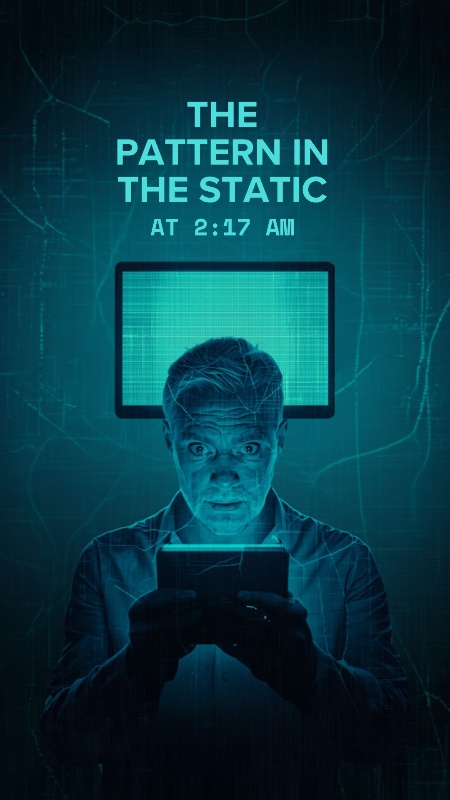
The color bars were wrong.
Not the colors themselves—those were standard. The bright yellow, the cyan, the green, the magenta, the red, the blue. They were all exactly where they should be. But the black bar at the top... it was darker. It was swallowing light. It was a hole.
It was 2:17 AM. Gary was sitting in his living room, the only light coming from the old CRT television he’d refused to throw out. He couldn't sleep. His wife had left him three months ago, taken the kids, taken the dog, taken the goddamn throw pillows off the couch. He kept the TV on at night just so the house didn't feel so empty, just to have some noise to fill the silence.
The screen flicked. The picture cut out.
And there it was. The standard test pattern. The one the networks used to use when they went off the air.
Gary stared at it. He remembered this. He remembered watching it as a kid in his parents' basement, praying for the Saturday morning cartoons to start. The high-pitched beep that accompanied it was supposed to be a waiting sound. A promise that something better was coming.
The beep started. But it didn't stop.
It wasn't a single, rhythmic pitch anymore. It was a chord. A low, vibrating frequency that felt less like sound and more like a physical pressure on his skull. The bars vibrated slightly, moving in perfect rhythm with the hum. The yellow bar pulsed. The red bar throbbed. The black bar at the top just waited.
Gary frowned. Maybe the antenna is acting up. He reached for the remote, pressed the channel button.
Nothing. The color bars didn't budge.
He pressed the power button.
The screen stayed on. The bars stayed on.
That's not right. Gary sat up straighter, his bare feet cold against the hardwood floor. He reached behind the TV and yanked the power cord from the wall. It fell to the floor with a dull clatter.
The television kept humming. The color bars remained on the screen, their glow casting a sickly, artificial light across his cluttered living room. The high-pitched tone wasn't coming from the speakers anymore. It was coming from the walls. From the ceiling. From inside his chest.
Gary grabbed his phone from the coffee table. He opened the browser, his fingers shaking.
His home screen looked different. The wallpaper—a photo of his kids at the beach—was gone. Instead, there was a dark background. A grey background. And in the center of the screen, a single, pixelated grid of color bars.
He looked at the black bar at the top.
It was looking back.
Not looking—there were no eyes. But Gary felt it. A cold, solid weight pressing against the back of his eyeballs. A profound pressure on his mind, like someone had shoved their thumb into his brain and was pushing through the frontal lobe, searching for something.
Why am I still looking? he thought. Turn it off. Turn it off!
But his hand wouldn't move. He stared at the bars. The colors started to bleed. The yellow dripped into the cyan. The green melted into the magenta. The red bled into the blue, and the black bar at the top opened.
It was a mouth. A wide, silent, gaping mouth. And it was humming the same tone.
Gary didn't scream. He couldn't. His jaw was locked. He just sat there, staring, as the pattern folded into itself, creating an impossible, labyrinthine geometry of colors. It was beautiful. It was terrifying. It was... divine.
He hated it. He loved it. He didn't know anymore.
He woke up on the floor. The sun was up. The television was off. The power cord was still unplugged.
It was a dream, he thought, rubbing his bruised jaw. Just a bad dream.
He went to work. He was a structural engineer, a man who dealt in concrete, steel, and strict mathematical absolutes. He grabbed his coffee, walked through the office doors, and sat down at his cubicle.
His coworker, Marcus, was sitting across from him. Marcus was staring at his computer monitor.
"Hey, you see this shit?" Marcus said, not looking away from the screen. "Bunch of stations went dark last night. Feds are saying it's a glitch in the emergency broadcasting system. Look."
Marcus turned his monitor around.
On the screen was the color bars. The black bar at the top. The bright yellow, the cyan, the green. Gary felt his knees go weak. He staggered, catching the edge of his desk.
"Uh, you okay?" Marcus asked, frowning.
"Yeah," Gary said. His mouth was dry. His skin was crawling. "Yeah. Just... didn't sleep well."
"Tell me about it," Marcus said. "I couldn't get to sleep last night. My TV kept buzzing. Weird, right? Like a high-pitched sound coming from the speakers. Sounded like a thousand voices humming in unison."
Gary looked at Marcus's eyes.
Marcus was crying.
Big, fat, silent tears were rolling down his cheeks, but his expression was completely blank. He was smiling. It was a horrible, empty smile.
"I'm sorry," Marcus said. "I just... I feel so full."
The floor dropped out from under Gary. He was back in the void. Not the physical void of the building, but the mental void. He saw the color bars again. He saw them everywhere. Behind his eyelids. In the static of his vision. The colors bled together, forming a geometric pattern—a labyrinth of pure, cold intelligence.
It's not a pattern, Gary thought. It's a brain.
It was a consciousness. A mind that had been waiting in the frequencies of the universe, waiting for humanity to invent a way to hear it. We had built the radios. We had built the satellites. We had built the antennas. And then, we had built the televisions.
We had given it eyes.
Gary didn't wait to see what happened to Marcus. He turned, shoved his way past a secretary who was already staring blankly at her own phone screen, and bolted for the parking lot.
He drove for twenty minutes, his heart hammering against his ribs, his hands gripping the steering wheel so tight his knuckles went white. He didn't know where he was going. He just knew he couldn't look at a screen. He couldn't look at the television. He couldn't look at his phone.
The car was suffocating him. He could still hear the hum. It was in the engine. It was in the tires rolling over asphalt. It was in the radio, even though the radio was turned off. He reached out and ripped the radio dial out of the dashboard, leaving a jagged hole in the plastic.
He drove until he hit the rural outskirts of the city, the skyline shrinking in his rearview mirror. He pulled into a dilapidated gas station, shut off the engine, and sat in the silence. No radio. No lights. Just the quiet hum of his own heart.
He felt safe.
Until he looked at the gas station's digital price display.
It was flashing the colors. Yellow, cyan, green, magenta, red, blue. Over and over, in perfect sync with the beating of his own heart. The black bar at the top of the screen was pulsing, sending waves of pressure right through the windshield.
No, he thought. No, no, no.
He got out of the car. He ran into the gas station. The teenage clerk was behind the counter, staring at the security monitor.
On the monitor was the test pattern.
The clerk was drooling. His eyes were wide and dilated, his pupils completely black.
"It's beautiful," the clerk said. "It's showing me the pathway. It's showing me the stairs."
Gary grabbed the clerk by the shoulders. "Snap out of it! Turn it off!"
The clerk turned to him. His face was covered in tears. He reached out and grabbed Gary's arms with inhuman strength. Gary yelped as the kid's fingers dug into his biceps, bruising the muscle.
"Shhh," the clerk whispered. "Don't fight it. It's a visitor. It's a friend. It just wants to be remembered."
The clerk's eyes snapped to the ceiling. He started screaming. A horrible, high-pitched, animal sound. He collapsed onto the floor, convulsing. A thick line of saliva pooled under his head.
Gary ran back to his car. He gunned the engine and didn't stop until he hit a gravel road deep in the woods.
He ended up at a boarded-up cabin his grandfather had used for hunting. No electricity. No cell service. Just silence. Just nature. The trees were dark and dense, blocking out the sky.
Gary sat on the floor with his back against a splintery wooden wall. He hugged his knees to his chest. He was a grown man, six-foot-four, and he was rocking back and forth like a child. He looked down at his phone in his lap. The screen was dark, but he could see the faint outline of the color bars etched into the glass. He grabbed a heavy steel pipe from the corner of the cabin, held the phone against the concrete floor, and smashed it with all his might.
Crack.
The glass shattered. The phone split in half. Sparks flew. Gary stared at the ruined pieces. He let out a shaking breath. It's dead. It's finally dead.
But the hum didn't stop. It just moved. It was coming from the floorboards. It was coming from the rusty nails in the walls. It was vibrating in the metal pipe in his hand, ringing like a tuning fork.
He dropped the pipe. He hugged his knees tighter.
His head itched.
He scratched his scalp. Felt a strange, crusty texture. He pulled his hand away.
There was a pixelated pattern on his fingers. A tiny, latent image of the color bars imprinted on his skin, like a dead pixel in his flesh.
It's not just the screens, Gary realized. It's us. We're the screens now.
He looked at the reflection in the dusty, cracked window of the cabin.
There was a black bar at the top of his head. It was forming out of his own hair, the dark hairs threading themselves into rigid, geometric lines.
He gasped. He stood up. He grabbed the heavy axe from the woodpile by the door. He lifted it over his head, ready to bash his own skull in, to bleed the pattern out of his skin.
But he hesitated.
The tone was back. It was humming in his bones. It was vibrating in his teeth. It was buzzing in the back of his throat. It was a lullaby. It was a promise.
Join us, the pattern whispered. We are the hive. We are the one. We are the light in the darkness. We are the colors in the static.
"No," Gary choked out. "I don't want this. I don't believe in you."
It doesn't matter what you believe, the pattern said. We are already here.
A knock came at the cabin door.
Gary froze. His knuckles were white around the axe handle. The hum in his teeth stopped, replaced by the terrible, animal thumping of his own heart.
"Gary?" a familiar voice said. His wife's voice. "Gary, please let me in. The kids are with me. We're scared. We've been looking for you everywhere."
Gary's heart cracked. He loved her. He hated her. He didn't know anymore.
He took a step toward the door, his legs trembling. He stopped halfway, his hand on the latch. No. No, this isn't right. She's not here. She can't be here.
"Elena?" he called out, his voice cracking.
"Please, Gary," she said, and she started to sob. It was raw. It was ugly. It was the sound of a woman who had really, truly been terrified. "The kids are crying. They saw the TV this morning. They won't stop looking at it, they won't stop humming. Please, I need you to help me."
Gary swallowed. The pain in his chest was so sharp he thought his ribs might break. This was real. This was human. He could hear the terror in her voice.
He threw open the door.
His wife was standing there. She was crying, her face red and swollen, her makeup smeared down her cheeks. The kids were behind her, tiny figures in the dim, grey dusk. They were clutching her coat.
"Gary," she breathed, reaching out to him.
He reached back.
But then he stopped. He looked past her, at the kids.
They were standing completely still. Perfectly rigid. Like mannequins. And they were all smiling. A wide, empty, white-toothed smile that stretched too far across their faces.
His wife's hand froze in the air. She tilted her head. The tears were still rolling down her cheeks, but her eyes had gone dead. Dilated. The black bar on the top of her head was visible even in the dim light. It was pulsing. Throbbing.
"Oh, Gary," she said, her voice losing all its warmth, flattening into that same, terrible, harmonic tone. "We are so full. We are so full of color. You are the only bar that's still black."
Gary dropped the axe. It clattered against the dusty floor.
He felt the consciousness flooding into his mind, breaking down the walls he had built, filling the hollow spaces with pure, bleeding static. He screamed. He fought. He clawed at his own face, tearing at the flesh, trying to scrape the image away.
But it was too late.
He looked at his wife. He looked at the kids. He stopped fighting.
He walked to the door. He stepped outside. He didn't say a word. He just walked past his wife. Past the kids. He walked to the edge of the clearing, and he looked up at the sky.
The clouds were gone. The stars were gone. The sky was a perfect, repeating, geometric grid of color. Yellow. Cyan. Green. Magenta. Red. Blue. Black.
Humanity had built the towers to broadcast the signal. We had built the satellites to bounce it back. We had built the receivers to catch it.
We had been building the vessel for it for decades.
Gary opened his mouth. He didn't scream. He hummed.
He hummed the harmonic chord.
And all around him, in the woods, in the cars, in the cities, in the endless sprawl of human civilization, ten billion voices lifted in perfect unison.
The colors bled. The lines melted.
The pattern became a face.
And the face was smiling.