
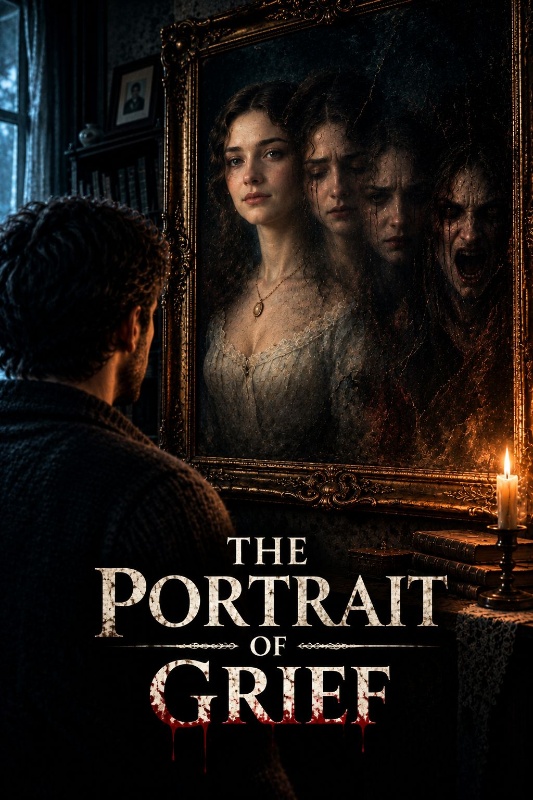
Some paintings preserve the faces of the dead. Others preserve the things the living refuse to remember.
The first time Daniel noticed his dead wife smiling, he was standing in the hallway at three seventeen in the morning, holding a glass of water he had forgotten to drink.
The house was silent. Rain whispered against the windows, and the old grandfather clock at the foot of the stairs had stopped again. Daniel had been awake for hours, listening to the familiar sounds of an empty home: the groan of timber, the hiss of wind beneath the doors, the occasional click of pipes cooling inside the walls.
Then he looked at the portrait.
It hung above the fireplace in the drawing room, its heavy gilt frame catching the faint light from the hallway. Eleanor had been dead for eleven months, and the painting was the last thing in the house that still seemed to belong entirely to her.
She had commissioned it the previous spring, insisting that the artist capture her exactly as she was-not younger, not prettier, not softened by the flattery painters offered their subjects.
“I want him to paint the woman you married,” she had told Daniel, laughing as she tucked a strand of auburn hair behind her ear. “Not the woman you wish you had married.”
The finished portrait showed her sitting beside an open window, dressed in her favorite blue silk gown. Her hands rested in her lap. Her wedding ring gleamed on her left hand. Beyond her shoulder, a pale garden dissolved into shadows.
And her expression was peaceful.
Not quite a smile, but something close to one. The quiet, private expression she wore when Daniel read aloud beside her bed, when they walked together through the garden, when she believed that the worst things in life happened to other people.
That night, however, the corners of her painted mouth had lifted.
Not by much. Barely enough to notice.
But Daniel had spent seventeen years learning every detail of that face. He knew the tiny crease beside her left eye, the slight asymmetry of her lips, the faint scar near her chin from a childhood fall. He knew the difference between her genuine smile and the polite one she wore for strangers.
This was a genuine smile.
He set down his glass.
“Eleanor?”
The name escaped him before he could stop it.
The room offered no answer.
He approached the portrait and examined it beneath the lamp. The paint was intact. There were no cracks, no smudges, no evidence that anyone had touched the canvas. The artist's signature remained in the bottom-right corner, written in dark, confident strokes.
Nothing had changed.
Nothing except her expression.
Daniel told himself that grief did strange things to the mind. He had been sleeping badly. He drank too much coffee, ate irregularly, and sometimes woke believing he had heard Eleanor calling from another room.
He had even caught himself setting two cups on the breakfast table.
A smile in a painting was nothing.
He turned off the lamp and went upstairs.
For the first time in eleven months, he dreamed of his wife.
She stood at the foot of their bed, wearing the blue gown from the portrait. Her hair hung wet against her cheeks. She looked at him with the same small smile.
Then she opened her mouth.
“Why did you leave me there?”
Daniel woke with a cry.
The clock on his bedside table read 3:17.
And from somewhere downstairs came the unmistakable sound of a woman weeping.
Chapter One: The First Change
By morning, Daniel had convinced himself that the crying had come from the wind.
He made coffee, opened the curtains, and walked into the drawing room with the deliberate calm of a man determined not to be frightened by his own imagination.
The portrait was unchanged.
Eleanor sat beside the painted window, her hands folded, her expression serene. Morning light fell across her face, revealing the subtle brushstrokes around her eyes.
Daniel stood before it for a long time.
Then he noticed the flowers.
In the painting, a small glass vase sat on the windowsill behind Eleanor. The artist had filled it with white roses, their petals just beginning to open. Daniel remembered them because Eleanor had complained that the artist made them look too perfect.
Now every rose in the vase had wilted.
Their heads drooped over the rim, and their petals had turned the color of old bruises.
He fetched a chair and climbed up to examine the canvas. The flowers had been painted with the same meticulous care as the rest of the portrait. He could see individual petals, delicate veins, even a tiny drop of water on one stem.
He touched the canvas.
The paint beneath his fingertip was cold.
Not cool, as paint might feel in a chilly room.
Cold as a stone pulled from the bottom of a river.
He withdrew his hand.
A small sound came from behind him.
A soft, almost affectionate sigh.
Daniel spun around.
The drawing room was empty.
That afternoon, he called the portrait's artist.
Arthur Bell had painted Eleanor over six weeks, visiting the house every few days and working in the drawing room while Daniel attended to his business in town. He was a thin, meticulous man who spoke about painting as if it were a form of surgery.
Daniel found his number in an old notebook.
“Mr. Bell, it's Daniel Vale. You painted my wife last year.”
“I remember,” Bell said. His voice was cautious. “I'm very sorry for your loss.”
“Thank you. I need to ask you something about the portrait.”
There was a pause.
“Has something happened to it?”
The question unsettled Daniel.
“What do you mean?”
“Nothing. I only wondered whether the frame had been damaged during the funeral preparations.”
“No. The frame is fine. It's the painting itself.”
Another pause.
Daniel gripped the telephone.
“Mr. Bell, did you ever alter the expression after you finished the portrait?”
“No.”
“Did you make any changes to it afterward? Perhaps when you delivered it?”
“Absolutely not. Why are you asking?”
Daniel looked toward the drawing room doorway.
“Her expression seems different.”
Silence.
Then Bell spoke, so quietly that Daniel almost missed the words.
“Different how?”
“She's smiling.”
The line went dead.
Daniel stared at the telephone.
He called back twice. Both times, Bell let it ring unanswered.
The following morning, Daniel drove to the artist's studio on the other side of town. He found a narrow brick building wedged between a tailor's shop and a shuttered bakery. The sign above the entrance had been removed, leaving a pale rectangle on the brickwork.
The door was unlocked.
Inside, dust covered the furniture. Canvases leaned against the walls, most of them unfinished. A small stove sat cold in the corner, and a cup of tea had dried into a brown ring on a worktable.
“Mr. Bell?”
No answer.
Daniel moved through the studio, calling again. At the back was a locked room with a narrow glass panel in the door. Through it, he could see shelves crowded with old paintings.
Something on the nearest shelf caught his eye.
A small portrait of Eleanor.
Not the finished painting that hung above his fireplace. This one showed her at a different angle, her face turned slightly toward the viewer. Her expression was solemn, almost mournful.
The canvas was covered in a fine layer of dust.
Daniel tried the door. It opened.
He stepped inside.
The room smelled of turpentine and damp wood. He found a worktable beneath a hanging bulb, scattered with brushes, scraps of canvas, and sheets of paper covered in Bell's handwriting.
Most of the notes concerned color, light, and composition.
Then he found a page with Eleanor's name at the top.
Mrs. Vale - preliminary sitting.
Below it, in smaller writing:
Remarkable difficulty maintaining the expression. Subject repeatedly returns to an expression of distress when asked to relax. Husband attributes this to fatigue.
Daniel read the sentence twice.
He turned the page.
Subject insists that I paint her as she appears when alone.
And beneath that, written in darker ink:
She says her husband does not know her.
Daniel felt a chill move through him.
He remembered Eleanor's sittings. She had complained that the studio was cold, that Bell asked strange questions, that he wanted her to think of memories while he painted.
He had assumed the artist was simply eccentric.
Another sheet had been folded in half and tucked beneath a jar of brushes.
It contained only three lines.
The first time I painted her smile, she wept.
The second time, she begged me to stop.
The third time, she told me what he had done.
Daniel dropped the paper.
For a moment, the room seemed to tilt around him.
He heard a door slam somewhere in the studio.
Then came footsteps.
Slow, uneven footsteps approaching the locked room.
Daniel backed toward the door.
“Mr. Bell?”
A shadow passed behind the glass.
The footsteps stopped.
Daniel waited, barely breathing.
Then a voice spoke from the other side.
“Don't take it home.”
Daniel yanked the door open.
The corridor was empty.
He ran out of the studio and did not stop until he reached his car.
He never saw Arthur Bell again.
Three days later, a police officer called to inform him that the artist had been found dead in his apartment. The cause appeared to be heart failure. There was no sign of forced entry, no evidence of a struggle, and no note.
Daniel thanked the officer and hung up.
Then he went into the drawing room.
The portrait was waiting for him.
Eleanor's smile was gone.
Her lips were pressed together. Her eyes were no longer peaceful. The corners of her mouth had drawn downward, and the skin beneath her eyes seemed darker, as if she had not slept for weeks.
She looked sad.
Not the gentle sadness of someone remembering a lost love.
The exhausted, unbearable sadness of someone who had been crying for a very long time.
That night, Daniel dreamed of the hospital.
He saw Eleanor lying beneath white sheets, her face pale and her breathing shallow. Machines clicked beside her bed. A nurse stood near the door, speaking to someone Daniel could not see.
Eleanor turned her head toward him.
“Please,” she whispered.
He tried to reach her, but his legs would not move.
“Daniel, please don't leave me alone.”
He woke before dawn, his pillow damp with sweat.
For the first time since her death, he remembered something he had spent eleven months trying not to remember.
The last time Eleanor had called his name.
Not in a dream.
In the hospital.
Chapter Two: The Woman in the Window
The memory returned in fragments.
Rain on the hospital windows.
A nurse asking him to stay.
Eleanor's hand reaching toward him beneath the blanket.
His own voice, impatient and exhausted, telling her that he would be back in the morning.
He remembered walking down the corridor.
He remembered the elevator doors closing.
And he remembered the telephone ringing in his car twenty minutes later.
He had not answered it.
When he finally listened to the voicemail, Eleanor was already gone.
Daniel sat at his kitchen table until the sun rose, staring at the untouched coffee in front of him.
He had told everyone that he had been with her until the end. It was easier that way. Her sister had been too devastated to question him. The doctors had been sympathetic. The funeral had been quiet.
No one had known he had left.
No one had known that Eleanor had been frightened of dying alone.
And no one had known that he had been angry with her.
They had argued the evening before her final hospitalization. Eleanor had discovered that Daniel had sold the little cottage they had planned to retire in, without telling her. The sale had been legal; the property was in his name. He had used the money to cover debts from a failed investment, convinced that he could replace it before she ever found out.
But she had found the documents.
She had looked at him as though he were a stranger.
“You didn't just sell the cottage,” she had said. “You sold the life we were supposed to have.”
He had accused her of being dramatic. She had called him selfish. The argument had ended with Eleanor locking herself in the bedroom, coughing so hard that he could hear her through the door.
Her illness had already weakened her lungs. The doctors had warned them that stress and exhaustion could make her condition worse.
Daniel had apologized the next morning.
She had accepted.
But something between them had broken, and neither of them had known how to mend it.
Now he stood in front of the portrait, remembering the woman he had loved and the woman he had failed.
“I'm sorry,” he whispered.
The painting did not change.
He spent the day searching the house for photographs of Eleanor. There were hundreds: wedding pictures, holidays by the sea, birthdays, ordinary mornings in the garden. He arranged them on the dining table and studied her expressions.
He found her laughing in nearly every photograph.
But in one picture, taken the winter before her death, she stood beside him beneath the bare branches of an apple tree. Daniel was smiling at the camera. Eleanor was looking at him.
She was not smiling.
He had never noticed that before.
He turned the photograph over.
On the back, in Eleanor's handwriting, were the words:
I wonder when he stopped seeing me.
Daniel sat down.
The house seemed impossibly quiet.
Then, from the drawing room, came the sound of a frame creaking against the wall.
He hurried to the portrait.
Eleanor's expression had changed again.
The sadness remained, but her eyes were different. They seemed to have shifted slightly toward the painted window behind her.
Daniel followed her gaze.
Beyond the window, the garden was no longer bright and green.
It was winter.
Bare trees stretched toward a colorless sky. The path was covered in dead leaves, and the rose bushes had become tangled masses of black stems. At the far end of the garden stood the old summerhouse, its door hanging open.
Daniel knew the summerhouse.
He and Eleanor had built it together when they were young. She had used it as a reading room, filling the shelves with novels and keeping a small electric heater beneath the desk. After she became ill, she had stopped going there because the cold aggravated her breathing.
The summerhouse had been demolished six months after her funeral.
Yet there it was, inside the painting, exactly as it had looked on the last day Eleanor had visited it.
Daniel leaned closer.
Something pale stood in the doorway.
A woman.
Her face was obscured by darkness, but one hand rested on the doorframe.
Daniel stepped back.
The figure raised its head.
Even from across the room, he recognized the blue gown.
His knees weakened.
He turned away, stumbled into the hall, and vomited into the sink.
When he returned, the painting showed only the empty summerhouse.
That evening, Daniel called Eleanor's younger sister, Margaret.
They had barely spoken since the funeral. Margaret had blamed him for keeping Eleanor's illness private for too long, while Daniel had resented her constant questions about the final hours.
He nearly hung up when she answered.
“Daniel?”
“I need to ask you something about Eleanor.”
“After all this time?”
“I know. I'm sorry.”
There was a long silence.
Then Margaret said, “What do you want to know?”
“Did Eleanor ever tell you she was frightened of me?”
The silence that followed was different.
“Yes,” Margaret said.
Daniel closed his eyes.
“When?”
“Not frightened that you would hurt her physically. She never said that. She said you had become a stranger to her. That you listened to her words but never heard what she was trying to tell you.”
He sank into a chair.
“Why didn't you tell me?”
“Because she asked me not to. She loved you, Daniel. Even when she was unhappy, she loved you. She kept hoping you would notice.”
Margaret's voice broke.
“Do you know what she asked me to do the night she went into the hospital?”
Daniel could barely speak.
“What?”
“She asked me to make sure you stayed with her. She was terrified of being alone. She said she didn't want to die with the sound of machines in her ears and no one holding her hand.”
Daniel pressed his fist against his mouth.
“Did she say anything else?”
“Yes.”
“What?”
Margaret took a shaky breath.
“She said that if you ever told people you had been there at the end, I should let you. Because she didn't want them to think you were a terrible husband.”
The telephone slipped in Daniel's hand.
For eleven months, he had told the world a lie.
Now he understood that Eleanor had protected him with her final act of love.
And he had mistaken her silence for forgiveness.
When he hung up, the house was dark.
He went to the drawing room.
The portrait had changed once more.
Eleanor was crying.
Two thin trails of tears glistened on her cheeks, painted so delicately that they seemed to catch the light. Her mouth trembled, and her eyes held a sorrow so profound that Daniel found himself reaching toward her as though she were standing on the other side of a window.
“I'm sorry,” he said again.
The tears remained.
He sank to his knees.
“I should have stayed.”
For a long time, nothing happened.
Then Eleanor's painted lips parted.
A thin, broken whisper drifted from the canvas.
“You should have.”
Daniel screamed and scrambled backward.
The portrait's eyes followed him.
And from somewhere inside the walls came the sound of a hospital monitor, its steady beeping growing faster and faster until it became a continuous, piercing tone.
Then silence.
When Daniel looked again, Eleanor's mouth was closed.
But the tears were still there.
Chapter Three: What the Dead Remember
Daniel did not sleep that night.
He sat in the kitchen with every light in the house switched on, listening to the rain. At dawn, he packed a bag and drove to a hotel across town.
He told himself that distance would help. A painting was an object. Whatever he had seen or heard could be explained by exhaustion, guilt, or the suggestive power of memory.
He repeated these arguments until they sounded almost convincing.
For two nights, he slept.
On the third night, he dreamed of Eleanor again.
This time, he was standing in the drawing room. The portrait hung above the fireplace, but the woman inside it was no longer sitting beside the window.
She was standing.
Her blue gown fell around her ankles. Her hair hung loose over her shoulders, and her face was hidden in shadow.
“Eleanor?”
She lifted her head.
Her eyes were red from crying.
“Come home,” she said.
Daniel woke in a cold sweat.
His telephone was ringing.
It was Margaret.
“Daniel, I've been thinking about what you asked me,” she said. “There's something I should have told you years ago.”
He sat on the edge of the hotel bed.
“What is it?”
“Eleanor kept a journal when she was ill. She gave it to me before she went into the hospital. She told me not to let you read it unless you ever asked me whether she was afraid of you.”
Daniel gripped the telephone.
“Why didn't you tell me before?”
“Because I didn't think you would ever ask.”
Margaret had kept the journal in a box with Eleanor's letters and a few pieces of jewelry. She offered to bring it to him, but Daniel insisted on collecting it himself.
When he arrived at her house, she looked at him for a long time before letting him in.
“You need to understand something,” she said as she handed him the small leather-bound book. “Eleanor didn't hate you. Even at the end, she didn't hate you.”
Daniel looked down at the journal.
“I wish she had.”
Margaret's expression softened.
“Don't say that. Hatred would have been easier for her. She was grieving the man she remembered you being while you were still standing right beside her.”
He left without answering.
Back at the hotel, he opened the journal.
Most of the entries were ordinary. Eleanor wrote about the weather, the books she had read, the flowers she wanted to plant when spring arrived. She recorded her medical appointments and the names of medicines she disliked. Sometimes she wrote about Daniel, remembering their early years together with a tenderness that made his chest ache.
Then, near the end, the entries became shorter.
March 4. Daniel says he will take me to the sea when the weather improves. I hope he remembers.
March 12. The cottage is gone. I keep thinking about the little kitchen and the mornings when we ate breakfast with the windows open. I don't know why something can be yours for twenty years and disappear in a single afternoon.
March 18. Daniel apologized. I believe he means it. I wish he understood that forgiveness is not the same as forgetting.
Daniel turned the page.
The next entry was dated three days before Eleanor's final hospitalization.
I dreamed about the painting again.
He frowned.
He read on.
The woman in it was crying. I asked her why, but she wouldn't answer. When I woke, I remembered the expression on her face. It was the face I used to make when Daniel promised me something and I knew he would forget.
A few pages later:
Arthur says he has never seen a portrait change after it is finished. He says the expression is fixed in the paint. But he looked frightened today. I think he knows something he doesn't want to tell me.
Daniel turned another page.
I asked him whether he had ever painted someone who was dead.
He said no.
I asked whether a painting could hold a person's grief.
He told me that painters put everything they understand into a face, and sometimes things they do not understand as well.
The next entry had been written in shaky handwriting.
I saw the woman in the window again. She looked like me, but older. She was standing in the summerhouse, looking toward the house. I think she was waiting for someone.
Daniel read the words again.
Then he reached the final entry.
It was dated the night before Eleanor was admitted to the hospital.
I asked Daniel to stay with me tonight. He said he was tired.
I wanted to tell him that I am afraid. Not of dying, exactly. I am afraid of disappearing while I am still here. I am afraid that one day he will remember only the woman who argued with him, the woman who was sick, the woman who needed too much.
I want him to remember the girl who married him.
I want him to remember that I loved him before we had anything, when all we owned was a secondhand sofa and two chipped cups.
I want him to remember that I would have stayed with him through anything.
Sometimes I wonder whether he would have done the same for me.
At the bottom of the page, Eleanor had written one final sentence.
If I die before he learns to see me, I hope someone will.
Daniel closed the journal.
He sat motionless for several minutes, listening to the hum of the hotel's air conditioner.
Then he understood something that frightened him more than the changing portrait.
Eleanor had not been asking him to save her from death.
She had been asking him to see her while she was alive.
And he had failed.
He returned home that afternoon.
He did not know what he expected to find. Perhaps the painting would have returned to its original state. Perhaps he would discover that the entire experience had been a manifestation of grief, made worse by the journal.
But when he entered the drawing room, he stopped so abruptly that his bag slipped from his hand.
The portrait was no longer the same painting.
Eleanor stood beside the painted window, her body turned slightly away from the viewer. The blue gown was dark, almost black. Her hair hung across one side of her face.
And her expression-
Her expression was furious.
Her brows were drawn together. Her jaw was clenched, and her lips had pulled back in a way Daniel had never seen in life.
The eyes were the worst.
They burned with a rage that seemed to extend beyond the canvas.
Daniel could hardly breathe.
A new detail had appeared in the painting.
In the lower corner, near Eleanor's feet, stood a small black telephone.
Its receiver lay beside it.
Daniel recognized it immediately.
It was the telephone from their old bedroom, the one he had left beside Eleanor's hospital bed when he walked out that night.
He took a step backward.
The portrait's mouth opened.
“You left me.”
The voice was no longer a whisper.
It filled the room, deep and ragged, carrying the weight of eleven months of silence.
Daniel covered his ears.
“I know!”
“You heard me.”
“I know!”
“You heard me calling.”
Daniel fell against the wall.
“Yes!”
The word tore from him.
“Yes, I heard you. I heard you, and I left.”
The house shuddered.
The windows rattled in their frames. The grandfather clock began to strike, though it was not the hour. Every photograph on the mantelpiece toppled face down.
Daniel slid to the floor, sobbing.
“I was angry,” he said. “I was ashamed. I thought there would be another morning. I thought I could come back and make everything right.”
The fury in Eleanor's face deepened.
“But you didn't.”
“No.”
“You promised.”
“Yes.”
“You promised you would never leave me alone.”
Daniel looked up at the painting.
He remembered saying those words on their wedding night, when Eleanor had laughed at the thunder and confessed that she was afraid of storms.
He remembered saying them again when she underwent her first operation, holding her hand beneath the hospital blankets.
He remembered all the promises he had made carelessly, believing that love meant he would always have another chance to keep them.
“I know,” he whispered.
Eleanor leaned forward within the painting.
For one terrible moment, Daniel thought she was going to climb out of it.
Instead, she raised one trembling hand and pressed it against the inside of the canvas.
The sound of her palm striking the painted surface was unmistakably real.
“Then why,” she screamed, “did you make me believe you would stay?”
The room plunged into darkness.
And somewhere upstairs, a bedroom door slammed.
Chapter Four: The Room That Wasn't There
Daniel did not remember getting upstairs.
One moment he was on the drawing room floor, surrounded by darkness. The next, he was standing in the corridor outside the bedroom he had shared with Eleanor.
The door was open.
He could hear the hospital monitor again.
Beep.
Beep.
Beep.
The sound came from inside the room.
Daniel stepped across the threshold.
The bedroom had changed.
The wallpaper was gone, replaced by pale hospital curtains. Their bed had disappeared. In its place stood a narrow hospital bed with metal rails, a white sheet, and a machine beside it.
Eleanor lay beneath the sheet.
Her face was turned toward the door.
Daniel gripped the frame.
“No.”
She was wearing the blue gown, the same one she had worn in the portrait. Her skin was translucent, her lips pale. A clear tube ran beneath her nose.
He knew this room.
Not the bedroom.
The hospital room.
He recognized the clock on the wall, the vase of flowers Margaret had brought, and the little table where he had left his keys.
He took a step toward the bed.
“Eleanor?”
Her eyes opened.
“Daniel?”
He approached her slowly, terrified that she would vanish if he moved too quickly.
“I'm here.”
She tried to smile, but the effort exhausted her.
“You came back.”
He reached for her hand.
It was warm.
He dropped to his knees beside the bed and held it between both of his.
“I'm sorry,” he whispered. “I'm so sorry.”
Eleanor studied his face.
“Are you staying?”
Daniel's throat tightened.
“Yes.”
“Until morning?”
“Until morning.”
“And if I need you before then?”
He pressed her hand against his cheek.
“I'll be here.”
She closed her eyes.
The monitor continued its steady rhythm.
For a while, Daniel sat beside her, holding her hand. He wanted to tell her everything: that he had been a fool, that the cottage did not matter, that the money did not matter, that all the things he had thought were important had become meaningless without her.
But the words seemed too small.
So he stayed silent.
He listened to her breathing.
He watched the light move across the wall.
He held her hand.
Then the monitor began to beep faster.
Eleanor opened her eyes.
“Daniel?”
“I'm here.”
“Don't go.”
“I won't.”
Her fingers tightened around his.
“Please.”
“I won't leave you.”
The monitor's rhythm became uneven.
Daniel rose, shouting for a nurse, but the door opened onto the empty drawing room. Beyond it, the portrait hung above the fireplace.
Eleanor's painted face was twisted with fury.
He turned back toward the bed.
The room was gone.
He stood alone in the corridor.
The bedroom door slammed shut behind him.
Daniel threw himself against it, pounding with both fists.
“Eleanor!”
The door would not open.
“Please!”
From the other side came the sound of her crying.
He sank to the floor.
Then, beneath the crying, he heard something else.
A telephone ringing.
One ring.
Two.
Three.
He knew what it was.
He knew what he would hear if he answered.
He had heard it before, in his car, eleven months ago.
He had listened to the message hundreds of times afterward, but never all the way through. He always stopped when Eleanor's voice became too weak to understand.
Now the voice came through the door, clear as if she were standing beside him.
“Daniel, it's me. The nurse says I should call you. I know you're tired, and I'm sorry to keep asking, but I don't want to be alone tonight.”
A pause.
Then a breath.
“I'm frightened.”
Daniel covered his mouth.
“I love you,” Eleanor said. “Whatever happens, I want you to know that.”
Another pause.
“And Daniel?”
“Yes,” he whispered.
“Please don't let me become a stranger to you.”
The telephone stopped ringing.
Daniel remained on the floor until the silence became unbearable.
When he finally stood, he saw that the bedroom door had disappeared.
In its place was a narrow staircase leading down into darkness.
At the bottom, a pale rectangle of light revealed the drawing room.
And the portrait.
Daniel descended.
The room was exactly as it had been before, except for one thing.
The portrait's frame stood open, as though the canvas had become a doorway.
Beyond it lay the painted garden.
The winter trees stretched into a gray sky. The path led toward the summerhouse, its door standing wide open.
Eleanor was nowhere to be seen.
Daniel understood, with a certainty that chilled him, that the painting was offering him a choice.
He could turn away.
He could leave the house, burn the portrait, and spend the rest of his life telling himself that grief had made him see things that could not possibly be real.
Or he could step through.
He could follow the woman he had loved into the place where she had been waiting.
Daniel approached the frame.
The air beyond it smelled of wet earth and dying roses.
He placed one foot on the painted path.
The canvas rippled beneath him like water.
And he stepped inside.
Chapter Five: The Last Sitting
The garden was colder than Daniel remembered.
Frost covered the grass. The branches of the apple trees scraped against one another overhead, though there was no wind. Every flowerbed had been reduced to a tangle of dead stems, and the path beneath his feet was littered with fallen petals.
He walked toward the summerhouse.
With every step, the house behind him seemed to grow smaller. When he turned to look, he could no longer see the drawing room or the portrait hanging above the fireplace. There was only a pale rectangle in the distance, like a window looking into another world.
He kept walking.
The summerhouse door creaked as he pushed it open.
Inside, everything was exactly as it had been the last time Eleanor had used it. Her books lined the shelves. A knitted blanket lay across the old armchair. Beside the window stood the small desk where she used to write letters, make lists, and record the names of flowers she wanted to grow.
On the desk rested a white porcelain cup.
Daniel recognized it as one of the two chipped cups they had owned when they first married.
He approached it.
Inside was a small amount of cold tea.
Beside the cup lay a sheet of paper.
He unfolded it.
It was a letter written in Eleanor's handwriting.
My darling Daniel,
If you are reading this, then perhaps you have finally come looking for me.
I have imagined this moment many times. In some versions, you arrive with flowers. In others, you fall to your knees and beg me to forgive you. Sometimes you are young again, with dark hair and a ridiculous tie, and you ask me to dance in the kitchen.
In every version, I am happy to see you.
I wish I could tell you that I am not angry. I wish I could tell you that love makes every wound disappear. But I have been waiting here for a long time, and waiting has a way of changing a heart.
I loved you when you had nothing. I loved you when we were young, when we had more dreams than money. I loved you when you forgot our anniversary and when you burned dinner and when you fell asleep halfway through the films I chose.
I loved you when you were difficult to love.
And when I became difficult to love, I hoped you would remember that.
Daniel lowered the letter.
His tears fell onto the paper.
He read the next lines.
I was never asking you to be perfect. I was asking you to notice when I was lonely. To hear me when I said I was afraid. To remember that I was still the woman you loved, even when my body became weak and my days grew small.
I wanted you to sit beside me when the world became frightening.
I wanted you to hold my hand.
I wanted one more ordinary morning.
The final paragraph was written in a different ink, as though Eleanor had added it later.
If you have come here because you want me to forgive you, then you have come for the wrong reason.
You must forgive yourself, Daniel. Not because you deserve it, but because you cannot spend the rest of your life making a shrine out of one terrible night.
I am not the worst thing you ever did.
I am the woman who loved you.
Please remember both of us.
Daniel pressed the letter against his chest.
For the first time since Eleanor's death, he understood the difference between punishment and grief.
Punishment demanded that he suffer forever.
Grief asked him to remember.
A sound came from the doorway.
“Daniel?”
He turned.
Eleanor stood beneath the frame, dressed in her blue gown. Her hair was pinned behind her ears, and her face was pale, but she looked almost as she had in the last photograph taken before her illness.
She was neither smiling nor crying.
She simply looked tired.
“Eleanor.”
He took a step toward her.
She raised one hand.
“Please don't come any closer.”
He stopped.
“I've missed you,” he said.
“I know.”
“I don't know how to live without you.”
“You lived without me while I was still here.”
The words struck him harder than any scream.
He lowered his head.
“Yes.”
Eleanor looked toward the window.
“When Arthur painted me, he asked me to remember the happiest moment of my life. I thought of our wedding day. I thought of the first time you kissed me in the rain. I thought of the little cottage and the apple trees.”
She looked back at him.
“But the painting would not stay that way.”
“Why?”
“Because I kept remembering other things.”
She touched her chest.
“The things I never said. The things I said and you didn't hear. The mornings I waited for you. The nights I cried quietly because I didn't want you to feel guilty for being tired of my illness.”
Daniel could not meet her eyes.
“I'm sorry.”
“I know.”
“I should have been there.”
“Yes.”
“I should have stayed.”
“Yes.”
He looked up at her, desperate for some sign of forgiveness.
“Can you ever forgive me?”
Eleanor's expression softened, but the sadness remained.
“Daniel, I forgave you a long time ago.”
He stared at her.
“Then why are you still here?”
She looked toward the distant window.
“Because you never forgave yourself. You kept me here, in that house, in that painting, in the worst moment of your life. Every time you looked at me, you saw the woman you abandoned.”
She took a breath.
“And every time you remembered me, you made me die all over again.”
Daniel began to cry.
“I didn't know what else to do.”
“You could have remembered me laughing.”
He looked at her.
“You could have told the truth. You could have spoken to my sister. You could have planted the roses we talked about. You could have gone to the sea and watched the waves. You could have lived, Daniel.”
Her voice trembled.
“You could have let me be dead.”
The summerhouse grew very quiet.
Daniel looked at the woman before him. He wanted to reach for her, to hold her as he had held her through their happiest years. But he understood that this was not his wife returned to him.
This was his grief, given a face.
And grief could not be loved back into life.
“What happens now?” he asked.
Eleanor glanced toward the door.
“You go home.”
“And you?”
She smiled faintly.
“I think I've waited long enough.”
Daniel looked at the letter in his hands.
“Will I ever see you again?”
“Not like this.”
He swallowed.
“Will you remember me?”
Eleanor's eyes filled with tears.
“I never forgot you.”
For a moment, they stood together in the cold light, separated by all the words they had failed to say and all the days they could no longer share.
Then Eleanor stepped forward.
She kissed his forehead.
It felt like the touch of a cool breeze.
“Goodbye, my darling.”
Daniel closed his eyes.
When he opened them, she was gone.
The summerhouse door stood open.
Beyond it, the garden had begun to change.
The frost was melting. The branches of the apple trees held tiny green buds. Somewhere, far away, a bird began to sing.
Daniel folded the letter carefully and placed it in his pocket.
Then he walked toward the light.
Chapter Six: The Face in the Frame
Daniel woke on the drawing room floor.
Morning sunlight streamed through the windows. The grandfather clock was ticking. Somewhere in the kitchen, water dripped from a tap he had forgotten to close.
For several minutes, he lay still, trying to understand how he had returned.
The portrait hung above the fireplace.
Eleanor sat beside the painted window in her blue gown, her hands folded in her lap.
Her face was serene.
The tears were gone. The fury had disappeared. The garden behind her was green again, and the white roses in the vase had opened.
Daniel rose unsteadily.
He approached the portrait.
For a long time, he looked at her.
Then he noticed something that made him catch his breath.
The expression was not exactly the same as it had been when Arthur Bell first delivered the painting.
It was warmer.
There was a small smile at the corners of Eleanor's mouth, and her eyes seemed to hold a quiet tenderness. Not the impossible peace of someone who had never suffered, but the gentler expression of someone who had finally put down a heavy burden.
Daniel reached toward the frame.
The canvas was no longer cold.
He did not touch the painted face.
Instead, he placed his hand against the wooden frame and whispered, “Goodbye, Eleanor.”
Nothing happened.
And for the first time, he was grateful.
He took the portrait down that afternoon.
Not because he wanted to forget her, but because he could no longer bear the thought of leaving her alone in a room where he came only to mourn.
He wrapped the painting in a blanket and carried it upstairs, where he placed it in the spare bedroom.
Then he opened every window in the house.
He let the sunlight in.
He called Margaret and told her the truth about the hospital. He told her about the argument, the unanswered call, and the lie he had lived with ever since.
She cried.
He cried.
They spoke for hours about Eleanor, remembering things neither had mentioned in months: her terrible singing, her habit of reading the final page of a novel before beginning it, the way she talked to flowers as if they were old friends.
For the first time, they remembered a woman rather than a death.
In the weeks that followed, Daniel began to change the house.
He planted white roses in the garden. He repaired the summerhouse, though he knew Eleanor would never sit inside it again. He gave away the clothes she had left behind to a local charity, keeping only a few pieces that still carried the faintest trace of her perfume.
He also began writing.
At first, he wrote letters to Eleanor, telling her about his days and the things he wished he had said. Eventually, the letters became stories about their life together: the small apartment where they had first lived, the cottage they had lost, the years when their greatest problem was deciding what to cook for dinner.
He wrote about the woman who had loved him.
He wrote about the woman he had failed to see.
And he wrote about the man he had been, without pretending that grief excused his choices.
Some nights, he still woke at three seventeen.
Sometimes he thought he heard footsteps in the hallway or the faint sound of a woman laughing in the garden. When he went to look, there was nothing there.
He stopped being afraid.
He learned that memory could be painful without being a punishment, and that loving someone did not require him to spend the rest of his life standing beside their grave.
One year after Eleanor's death, Daniel visited the cemetery with a bundle of white roses.
He knelt beside her grave and placed the flowers on the stone.
“I finally understand,” he said.
The wind moved softly through the trees.
“I thought loving you meant never letting you go. I was wrong.”
He brushed a fallen leaf from the inscription.
“I'll remember you. All of you. Not just the way you died.”
He stayed until the afternoon light began to fade.
Then he went home.
That evening, he made dinner for one and ate it by the open kitchen window. Afterward, he read one of Eleanor's favorite novels, laughing at a passage he remembered her quoting years earlier.
For the first time in a long while, the house felt like a home.
Before bed, he stopped outside the spare bedroom.
The portrait hung on the wall.
Eleanor's expression was peaceful, her hands folded, her eyes turned toward the painted garden.
Daniel smiled at her.
Then he turned off the light.
Behind him, the house settled into silence.
And the portrait remained still.
For nearly a year, it did not change.
Epilogue: The New Owner
Two years later, Daniel sold the house.
He had decided to move closer to the coast, somewhere he and Eleanor had once dreamed of retiring. He kept the portrait, intending to hang it in his new study, but the removal company accidentally left it behind in the spare bedroom.
By the time he discovered the mistake, the new owners had already moved in.
Daniel called them immediately, apologizing and arranging to collect the painting.
The woman who answered sounded puzzled.
“The portrait?” she asked. “Oh, yes. It's beautiful. We thought it was part of the house.”
“Please don't touch it,” Daniel said, surprising himself with the urgency in his voice. “I'll come for it tomorrow.”
The woman laughed softly.
“Of course. Although I have to say, my husband thinks the lady looks rather sad.”
Daniel went silent.
“Sad?”
“Yes. A little. I suppose it's the eyes.”
He thanked her and hung up.
That night, he slept badly.
At dawn, he drove to the old house.
The new owners welcomed him inside. They had painted the walls a warm cream color and filled the rooms with furniture. The drawing room was brighter than he remembered, and a vase of fresh flowers stood on the mantelpiece.
The portrait hung above it.
Daniel stopped in the doorway.
Eleanor's expression was peaceful.
Her eyes were clear. The small smile remained at the corners of her mouth, and the garden behind her was filled with summer light.
He exhaled.
“It's a lovely painting,” the new owner said. “Who is she?”
“My wife.”
“She's beautiful.”
Daniel smiled.
“Yes. She was.”
He took the portrait down, thanked the couple, and carried it carefully to his car.
As he drove toward the coast, the sun rose over the road.
For the first time in years, he felt no need to look in the rearview mirror.
He arrived at his new home that afternoon and hung the portrait in a small room overlooking the sea. The light was gentle there, and the sound of the waves filled the quiet spaces between his thoughts.
He stood before the painting for a final moment.
“I love you,” he said.
Then he left the room.
Behind him, the painted woman sat beside her window, her hands folded in her lap, her expression calm.
The door clicked shut.
The house grew quiet.
And somewhere inside the frame, a single tear slipped down Eleanor's cheek.
It fell slowly, tracing a shining line through the paint.
Then another followed.
Her lips trembled.
The smile vanished.
For a moment, her face held an expression of unbearable sorrow.
Then her eyes shifted toward the empty doorway.
And the sorrow became something else.
Something older.
Something furious.
Because Daniel had finally learned to live without her.
But the thing inside the portrait had never been Eleanor.
It had only ever worn her face.
And now, at last, it was alone with someone who could no longer hear it calling.
The End