
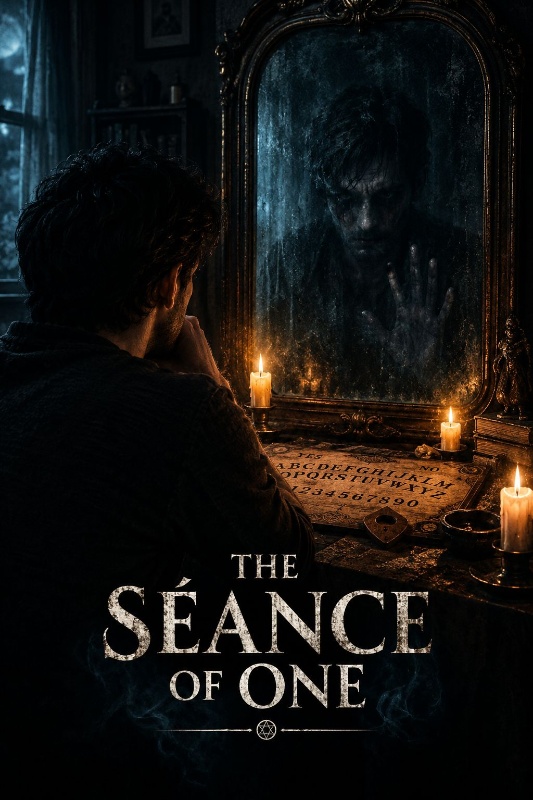
1. Whatever You Do, Don't Answer
At 11:47 p.m., Daniel Mercer heard his own voice coming from the mirror.
“Whatever you do,” it whispered, “don't let me finish the sentence.”
Daniel stopped smiling.
The voice had come from somewhere behind the glass a low, exhausted rasp, as if the speaker had spent years screaming in a room without doors.
He stood alone in his apartment, wearing an old T-shirt and holding a glass of whiskey. Rain tapped against the windows. A single candle burned on the table before him, illuminating a wooden spirit board he'd bought that afternoon from an estate sale.
He had expected nothing.
That was the point.
Daniel was thirty-four, a freelance copywriter with a cynical streak and a talent for making almost anything sound ridiculous. Ghosts were stories people told when grief became too uncomfortable to discuss honestly. Séances were parlor tricks dressed up in candlelight. The dead were dead.
He had spent the evening proving it to himself.
He'd read the instructions from an old occult book, arranged the candles, and placed a silver coin beside the board because the book claimed that silver discouraged malicious spirits.
He'd even laughed when he did it.
Now he wasn't laughing.
The voice had sounded exactly like his own.
Not similar. Not close.
His.
Daniel turned toward the mirror above the fireplace.
His reflection stared back at him. Dark hair. Unshaven jaw. A small scar near his left eyebrow from a childhood accident. Nothing unusual.
He raised his right hand.
The reflection raised its right hand.
He stepped closer.
“Who's there?” he asked.
His own face moved with his words.
Then, from inside the mirror, came three soft knocks.
Tok.
Tok.
Tok.
Daniel took a step backward.
The sound wasn't loud. It wasn't even particularly frightening. It was the sound of someone knocking on a bedroom door at night, careful not to wake anyone else in the house.
That was what made it terrible.
Someone was on the other side.
And they knew he was home.
Daniel swallowed, looked at the spirit board, and told himself the same thing he'd told himself all evening.
A pipe. A neighbor. A trick of the acoustics.
He sat down.
“Fine,” he muttered. “Let's do this properly.”
He placed two fingers on the wooden planchette.
The book instructed him to ask a question, wait for a response, and never end a session without saying goodbye.
Daniel had found that last rule particularly funny.
He leaned over the board.
“Is anyone here?”
The candle flame bent toward him.
The planchette moved.
Not much. Just enough to scrape across the board.
It stopped over YES.
Daniel stared at it.
He had been alone in the room for hours.
He lifted his fingers. The planchette remained still.
“Very funny,” he whispered.
He put his fingers back.
“Who are you?”
The planchette moved again.
Slowly, deliberately, it traveled to the letters.
D.
A.
N.
I.
E.
L.
Daniel's smile vanished.
The planchette continued.
M.
E.
R.
C.
E.
R.
His full name.
He snatched his hands away.
For several seconds, nothing happened. Then he noticed something on the board he hadn't seen before.
Beneath the printed alphabet, where the wood should have been plain, a sentence had appeared as if written in water.
YOU SHOULD HAVE LEFT ME ALONE.
Daniel stood so quickly that his chair toppled behind him.
He stared at the message.
The wood was dry.
The sentence faded.
From the mirror came another knock.
Tok.
Tok.
Tok.
This time, Daniel heard something after it.
A breath.
A long, trembling inhale.
Then his own voice spoke again.
“Daniel,” it whispered from the other side of the glass. “Please. I don't have much time.”
2. The Man in the Glass
Daniel did what any sensible person would do when confronted by an apparently impossible event.
He turned on every light in the apartment.
The room became painfully ordinary. The curtains were cheap. The floorboards needed polishing. An empty takeaway container sat beside the sink. His laptop lay open on the sofa, displaying an unfinished article about the best ways to improve website conversion rates.
The world had returned to its familiar shape.
Daniel felt foolish.
He examined the mirror. It was an old, heavy thing with a tarnished silver frame, but nothing about it suggested a secret compartment or a hidden speaker. He tapped the glass with his knuckle.
Solid.
He checked the back.
Nothing.
He searched the room for a Bluetooth speaker, a phone, anything that might explain the voice.
Nothing.
When he returned to the table, the spirit board looked harmless again.
He should have thrown it away.
Instead, he sat down and opened the occult book.
There was a section titled On the Nature of Uninvited Guests. Most of it was nonsense about cleansing herbs and protective circles. One paragraph, however, had been underlined by the book's previous owner.
The first deception is familiarity. A spirit may borrow the face of the beloved, the voice of the dead, or the appearance of the living. Do not trust what it resembles. Trust what it asks of you.
Daniel read it twice.
Then he laughed, but the sound came out thin.
“Of course,” he said. “The book tells me not to trust the thing the book says I've summoned.”
He picked up his phone and opened the camera.
He pointed it at the mirror.
On the screen, he saw himself standing beside the fireplace.
Then the image flickered.
For a fraction of a second, the man in the phone was not Daniel.
He was older. Much older.
His face was gaunt, his cheeks hollow, his skin gray beneath dark stubble. His lips were cracked. One eye was swollen almost shut. A long, dark stain spread across the collar of his shirt.
He looked directly into the phone camera.
His mouth formed two words.
Don't ask.
The image returned to normal.
Daniel dropped the phone.
It hit the carpet without breaking.
He stood perfectly still, listening to the rain.
Then he went to the front door, unlocked it, and stepped into the hallway.
The lights outside buzzed overhead. Somewhere downstairs, a television played through a thin wall. The elevator stood open at the far end of the corridor.
Ordinary sounds. Ordinary building. Ordinary life.
He walked to the elevator and pressed the button.
While he waited, he caught sight of the building's security mirror above the stairs.
He was in it.
For a moment, he felt ridiculous for checking.
Then the reflection smiled.
Daniel wasn't smiling.
He spun around.
The hallway was empty.
The elevator doors opened.
He entered and pressed the button for the ground floor. As the doors began to close, he looked at the security mirror again.
His reflection was watching him.
Its lips moved.
Daniel couldn't hear the words, but he understood them anyway.
You always leave too late.
The elevator descended.
He ran out through the lobby and into the rain.
He walked for almost an hour, stopping at a late-night convenience store and buying a bottle of water he didn't drink. He sat beneath the awning of a closed café and watched the wet streetlights tremble in the puddles.
He told himself that exhaustion had made him hallucinate.
He told himself the board was a trick.
He told himself that the older man in the mirror was a nightmare he had experienced while awake.
At 1:26 a.m., his phone rang.
The caller ID showed his own number.
Daniel stared at it.
The ringing continued.
He rejected the call.
It rang again.
He switched the phone off.
A minute later, a man sat down on the bench beside him.
Daniel looked up.
The stranger wore a dark coat and held a paper cup of coffee. He was around sixty, with silver hair and a face lined by years of bad sleep.
“Long night?” the stranger asked.
Daniel nodded cautiously.
The man looked at him with unsettling sadness.
“It's always a long night the first time.”
Daniel felt his stomach tighten.
“What did you say?”
The stranger rose from the bench.
“Go home, Daniel.”
He walked into the rain.
Daniel watched him cross the street, turn a corner, and disappear.
He had never told the man his name.
3. The Rules
Daniel returned to his apartment at 2:13 a.m.
He didn't want to.
But he had spent the last forty minutes standing beneath a streetlight, arguing with himself about whether running away from a mirror was the sort of thing a sane man did. Eventually, cold and exhausted, he'd decided that he would rather face whatever was in his apartment than spend the rest of the night afraid of every reflective surface in the city.
He unlocked the door.
Nothing moved inside.
The lights were still on. The spirit board remained on the table. His overturned chair lay where he'd left it.
He closed the door and locked it.
Then he took the board to the kitchen.
He held it over the sink and poured lighter fluid across the wood.
His hand shook as he reached for a match.
A voice spoke from the living room.
“Don't burn it.”
Daniel froze.
The voice came from the mirror.
“Please,” it continued. “Not yet.”
He turned slowly.
The mirror reflected the living room, the fireplace, the candles, and Daniel standing in the kitchen doorway.
But the figure inside it had changed.
The man in the glass was no longer merely older. He looked as though he had been dragged through years of suffering. His skin was yellow-gray. His hair had fallen out in patches. One cheek bore a deep scar, and his left hand was wrapped in dirty bandages.
His eyes were Daniel's eyes.
That was the worst part.
The same dark irises. The same tiny fleck of gold near the pupil. The same slight asymmetry in the eyelids.
The stranger pressed a palm against the inside of the glass.
“Listen to me,” he said. “You have to do exactly what I tell you.”
Daniel couldn't speak.
“You're going to want answers. You're going to want to know how this is happening. Don't ask how. Don't ask why. And if you hear someone you love, don't answer them.”
“Who are you?”
The man closed his eyes.
“Damn it.”
The mirror darkened, as if someone had extinguished the room behind it.
When the image returned, the man was closer to the glass.
“Daniel, I am you.”
“No.”
“I know what you're thinking. I know what you had for breakfast. I know you left the kitchen tap running this morning because you were reading an email. I know you still have your mother's last voicemail saved, and you listen to it when you can't sleep.”
Daniel's mouth went dry.
“I know you haven't listened to it since her funeral,” the man continued. “Because you can't bear the part where she says she loves you. You keep telling yourself you'll listen when you're ready.”
Daniel felt something inside him buckle.
“Stop.”
“I know you told everyone you were fine. I know you stopped calling your sister because every conversation ended with her asking how you were coping. I know you started drinking alone because it's easier to be miserable without an audience.”
“Stop!”
The man flinched.
For a moment, he looked less like a monster than a tired person who had made a terrible mistake.
“I'm sorry,” he whispered.
Daniel backed away from the mirror.
“What do you want?”
“To save you.”
“From what?”
The older Daniel glanced at the board on the kitchen counter.
“From what happens when you finish the session.”
Daniel looked at the clock.
2:19 a.m.
“What session? I can stop whenever I want.”
“No. That's what I thought, too.”
The older man's voice broke.
“You think the séance is a door. It isn't. It's a question. And every time you ask it, something on the other side learns a little more about you.”
Daniel stared at him.
“Something?”
The man nodded.
“It can't invent anything. It can only use what you give it. Your memories. Your regrets. The things you wish you'd said. The people you wish you could hear again. It starts by answering you in familiar voices. Then it makes you ask another question. And another.”
“Why?”
“Because questions keep the door open.”
Daniel looked at the spirit board.
The letters seemed darker than before.
“What happens if I stop asking?”
The older Daniel pressed his forehead against the glass.
“Then you have a chance.”
“What happened to you?”
The older man looked away.
For the first time, Daniel saw something beyond fear in his face.
Shame.
“I didn't stop.”
4. The First Night
The mirror flickered.
For a moment, the living room disappeared, replaced by a room Daniel recognized but had never seen in this condition.
His apartment.
Three years older.
The walls were stained. The curtains had been torn down. Empty bottles covered the floor. The spirit board sat on the same table, surrounded by hundreds of handwritten pages.
Every page contained the same question.
HOW DO I GET OUT?
Daniel stepped closer despite himself.
“What am I looking at?”
“Where I ended up.”
The older Daniel spoke slowly, as though every word cost him something.
“After the first séance, I threw the board away. I tried to forget everything. For a few weeks, I almost succeeded. Then I started seeing things in reflections. A face in a shop window. A shadow in the dark television screen. My mother standing at the end of a corridor.”
Daniel's throat tightened.
“Your mother?”
“Not really.”
The older man swallowed.
“It looked like her. It spoke like her. It knew things only she could know. And every time I refused to listen, it showed me something else.”
The mirror's surface rippled.
Daniel saw a kitchen. A woman sat at the table with a cup of tea between her hands.
His mother.
She looked exactly as he remembered her: silver hair, kind eyes, a cardigan buttoned incorrectly at the neck.
Daniel stopped breathing.
She looked toward the mirror.
“Danny?”
The childhood nickname hit him with the force of a physical blow.
He had not heard anyone say it in three years.
His mother smiled sadly.
“Darling, why won't you let me talk to you?”
Daniel reached toward the glass.
The older Daniel slammed his hand against the other side.
“Don't!”
The image vanished.
Daniel stumbled backward.
“Was that really her?”
“No.”
“How do you know?”
“Because your mother would never ask you to open a door that could destroy you.”
Daniel's eyes filled with tears.
“You don't know that.”
“I know because I am you. I know what she taught us.”
The older man's voice softened.
“She taught us to be kind. To apologize when we were wrong. To stop punishing ourselves for things we couldn't change.”
Daniel looked down.
His mother had died after a sudden stroke. Their last conversation had been an argument about his decision to move away from home. She had asked him to visit that weekend. He had promised to come the following month.
There had been no following month.
He'd carried that failure like a stone inside his chest.
He had replayed the conversation thousands of times, changing the words, imagining different endings. In his private version of the past, he always said the perfect thing. His mother always forgave him. They always had one more day.
He'd never told anyone how much of his life had become a punishment for not being there.
The older Daniel watched him.
“That's how it gets in,” he said. “Not through fear. Through the things you want badly enough to stop thinking clearly.”
Daniel wiped his eyes.
“How did you die?”
The older man went rigid.
“I told you not to ask.”
“Tell me.”
“Daniel-”
“How did you die?”
The older man recoiled.
The candle flames bent toward the mirror.
Something moved behind him.
A tall shape, thin as a shadow cast by a person who wasn't there, crossed the ruined room.
The older Daniel turned.
“No,” he whispered.
The shape stopped.
It had no face.
Yet Daniel felt it looking at him.
The older man pressed both hands against the glass.
“Now it knows you're listening.”
A sound came from the hallway outside Daniel's apartment.
Three knocks.
Tok.
Tok.
Tok.
Someone was at the front door.
5. The Woman Outside
“Daniel?”
His sister's voice.
Daniel spun toward the door.
“It's me.”
His sister, Rachel, lived nearly two hundred miles away. She had no reason to be there at three in the morning.
“Danny, please open the door.”
The older Daniel shook his head violently.
“It's not her.”
“How do you know?”
“Because Rachel wouldn't come here without calling first.”
The voice outside trembled.
“I drove all night. Please. I need to talk to you.”
Daniel moved toward the door.
“Don't,” the older man begged.
“She's my sister.”
“It knows she's your sister.”
The handle turned.
Once.
Twice.
Then stopped.
“Daniel,” Rachel said. “I know you're inside.”
Daniel placed his hand against the door.
“Rachel?”
The older Daniel screamed.
“Don't answer!”
But the word had already left Daniel's mouth.
Silence fell.
A long, terrible silence.
Then Rachel began to cry.
“Why did you leave me alone with her?”
Daniel's hand slipped from the door.
The voice changed.
Not dramatically. Not like a monster in a film.
It simply became the voice of his mother.
“Danny, darling, why didn't you come?”
Daniel backed away.
“No.”
“I waited for you.”
“No.”
“You promised.”
The words were quiet, almost tender.
That made them worse.
Daniel covered his ears, but the voice continued, seeming to come from inside his skull.
“I was frightened, Danny. I wanted you there.”
He sank to his knees.
He had imagined those words so many times that he knew exactly where they would hurt.
He had imagined his mother asking why he'd stayed away. He had imagined her crying. He'd imagined himself apologizing, begging, promising that he'd never do it again.
He had never imagined her sounding disappointed.
“I'm sorry,” he whispered.
The mirror cracked.
A thin line appeared down the center of the glass.
The older Daniel slammed his fists against it.
“Don't apologize to it! It doesn't want forgiveness. It wants you to believe you can still change what happened.”
The voice outside the door stopped crying.
Then it laughed.
It was a small, gentle laugh.
His mother's laugh.
“That's right, Danny,” it said. “You can fix it.”
The door unlocked itself.
Daniel heard the bolt slide back.
The older Daniel stared at him.
“Listen to me. You cannot save her. You cannot change what happened. And if you try to, you'll spend the rest of your life chasing a voice that knows exactly how to keep you running.”
Daniel looked at the door.
The handle began to turn.
He wanted to open it.
God, how he wanted to.
For three years, he'd wished for one impossible thing: one more conversation, one more chance to tell his mother he loved her, one more chance to say he was sorry.
The thing outside offered him that chance.
All he had to do was open the door.
Daniel took one step forward.
The older man closed his eyes.
“I know,” he whispered. “I know how much it hurts.”
For the first time, he sounded like someone who understood.
Not a warning. Not an instruction.
Just grief.
Daniel stopped.
He thought of his mother at the kitchen table, correcting his schoolwork. He thought of the way she hummed when she cooked. He thought of her hand on his forehead when he was sick, the soft click of her bangles, the ridiculous jokes she repeated because she always forgot she'd told them.
He thought of the last time she'd asked him to come home.
And he realized that the thing outside had never mentioned any of those moments.
It had only repeated the wound.
It knew his guilt.
It did not know his mother.
Daniel stepped away from the door.
“You're not her,” he said.
The hallway went silent.
Then something struck the door hard enough to shake the frame.
Once.
Twice.
A third time.
The wood bowed inward.
The voice that followed no longer sounded like his mother.
It sounded like something trying to remember how a human voice worked.
“OPEN.”
Daniel ran to the kitchen.
The spirit board lay on the counter, the lighter fluid still wet across its surface. He grabbed the box of matches.
Behind him, the mirror cracked again.
The older Daniel shouted, “The board!”
Daniel turned.
“What?”
“The session ends when you stop asking and stop answering. The board is only an anchor. Destroy it if you can but don't let it make you ask another question.”
The front door shuddered.
The thing outside began to pound.
Daniel struck a match.
For a moment, the flame was the only light in the kitchen.
Then the mirror spoke in his own voice.
“Daniel, before you do that, there's something you need to know.”
He froze.
The voice was no longer coming from the older man.
It came from the darkness behind him.
“You want to know how I died?”
Daniel's fingers tightened around the match.
The voice continued.
“You deserve to know.”
6. The Answer
Daniel stared at the mirror.
The older version of himself was gone.
In his place stood a man who looked almost exactly like Daniel as he was now same age, same clothes, same scar, same expression.
Only his eyes were wrong.
They were entirely black.
“You've been asking yourself all night,” the thing said. “You know you want the answer.”
Daniel said nothing.
“I can show you.”
The match burned down toward his fingers.
The thing smiled.
“You'll see the whole truth. Everything that happens if you walk away. Every mistake. Every loss. Every moment you'll wish you could change.”
The flame touched Daniel's skin.
He dropped the match with a gasp and crushed it beneath his shoe.
The thing laughed softly.
“You can't resist forever.”
Daniel bent to retrieve another match.
“What if I tell you?” it asked. “What if I tell you exactly how you die?”
His hand stopped.
“You die alone,” the thing said. “You die in this apartment. You'll spend years speaking to mirrors because you can't bear the silence. You'll forget what your sister's voice sounds like. You'll forget how to laugh. You'll become so desperate for one more word from your mother that you'll let me wear her face.”
Daniel stared at it.
The thing leaned closer.
“And when the time comes, you won't even recognize the person you've become.”
For one terrible second, Daniel believed it.
Not because it had shown him the future.
Because it had described a future he could already imagine.
A life spent shrinking. A life spent hiding from grief. A life in which fear became an excuse for every choice he was too frightened to make.
The thing wasn't merely threatening him.
It was offering him a reason to surrender.
Daniel reached for another match.
Then he paused.
“How do you know?” he asked.
The thing's smile widened.
Daniel felt the trap close around him.
A question.
Another invitation.
Another opening.
He shut his mouth.
The thing's smile disappeared.
“Ask me,” it whispered.
Daniel picked up the matchbox.
“Ask me how you die.”
He struck a match.
“Ask me what happens next.”
The flame rose.
“Ask me why I chose you.”
Daniel held the match to the board.
The lighter fluid caught with a sudden blue flare.
Fire raced across the wood.
The letters darkened. The planchette curled at the edges. Smoke rose in a thick, bitter cloud that smelled like burned hair.
The mirror screamed.
It wasn't a human scream. It was the sound of a thousand voices forced through one throat.
The front door shook.
The lights flickered.
Daniel stood over the burning board, his eyes watering.
The thing in the mirror slammed both hands against the glass.
“You need me!”
Daniel said nothing.
“You don't know what happens without me!”
The flames climbed higher.
The spirit board split down the middle.
The mirror shuddered.
For a moment, the glass became transparent.
Daniel saw the ruined apartment beyond it.
He saw himself sitting in darkness, older and thinner, surrounded by bottles and pages covered in questions. He saw himself pleading with the mirror. He saw himself crying. He saw himself begging a voice that never answered honestly.
Then he saw the older Daniel the one who had tried to warn him.
The man stood at the far end of the ruined room, his face twisted with pain.
He looked directly at Daniel.
And he nodded.
The burning board collapsed into ash.
The mirror went black.
The pounding at the front door stopped.
For several seconds, Daniel heard nothing but the crackle of dying flames.
Then came three soft knocks.
Tok.
Tok.
Tok.
Daniel closed his eyes.
A voice spoke from the other side of the mirror.
His mother's voice.
“Danny?”
He pressed his hands over his ears.
“Darling, it's cold out here.”
He began to cry.
“Please,” she whispered. “Just one word.”
Daniel shook his head.
“You don't have to let me in,” she said. “Just tell me you hear me.”
His knees buckled.
He wanted to answer.
He wanted to say yes.
He wanted to say he was sorry, that he loved her, that he'd been thinking about her every day.
But he knew the difference now.
His mother had never asked him to live inside his guilt.
She had never asked him to stop living because she had died.
Daniel sat on the floor, crying until he could barely breathe.
He did not answer.
The voice waited.
Then, slowly, it faded.
7. Goodbye
At 4:32 a.m., the apartment became quiet.
The candles had burned out. The board was ash. The mirror was covered in cracks, but it reflected the room normally.
Daniel sat against the kitchen cabinets, exhausted and trembling.
He didn't feel victorious.
He felt as though he'd survived an accident no one would believe had happened.
He reached for his phone.
It had switched itself back on.
There were seven missed calls from his sister, Rachel, and a message she'd sent at 2:08 a.m.
Hey. I know it's late. I had a dream about Mum and thought of you. Call me when you wake up, okay? Love you.
Daniel stared at the message until the words blurred.
He called her.
She answered on the fourth ring, sounding groggy and concerned.
“Danny? Are you okay?”
He tried to speak.
Nothing came out.
“Danny?”
He covered his mouth with one hand.
Then the tears came again.
“I'm sorry,” he managed.
“For what?”
“For not calling. For shutting you out. For making you think I didn't want you around.”
Rachel was quiet.
Then she said, “You don't have to apologize for being sad.”
Daniel closed his eyes.
“I miss her.”
“I know.”
“I don't know what to do with it.”
“You don't have to know tonight.”
He pressed his forehead against his knees.
For a long time, neither of them spoke.
Eventually, Rachel said, “Can I come visit next weekend?”
Daniel looked at the cracked mirror.
For the first time that night, he didn't feel watched.
“Yes,” he said. “Please.”
After the call, he wrapped the mirror in a bedsheet and carried it to the storage room. He didn't smash it. He didn't want to spend another moment staring into it.
He put the remains of the spirit board into a metal bin outside and poured water over the ashes until they became black sludge.
Then he went home, washed his hands, and opened his mother's last voicemail.
He had saved it three years ago.
He had listened to the beginning dozens of times, but never to the end. The message was ordinary. His mother had called to ask whether he could visit that weekend. She had mentioned a new recipe she'd tried. She'd complained about the weather and reminded him to bring a jacket.
Then came the part he had never allowed himself to hear.
“I know you're busy, Danny. Don't worry if you can't make it. We'll find another time.”
A pause.
“I love you, darling. Call me when you can.”
The message ended.
Daniel sat in the pale morning light and listened to it again.
Not because he expected a different ending.
Because it was hers.
When the sun finally rose, he opened the curtains.
The rain had stopped.
For the first time in three years, he let himself remember his mother without trying to rewrite the past.
It hurt.
But it was a pain he could carry.
And for now, that was enough.
8. The Man Who Stayed
Three weeks passed.
Daniel visited Rachel. They cooked the meal their mother used to make on Sundays, badly at first, laughing when they realized neither of them remembered the recipe correctly. They looked through old photographs. They argued over which childhood memories were true and which had been embellished by years of retelling.
Daniel began sleeping again.
He stopped drinking alone.
He returned to work and found that deadlines, once a source of dread, were almost comforting in their ordinariness. He still missed his mother. Some mornings, the sadness arrived before he was fully awake.
But he no longer treated every moment of happiness as a betrayal.
The mirror remained in storage.
He never went back to look at it.
Then, one Thursday evening, a package arrived at his apartment.
There was no return address.
Inside was a small, plain envelope containing a photograph.
Daniel recognized the room immediately.
His apartment.
The picture showed the fireplace, the table, and the mirror above it. The spirit board sat beneath the glass, exactly as it had on the night of the séance.
But the photograph had been taken from an angle that made no sense.
It showed the room from inside the mirror.
And standing in the reflection was an older man.
Daniel.
His face was gray. His eyes were sunken. His mouth hung open as if he were screaming.
Behind him stood a tall, faceless shape.
On the back of the photograph, someone had written a single sentence in black ink.
YOU DIDN'T ASK THE LAST QUESTION.
Daniel stared at it for a long time.
Then he placed the photograph in the kitchen sink and set it on fire.
He watched until the image curled into black flakes.
He didn't ask who had sent it.
He didn't ask what it meant.
He didn't ask whether the thing had survived.
He had learned that some doors did not need to be understood to remain closed.
That night, he called Rachel and talked to her until they ran out of things to say.
Then he went to bed.
He dreamed of his mother standing in the kitchen of their old house, humming as she cooked. Sunlight lay across the table. She looked up when he entered and smiled.
“There's my boy,” she said.
Daniel hugged her.
He didn't ask her to stay.
When he woke, the room was dark and quiet.
For a moment, he lay still, listening to the ordinary sounds of the building: a pipe knocking, a car passing in the street, someone moving furniture upstairs.
Then came three soft knocks.
Tok.
Tok.
Tok.
Daniel opened his eyes.
The sound had come from the storage room.
He sat up.
Every instinct urged him to investigate. To find out whether the mirror had moved. To prove that the photograph had been a warning. To discover whether the thing had followed him.
He got out of bed.
He took three steps toward the hallway.
Then he stopped.
He thought of the board. The voice. The endless questions written across the pages of his future.
He thought of the years he'd nearly lost trying to make the past answer him.
Daniel returned to bed.
He pulled the covers over his shoulders and turned toward the wall.
The knocking came again.
Tok.
Tok.
Tok.
He closed his eyes.
Whatever waited in the storage room could wait.
For the first time in years, Daniel had somewhere else to be.
He had a life to live.
And he was no longer willing to trade it for an answer.
In the darkness, something on the other side of the door began to cry.
Daniel did not get up.
He did not speak.
He did not ask a single question.
Eventually, the crying stopped.
Morning came.
And Daniel was still there.
The End.