
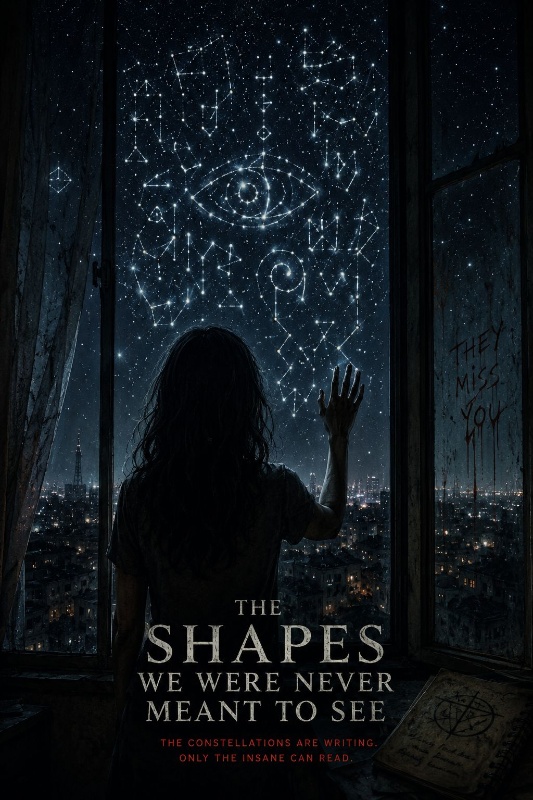
The first star moved while Mara was brushing her teeth.
She saw it in the bathroom mirror.
Not directly. That was the first thing she couldn't explain later, and the second thing she kept lying about.
She was brushing her teeth, half asleep, wearing the old gray T-shirt she'd stolen from Daniel three years before he died, when something bright slipped across the black square of the bathroom window.
Mara stopped.
The toothbrush stayed in her mouth.
For a few seconds she didn't move at all.
Then she spat foam into the sink.
"Okay."
Her voice sounded ridiculous.
She wiped her mouth with the back of her hand and looked again.
Nothing.
Just the window. The neighboring building. A slice of Delhi's dirty-orange sky. A satellite dish on the roof opposite, tilted toward something she couldn't see.
She laughed.
Actually laughed.
"Jesus Christ."
She'd been awake for twenty-three hours.
That was it.
Too much coffee. Too little sleep. Grief doing strange things to the brain. The human mind was a cheap machine, really. Give it enough exhaustion and it'll invent a ghost because it can't stand an empty room.
She rinsed the toothbrush.
Turned off the tap.
The star moved again.
This time she saw it.
Not falling.
Not shooting.
Moving sideways.
Slowly.
Deliberately.
Mara's hand tightened around the toothbrush until the plastic cracked.
"No."
She stepped toward the window.
The star stopped.
There were thousands of stars above the city, though most nights she couldn't see more than a handful through the haze. Tonight the sky was unusually clear. Almost offensively clear.
She opened the window.
Hot air pressed against her face.
Somewhere below, a scooter coughed to life. A dog barked. Someone shouted at someone else. A pressure cooker whistled in a neighboring apartment.
Normal.
Everything was normal.
Mara leaned out.
The star was still there.
And beside it—
She frowned.
There was another one.
She stared.
Then another.
Three stars, almost perfectly aligned.
No.
Not aligned.
They were forming a line.
A short line.
Then another star moved into place.
Mara stopped breathing.
The four points made the beginning of a shape.
Not a constellation she recognized. Not Orion. Not Cassiopeia. Not anything she'd learned as a child while her father tried to teach her the names of things.
This looked like writing.
She shut the window.
She shut the curtains.
She stood in the bathroom with the broken toothbrush in her hand and whispered, "I'm tired."
The apartment gave no answer.
She went to bed.
At 2:17 AM, every dog in the neighborhood started screaming.
By morning, forty-three people had killed themselves.
Nobody knew about the number yet.
That came later.
At 7:30, the news was still calling it a freak atmospheric event.
At 8:15, the first video appeared online.
At 8:40, it was gone.
At 9:02, Mara watched it again from a cached copy someone had uploaded under the title THE SKY IS WRITING.
The video had been filmed from a rooftop somewhere in Jaipur.
The stars were moving.
Not all of them.
Just certain ones.
Tiny points of light sliding through the sky with awful patience, rearranging themselves into something enormous.
The person filming kept breathing hard.
"Oh God."
A woman's voice in the background said, "Don't look at it."
"What?"
"Don't look."
"Why?"
"Because they can see you."
The camera jerked.
Someone started crying.
Then the video ended.
Mara watched it three times.
On the fourth, she noticed something she'd missed.
In the bottom corner, barely visible between two buildings, a man was standing on a rooftop.
He was staring upward.
He had both hands over his ears.
He was smiling.
Not happily.
Not even knowingly.
He was smiling the way people smile when they're trying not to scream.
Mara paused the video.
Zoomed in.
Her laptop complained about the resolution.
She zoomed again.
The man's face became a smear of pixels.
But his mouth was clear.
He was saying something.
Mara leaned closer.
"What?"
The man moved his lips.
Again.
She couldn't hear him.
Then she realized what he was saying.
I can read it.
Mara closed the laptop.
She went to the kitchen.
Made tea.
Forgot the tea existed.
At 10:11, she found it cold beside her elbow.
At 10:24, Daniel's mother called.
Mara didn't answer.
At 10:26, she called again.
Mara answered.
"Hello?"
Nothing.
"Ma'am?"
A breath.
Then Mrs. Sen said, "You've seen it."
Mara's stomach tightened.
"Seen what?"
"Don't."
"What?"
"Don't lie to me."
Mara looked toward the kitchen window.
The curtains were closed.
"I saw the stars."
Silence.
Then Mrs. Sen whispered, "Daniel saw them too."
Mara stopped.
"No."
"He called me."
"When?"
"Three nights before he—"
"Don't."
"I need you to listen."
"No."
"He said there was something wrong with the sky."
"Ma'am, Daniel was sick."
"I know."
"He wasn't—"
"I know what he was."
Mara swallowed.
Mrs. Sen's voice broke.
"He told me he finally understood why he was afraid."
Mara closed her eyes.
She remembered the hospital.
Daniel sitting beside her with a paper cup of water between his hands.
His fingernails bitten down until they bled.
His face thinner than it should have been.
Don't let them put me near a window.
She'd thought it was medication.
Fear.
The tumor.
Whatever word made the thing easier to carry.
She'd told him he'd be fine.
She'd lied.
Of course she'd lied.
People lie most often when they're trying to be kind.
"What did he say?" Mara asked.
Mrs. Sen began crying.
"I don't know."
"You just said—"
"I couldn't understand him."
Mara's heart began beating faster.
"What did he say?"
"He said the stars weren't moving."
A pause.
"They were coming back."
Three days later, the government told everyone to stay indoors after sunset.
By then, the internet was full of theories.
Military satellites.
Solar storms.
Aliens.
A secret Chinese weapon.
A secret American weapon.
A secret Indian weapon.
A secret weapon made by everyone.
Somebody posted a photograph of a constellation that looked like a human eye.
Another showed a mouth.
Another looked like a hand.
Another looked like a woman kneeling beside a grave.
That one disappeared within an hour.
Mara saved it first.
She didn't know why.
She knew exactly why.
The grave was Daniel's.
She recognized the posture.
The way the shoulders bent.
The slight tilt of the head.
She could have sworn she'd seen that posture a thousand times.
She stared at the image until her eyes hurt.
Then she noticed something.
The stars weren't forming a woman.
They were forming Mara.
Not her face.
Her handwriting.
The same strange little hook she'd always made at the end of the letter r.
The constellation spelled a word.
She didn't know the word.
But when she saw it, she understood it.
Not intellectually.
Something deeper.
Her body understood it.
Her knees buckled.
She vomited into the sink.
The word meant:
OPEN.
Professor Ilyan Rao lived eleven floors above Mara.
He was eighty-two years old, retired from the Indian Institute of Astrophysics, and had been diagnosed with early-stage dementia six years earlier.
He was also the first person Mara met who wasn't afraid of the stars.
That frightened her more.
He answered the door wearing slippers and a brown cardigan with three missing buttons.
"You came."
"You knew I would?"
"No."
He smiled.
"That's worse."
Mara stared at him.
"Can I come in?"
"You already are."
She looked down.
She was standing in his hallway.
She hadn't remembered entering.
"Sorry."
"Don't apologize. I've been forgetting where rooms are. Last week I opened my bedroom door and found the kitchen."
"The kitchen?"
"Yes."
He shrugged.
"Terrible architecture."
Mara almost laughed.
It came out as a strangled sound.
Rao watched her carefully.
"You've seen the writing."
She nodded.
"How long?"
"Three nights."
"Only three?"
She nodded.
He looked relieved.
"Good."
"Good?"
"Means you're still early."
"Early for what?"
He didn't answer.
Instead he walked toward the living room.
The walls were covered in paper.
Hundreds of pages.
Some were covered with astronomical charts.
Others contained drawings.
Some were just circles.
Some were lines.
Some looked like letters.
Some made Mara's eyes hurt if she stared too long.
"Don't look at those," Rao said.
"Why?"
"They remember you."
Mara turned.
"What does that mean?"
"I don't know."
He sat down.
"That's the problem."
She remained standing.
"How long have you known?"
"Since 1974."
Mara blinked.
"What?"
"The first time."
"There was a first time?"
Rao nodded.
"Every few thousand years."
She stared at him.
He looked embarrassed.
"Not exactly every few thousand. That's an approximation."
"You're saying this has happened before?"
"Yes."
"When?"
"Nobody knows."
"Then how do you know?"
He smiled sadly.
"Because civilizations leave behind mistakes."
He pointed to a stack of photographs.
Mara picked them up.
Cave paintings.
Stone carvings.
Ancient tablets.
Astronomical diagrams.
At first they looked unrelated.
Then she saw it.
The same shape.
Again.
Again.
Again.
A crooked circle with four points inside it.
Her stomach dropped.
"What's that?"
Rao didn't answer.
"Professor."
"Don't call me that."
"What's the shape?"
He looked at her.
"It's not a shape."
"What is it?"
"It's a name."
Mara felt suddenly cold.
"Whose?"
Rao's eyes filled with tears.
"I don't know."
He wiped them away angrily.
"That's the part I hate."
The first person Mara knew who went insane was a taxi driver.
His name was Rakesh.
He drove her to the hospital on the fifth day because she had started bleeding from her nose.
He kept glancing upward through the windshield.
"Don't," Mara said.
"I'm not."
"You are."
"I'm looking at traffic."
"You're looking at the sky."
"Madam, traffic is also in sky?"
He laughed.
Mara didn't.
"Sorry."
He drove another hundred meters.
Then said, "You know what they look like?"
"What?"
"The stars."
Mara's mouth went dry.
Rakesh smiled.
"Teeth."
She told him to stop the car.
He did.
She got out.
She walked the rest of the way.
At the hospital, there were people sleeping in corridors.
Some were praying.
Some were screaming.
One man had scratched both his eyes until the skin around them was raw.
A nurse tried to stop Mara from entering the emergency ward.
"My brother," Mara said.
"Name?"
"Daniel Sen."
The nurse looked at her.
"He's dead."
"I know."
"Then why—"
"I need his records."
The nurse hesitated.
"Why?"
Mara didn't know how to explain it.
Because the dead were beginning to speak.
Because Daniel had been afraid of windows.
Because she'd found his old notebook hidden beneath his mattress.
Because on the last page, written in his handwriting, were six words:
WHEN THEY MOVE, DON'T REMEMBER ME.
She hadn't shown anyone.
She hadn't even admitted she'd found it.
The nurse sighed.
"Wait."
Mara waited.
A vending machine hummed nearby.
Someone's phone rang.
A child was crying behind a curtain.
For almost ten minutes, nothing supernatural happened.
It was oddly comforting.
Then the overhead lights flickered.
Every phone in the corridor rang at once.
Every single one.
People stared.
Mara's phone vibrated in her pocket.
She pulled it out.
Unknown number.
She answered.
"Hello?"
A man's voice said:
"Mara?"
Her heart stopped.
Daniel.
It was Daniel.
Older somehow.
Tired.
Terrified.
She couldn't breathe.
"Daniel?"
"Mara, listen to me."
She began crying.
"I thought you were—"
"I know."
"Where are you?"
"I don't have much time."
"Where are you?"
"Don't let them finish."
"Finish what?"
The line crackled.
"Mara."
"I'm here."
"Whatever happens, don't look at the northern sky."
She laughed.
She couldn't help it.
A horrible little laugh.
"Daniel, you're dead."
Silence.
Then:
"I know."
The call ended.
That night Mara broke the rule.
Of course she did.
Everyone breaks the rule.
That's what rules are for when you're frightened enough.
At 1:53 AM she stood on the balcony.
The city below was unusually quiet.
No traffic.
No horns.
No dogs.
Even the air seemed to be holding itself still.
Mara looked north.
At first, nothing happened.
Then the stars shifted.
One.
Two.
Seven.
Twenty.
The entire northern sky began rearranging itself.
Mara's heart hammered.
She gripped the balcony railing.
The stars connected.
Lines appeared where no lines existed.
A vast pattern emerged.
It was too large to understand.
Her eyes tried to make sense of it and failed.
Then—
She understood.
She didn't see a picture.
She remembered one.
A childhood bedroom.
Her father's hand on her forehead.
Daniel laughing because she'd spilled milk.
Her mother singing in the kitchen.
A rainy afternoon.
A funeral.
A hospital corridor.
Daniel whispering, Don't let them put me near a window.
Except—
That hadn't happened.
No.
No.
She remembered it differently.
She remembered Daniel opening the window.
She remembered him looking up.
She remembered him smiling.
She remembered him saying:
"They're beautiful."
Mara staggered backward.
The balcony railing pressed into her spine.
"No."
Another memory arrived.
Daniel wasn't sick.
He hadn't had a tumor.
He'd never been in the hospital.
He'd never died.
He was—
Mara screamed.
The stars moved again.
And suddenly she saw what they were writing.
Not a word.
A sentence.
Not in any human language.
But she understood it.
WE MISSED YOU.
Mara fell to the floor.
She covered her face.
"Stop."
The sky continued.
"STOP."
Someone laughed behind her.
Mara turned.
Nobody was there.
But Daniel's voice said:
"You always were bad at saying goodbye."
She spent the next morning sitting on the kitchen floor.
There was blood under her fingernails.
She didn't know where it came from.
The kettle clicked off.
She watched steam disappear.
Her phone contained thirty-seven missed calls.
Rao had called eleven times.
Mrs. Sen had called six.
The rest were unknown.
She deleted them all.
Then she laughed.
Not because anything was funny.
Because the kettle looked ridiculous.
A little metal thing.
Making tea while the sky was becoming a language.
She laughed until she cried.
Then she cried until she couldn't remember why she'd started.
At noon, Rao came downstairs.
He sat on the floor beside her.
Neither spoke.
After a while he said, "I saw my wife."
Mara looked at him.
"Where?"
"In the sky."
"Is she dead?"
"Forty years."
"I'm sorry."
He nodded.
"She wasn't there."
Mara frowned.
"What?"
"It wasn't her."
He rubbed his hands together.
"I thought it was. For a moment. Then I understood."
"Understood what?"
"Whatever is speaking through the stars doesn't know us."
Mara stared at him.
"It knows our memories."
"Yes."
"That's worse."
"Much worse."
He looked toward the window.
"They're learning."
"Learning what?"
"How to become believable."
Mara's mouth went dry.
"How long?"
"Until what?"
"Until they finish."
Rao looked at her.
Then he smiled.
It was a terrible smile.
"That's the question, isn't it?"
On the ninth night, the stars stopped moving.
For six hours, nothing happened.
The world began to breathe again.
People went outside.
News anchors declared the phenomenon "apparently resolved."
Someone opened a restaurant.
Children played cricket in the streets.
A man on television proposed to his girlfriend because he'd decided life was short.
She said no.
He cried.
The internet loved it.
For one brief, stupid hour, the world was normal.
Mara went downstairs.
She bought bread.
Milk.
Toothpaste.
She stood in line behind a woman arguing about the price of tomatoes.
Mara almost smiled.
Then she noticed the woman had six fingers.
She blinked.
Five.
Of course.
Five.
She paid.
Walked home.
Forgot the incident.
At 11:48 PM, she remembered.
By midnight, the stars began moving again.
This time there was no pattern.
No constellation.
No writing.
Just movement.
Random.
Chaotic.
Mara stood at the window.
She waited.
Nothing.
Then one star disappeared.
Another.
Another.
The sky was going dark.
Mara felt a strange relief.
Maybe that was it.
Maybe the thing had gone away.
Maybe the stars had finally—
A knock came from inside the apartment.
Mara froze.
Her front door was locked.
The knock came again.
Three times.
Softly.
She walked toward it.
"Who is it?"
No answer.
"Mara."
Daniel.
She shut her eyes.
"No."
"Mara, please."
She backed away.
"You're not real."
"I know."
She laughed bitterly.
"That's getting old."
"I need you to open the door."
"No."
"I'm cold."
Her chest tightened.
That was something Daniel used to say.
When he was alive.
He'd always been cold.
Even in summer.
He'd sit beside the window with a blanket around his shoulders and complain about the fan.
"Mara."
She pressed both hands against her ears.
"Go away."
"I can't."
"Why?"
A pause.
Then Daniel said:
"Because you haven't remembered me correctly yet."
She opened her eyes.
The apartment had changed.
Not physically.
Something worse.
She knew the couch was hers.
The kitchen.
The hallway.
But the proportions were wrong.
The ceiling seemed too high.
The walls seemed farther apart.
Her photographs had changed.
She walked toward them.
There was one of Daniel and her as children.
Except she was missing.
There was another.
Her parents at the beach.
Her father had no face.
Another.
Daniel's funeral.
The coffin was open.
Inside it was Mara.
She dropped the photograph.
The glass shattered.
Behind her, the knocking stopped.
Then the front door opened.
Mara screamed.
Daniel stood outside.
He looked exactly as he had at thirty-two.
Thin.
Dark hair.
Tired eyes.
That stupid blue shirt.
She hated that shirt.
She loved that shirt.
She hated him.
She loved him.
She couldn't tell anymore.
"Don't come closer."
He didn't.
"Mara."
"You're not him."
"I know."
"Then what are you?"
Daniel looked toward the ceiling.
For the first time, he looked afraid.
"I don't know."
That answer broke something inside her.
Not because it was frightening.
Because it sounded honest.
He whispered:
"I think I'm what's left when someone remembers you too many times."
Mara began shaking.
"Where's the real you?"
Daniel smiled.
"I think he died a long time ago."
"When?"
"I don't remember."
She stepped closer.
"Do you know my birthday?"
"March seventeenth."
"Where did Dad hide the Christmas money?"
"Behind the broken clock."
"What did Mom call you when she was angry?"
"Daniel."
Mara laughed through her tears.
"That's not a nickname."
"I know."
"Tell me something only he would know."
Daniel stared at her.
Nothing.
His face changed.
Not dramatically.
Just slightly.
The eyes were wrong.
Too deep.
Too patient.
Mara stepped backward.
"You're not him."
"No."
"What are you?"
He looked past her.
Toward the window.
"The stars are almost finished."
Mara turned.
The sky was black.
Completely black.
No stars.
No moon.
Nothing.
She looked back.
Daniel was gone.
At 3:06 AM, every light in Delhi went out.
Mara sat in the dark.
She didn't scream.
She'd run out of screaming.
Her hands were numb.
Her body had entered that strange place beyond fear where everything becomes boring.
She thought about laundry.
About unpaid electricity bills.
About whether there was bread left.
She thought about calling Mrs. Sen.
She didn't.
At 3:17 AM, the stars came back.
Not thousands.
Millions.
Far more than should have been visible.
They filled the sky.
And they weren't above her anymore.
They were everywhere.
Behind the walls.
Under the floor.
Inside her eyes.
She understood then.
The stars had never been rearranging.
They had been moving closer.
Slowly.
For millennia.
Closer.
Closer.
Closer.
Until humanity finally noticed.
Mara pressed her palms against her eyes.
She could still see them.
She could see their positions.
Their distances.
Their impossible geometry.
She could see the spaces between them.
And something was standing in those spaces.
Something enormous.
Something that had no shape because shape was a human agreement.
She began to laugh.
"No."
Her laughter became sobbing.
"No, no, no."
She remembered Daniel.
Not the false Daniel.
Not the thing wearing his face.
The real one.
He had been afraid.
He had known.
He'd tried to tell her.
And she had ignored him.
Because she was tired.
Because she was angry.
Because she couldn't bear losing him.
Because sometimes love makes cowards of us.
Mara stood.
She walked to the window.
Outside, the sky was beautiful.
That was the worst part.
It was beautiful.
She opened the curtains.
The stars were forming one final shape.
A human eye.
Then another.
Then another.
Hundreds.
Thousands.
Millions.
Watching.
Mara whispered, "I'm sorry."
She didn't know who she was apologizing to.
Daniel.
Herself.
The dead.
The living.
Whatever waited between the stars.
She placed her hand against the glass.
Something touched it from the other side.
The glass was cold.
Mara smiled.
Not because she was happy.
Because she finally understood what the writing meant.
The constellations weren't symbols for the insane.
They were symbols to the insane.
A language you could only read after something inside you had broken badly enough to let the truth through.
And Mara had broken.
Oh God.
She had broken.
Behind her, in the dark apartment, someone whispered her name.
She didn't turn around.
She was afraid that if she did, she'd see Daniel.
She was more afraid that she wouldn't.
So she stayed at the window, hand pressed to the glass, while the stars slowly rearranged themselves into the shape of a door.
And on the other side of that door, something knocked.
Once.
Twice.
Then, very gently—
three times.
Mara began to cry.
Not loudly.
Not dramatically.
Just the exhausted, helpless crying of someone who has finally run out of lies.
And somewhere above the city, one small star moved into place.
It looked, for just a moment, exactly like a human fingerprint.
Then another appeared beside it.
And another.
As though something enormous was learning how to touch the world.