
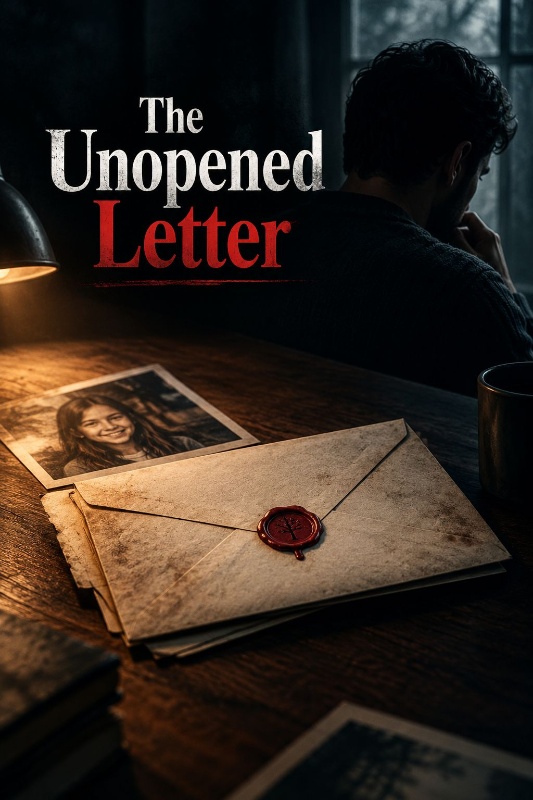
The first letter arrived on a Tuesday.
It had no stamp, no return address, and no name on the front. Just a cream-colored envelope resting on Daniel Mercer’s doormat, placed so neatly that it looked less like something delivered and more like something that had been waiting for him to come home.
Daniel nearly stepped on it.
He had spent fourteen hours at the architectural firm, arguing with a client who wanted a Victorian townhouse transformed into something that looked like a glass box. His head throbbed. His shoulders ached. Rainwater dripped from the hem of his coat, and all he wanted was a hot shower, a glass of whiskey, and the blessed silence of his apartment.
He bent to pick up the envelope.
His name was written across the front in black ink.
Daniel Mercer.
The handwriting was unfamiliar, but something about it made him pause. The letters were narrow and deliberate, with the kind of careful loops he associated with old-fashioned correspondence. Whoever had written his name had taken their time.
He turned the envelope over.
The flap was sealed with a small circle of dark red wax. There was no emblem pressed into it, only a faint indentation that might have been made by a fingertip.
Daniel frowned.
He lived on the fourth floor of a converted Victorian building in North London. The front entrance required a security code, the lift was accessible only to residents, and the hallway outside his apartment was covered by a camera that the building manager insisted worked perfectly.
Nobody could have left a letter on his doormat without coming inside.
Unless it had been delivered by mistake.
He checked the neighboring doors. Nothing.
Then he examined the envelope again.
It was dry.
That was the first thing that unsettled him.
The corridor smelled of wet wool and damp plaster. His shoes had left dark marks on the floor, and the shoulders of his coat were soaked through. Yet the envelope was perfectly dry, without a single water stain.
Daniel rubbed his thumb across the paper.
Old-fashioned, heavy stock. Slightly rough. Expensive, perhaps.
He considered opening it.
Then he noticed that there was no postmark.
No stamp.
No indication that the envelope had ever passed through a postal service.
A ridiculous thought crossed his mind: someone had been inside his apartment.
He immediately dismissed it. He had locked the door that morning. He always locked the door.
Still, he checked the handle.
Locked.
He unlocked the door, stepped inside, and placed the letter on the narrow console beside his keys.
He would deal with it later.
For the moment, he wanted a shower.
By the time he came back into the living room, the envelope had disappeared beneath a pile of unopened bills and supermarket receipts.
Daniel did not think about it again until the following morning.
And even then, he did not open it.
1. The Second Letter
Daniel found the first envelope while searching for his electricity bill.
He pulled it from beneath a supermarket receipt, stared at it for several seconds, then dropped it into the kitchen bin.
He was not superstitious. He did not believe in omens, ghosts, or anonymous messages from mysterious strangers. He believed in reasonable explanations, even when he had not yet found one.
Someone had probably mistaken his apartment for another. Or perhaps a neighbor was playing a prank.
Either way, the letter was not his problem.
That evening, he returned home shortly after eight. He had spent the day reviewing plans for a hotel renovation and had stopped at a restaurant on the way back. His phone battery was nearly dead, his shoes were soaked again, and he was looking forward to spending the night doing absolutely nothing.
He unlocked his apartment.
The kitchen bin stood open.
Daniel stopped.
He was certain he had closed it before leaving. He was equally certain that he had thrown the envelope away that morning.
Now it lay on the kitchen counter.
The wax seal was intact.
For a moment, he simply stared at it.
Then he laughed.
It was a short, humorless sound.
"Very funny."
He checked the kitchen window. Locked. He checked the front door. Locked. There was no sign of a break-in, no disturbed furniture, no missing possessions.
He picked up the envelope and examined it again.
Something had changed.
Beneath his name, in handwriting so small that he had missed it the first time, were six words.
You should have opened it, Daniel.
His stomach tightened.
He carried the letter into the living room and set it on the coffee table.
Then he called his building manager.
The manager, a heavyset man named Peter, answered after the fourth ring.
"Everything all right, Daniel?"
"Did anyone come into the building today?"
"People come into the building every day."
"Anyone unfamiliar? Deliveries? Maintenance?"
"Not that I know of. Why?"
"Someone left something outside my apartment."
"Did you report it to the police?"
Daniel glanced at the envelope.
"Not yet."
"Well, if someone's bothering you, let me know. I'll check the camera footage."
"Could you check it tonight?"
Peter sighed. "I'll have a look tomorrow morning."
Daniel thanked him and ended the call.
He should have opened the letter. He knew that now.
Instead, he took a photograph of the envelope and sent it to a friend, asking whether the handwriting looked familiar.
Then he turned on the television, ordered another drink, and tried to forget about it.
At 11:43 p.m., the television switched itself off.
Daniel looked up from his phone.
The room went silent.
He pressed the remote. Nothing happened.
He reached for his phone to use its flashlight, and that was when he noticed the envelope.
It was no longer on the coffee table.
It lay on the floor beside the front door.
A thin, dark line ran beneath the door, as though water were seeping into the apartment from the hallway.
Daniel stood.
He had lived in the building for three years. He knew the sound of the pipes, the groan of the lift, the occasional thud of a neighbor's footsteps overhead.
He had never heard anything like the sound coming from the other side of his door.
Three slow scratches.
Then silence.
Then three more.
Daniel approached the door without switching on the lights.
He looked through the peephole.
The hallway was empty.
He unlocked the deadbolt, opened the door a few inches, and peered outside.
Nothing.
The corridor lights flickered.
At his feet lay another envelope.
This one was smaller, the paper yellowed at the edges.
Daniel picked it up.
His fingers had begun to tremble.
His name was written on the front.
And beneath it, in the same narrow handwriting, were seven words.
I know why you never say her name.
Daniel dropped the envelope.
For several seconds, he could not breathe properly.
Because there was only one person in the world whose name he had spent five years refusing to say.
His younger sister.
Rebecca.
2. The Name He Buried
Rebecca Mercer had died five years earlier.
She was twenty-six, three years younger than Daniel, with a habit of laughing at inappropriate moments and a talent for remembering things he wished she would forget.
They had grown up in a small house outside York, raised by a mother who worked nights at a nursing home and a father who had left when Rebecca was seven.
Daniel had always been the responsible one.
Rebecca had been the reckless one.
He went to university, found a job, bought a flat, and built a life that looked respectable from the outside. Rebecca changed jobs, traveled whenever she could, fell in love too quickly, and called him at inconvenient hours to tell him stories that began with, "You are not going to believe what happened."
Despite their differences, they had been close.
Until the night she died.
It was a Thursday in November. Daniel remembered the date because it had been raining, and he had been working late on a presentation that could have secured him a promotion.
Rebecca had called at 10:17 p.m.
He had watched her name flash across his phone.
He had let it ring.
She called again.
He declined the call.
Then she sent a message.
Dan, please pick up. I need you.
He had read it.
He remembered reading it while sitting at his desk, irritated because he was behind schedule and certain she would ask him for money or advice about another disastrous relationship.
He had typed a reply.
Can it wait until tomorrow? I'm busy.
Then he had deleted it without sending it.
At 10:42 p.m., she called again.
He silenced the phone.
At 11:06 p.m., the police arrived at his apartment.
Rebecca had been driving home through the rain when her car had left the road and struck a tree. The road was narrow, the visibility poor, and the emergency services believed she had lost control on a bend.
She had died before the ambulance arrived.
Her phone had been found on the passenger seat.
The final message she had attempted to send was still open on its screen.
Dan, please pick up. I need you.
For five years, Daniel had replayed that night in his head.
He told himself he could not have known. He told himself that even if he had answered, he could not have prevented the accident. He told himself that the police had found no evidence of another vehicle, no sign of foul play, nothing to suggest that anyone else had been involved.
But guilt was not interested in evidence.
It did not care that Daniel had not caused the accident.
It cared only that his sister had needed him, and he had chosen not to answer.
He stopped talking about Rebecca.
He packed away her photographs, deleted their message history, and avoided the town where they had grown up. When his mother mentioned her, he found reasons to leave the room.
Eventually, people stopped asking.
He had mistaken their silence for forgiveness.
Now, standing in his apartment at midnight, he stared at the second envelope.
The hallway was empty.
The scratching had stopped.
He picked up the letter and carried it inside.
For the first time, he broke the wax seal.
Inside was a single sheet of paper.
The handwriting matched the writing on the envelope.
Dear Daniel,
You have spent five years telling yourself that you did not know she needed you.
That is not the truth.
You knew she was afraid. You knew she was crying. You knew she would not have called three times unless something was wrong.
You did not answer because you thought your work was more important.
You have punished yourself for five years, but punishment is not the same as remorse.
You have never once asked what she was trying to tell you.
Tomorrow, you will receive another letter.
This time, please open it.
Someone who remembers.
Daniel read it twice.
Then a third time.
He checked the paper for a signature.
There was none.
He searched the handwriting online, looking for a match. He examined the envelope under the kitchen light. He called Peter again, but the manager did not answer.
At 1:15 a.m., Daniel put the letter in a drawer, locked the drawer, and placed the key in his pocket.
He slept badly.
At 3:26 a.m., he woke to the sound of paper sliding across wood.
His bedroom door was closed.
The sound came from the kitchen.
He lay still, listening.
A soft scrape.
Then another.
Then the unmistakable sound of an envelope being pushed across a surface.
Daniel got out of bed.
He walked down the hallway, switched on the kitchen light, and stopped at the doorway.
A third envelope lay in the center of the table.
The drawer was still locked.
The key was still in his pocket.
On the envelope, someone had written:
Tonight, you will remember what you forgot.
3. The Letters Know
Daniel did not go to work the next morning.
He called in sick, drew the curtains, and spent two hours searching his apartment for hidden cameras or evidence of an intruder.
He found nothing.
At nine, he phoned Peter.
"I need you to check the security footage from the last three nights."
"Daniel, I haven't got time to-"
"Someone is entering my apartment."
That silenced him.
"What do you mean, entering?"
"I mean things are appearing in locked rooms. Someone knows things about my family that nobody here could possibly know."
Peter promised to review the footage.
At ten, Daniel opened the third letter.
Dear Daniel,
You remember the accident.
You remember the rain.
You remember the missed calls.
But memory is a room with more than one door, and you have spent five years keeping one of yours locked.
Do you remember the message she sent you at 10:19 p.m.?
Daniel frowned.
He remembered the final message. The one asking him to pick up.
He had never known of another.
You deleted it before the police arrived.
You told yourself it was nothing.
Find the old phone.
Open the message.
And stop lying about the last time you saw your sister.
Daniel read the letter until the words blurred.
The old phone.
He had kept Rebecca's things after her death, including a cracked smartphone that the police had returned to the family. He had stored it in a cardboard box in his wardrobe, along with her spare keys, a scarf, and a collection of photographs.
He had not opened that box in years.
He went into the bedroom and pulled it from the top shelf.
The box was dusty. The cardboard had softened with age.
Inside, beneath the scarf, lay the phone.
He charged it for forty minutes before it would turn on.
The screen flickered.
The battery icon appeared.
Then the familiar lock screen filled with a photograph of Rebecca standing on a beach, her hair whipping across her face as she laughed at whoever had taken the picture.
Daniel sat on the edge of the bed.
He entered her birthday as the passcode.
The phone unlocked.
For a long time, he did nothing.
Then he opened the messages.
There were hundreds. Conversations with friends, messages from work, photographs, reminders, jokes, complaints about the weather.
He searched for his own name.
The final conversation appeared.
Three missed calls.
Two messages.
The first was the one he remembered.
Dan, please pick up. I need you.
The second was timestamped 10:19 p.m.
He had never seen it before.
His hands went cold.
I think someone is following me.
He stared at the words.
Below them was another message, sent at 10:21 p.m.
I'm turning onto the old road. Please don't let me go home alone.
Then, at 10:23 p.m., a photograph.
The image was dark and blurred. Rain streaked across the windshield. Headlights glowed in the distance.
But Daniel could make out the shape of a car behind her.
A dark sedan.
Its headlights were too close.
He zoomed in.
The photograph broke into pixels.
He tried to open the next image, but the phone froze.
Then the screen went black.
Daniel pressed the power button.
Nothing.
He connected the charger again.
Nothing.
He sat motionless, the old phone resting in his palm.
He had spent five years believing Rebecca had called because she was upset, because she was lonely, because she wanted to talk about something that could wait.
But she had been frightened.
Someone had been following her.
And he had not answered.
A knock sounded at the front door.
Daniel nearly dropped the phone.
He went to the hallway and looked through the peephole.
Peter stood outside, holding a tablet.
Daniel opened the door immediately.
"Did you find something?"
Peter looked uncomfortable.
"I checked the cameras."
"And?"
Peter turned the tablet toward him.
The footage showed the corridor outside Daniel's apartment on Tuesday evening.
At 6:14 p.m., Daniel entered the building.
At 6:16 p.m., he entered his apartment.
Nobody else appeared in the corridor for the next six hours.
At 12:03 a.m., the corridor lights flickered.
For three seconds, the camera image turned black.
When it returned, an envelope lay on Daniel's doormat.
Peter swiped to the next recording.
The same thing happened on Wednesday.
No person. No open door. No movement.
Only a brief interruption in the footage, followed by another envelope.
"Could be a camera fault," Peter said. "Electrical interference. These systems aren't perfect."
Daniel watched the recording again.
"Can you show me the footage from inside the building entrance?"
Peter did.
At 6:14 p.m. on Tuesday, Daniel entered the building alone.
No one followed him.
No one came through the door before the envelope appeared.
Daniel felt the room tilt.
Peter studied his face.
"Do you want me to call the police?"
Daniel looked at the tablet.
"Yes," he said. "I think I do."
4. The Woman in the Hallway
The police arrived that afternoon.
Daniel explained everything: the envelopes, the impossible appearances, the messages that seemed to know his private thoughts, and the old phone.
He did not mention ghosts.
He did not need to.
Detective Helen Ward listened without interrupting. She was in her early forties, with tired eyes and a voice that made even ordinary questions sound like they mattered.
"Has anyone threatened you before?" she asked.
"No."
"Anyone who might know about your sister?"
"Her friends. My family. A few colleagues from the time."
"Did your sister have a stalker?"
Daniel hesitated.
"I don't know."
"You don't know?"
"She never told me about one. Not directly."
Ward made a note.
"What about the photographs on the phone?"
"I couldn't recover the last one. The phone died."
"Where is it now?"
"On my bed."
She asked an officer to photograph the envelopes and arranged for the phone to be examined. She also requested the building's security footage.
Before leaving, she paused at the front door.
"Mr. Mercer, I want you to do something for me."
"What's that?"
"If another letter arrives, don't open it alone. Call us first. And don't throw anything away."
Daniel nodded.
She studied him for a moment.
"One more thing. Did your sister ever mention a man named Thomas Vale?"
The question struck him with unexpected force.
"Thomas?"
"Thomas Vale. He was interviewed during the original investigation. He had worked with your sister at a property management company."
Daniel searched his memory.
"She mentioned him once. I thought he was a colleague."
"Do you remember anything else?"
"No."
Ward closed her notebook.
"All right. We'll be in touch."
After the police left, Daniel searched his sister's name alongside Thomas Vale's.
The results were sparse. A few professional profiles, an old company announcement, a photograph of a charity event.
Then he found a news article from six years earlier.
Local Man Cleared After Harassment Complaint.
The article described a complaint made by a woman whose name had been withheld. She had reported receiving unwanted visits, threatening messages, and letters from a former colleague.
The man had denied the allegations.
The case had been closed for lack of evidence.
There was a photograph of him outside a courthouse.
Thomas Vale.
Daniel felt sick.
He enlarged the image.
The man's face was familiar, but not because he had met him. It was because of the photograph on Rebecca's phone.
The dark sedan.
The headlights.
He could not prove it was the same man. He could barely remember the car in the photograph. But something in him had begun to connect the pieces.
He searched for Thomas's current address.
Nothing reliable appeared.
He searched social media.
A dormant account. No recent photographs. No obvious connection to Rebecca.
Then he found a comment beneath an old photograph of her.
It had been posted two days after her funeral.
You cannot ignore me forever.
The account had since been deleted.
Daniel took a screenshot and sent it to Detective Ward.
Then he sat at the kitchen table and stared at the three letters.
They lay in a neat row.
He read them again, hoping the words would change.
They did not.
At 8:30 p.m., the doorbell rang.
Daniel froze.
He looked through the peephole.
A woman stood in the corridor.
She was wearing a dark coat, her hair tied back, her face pale beneath the yellow hallway lights.
For one impossible second, Daniel thought it was Rebecca.
The same height.
The same tilt of the head.
The same habit of standing with one shoulder slightly raised, as though she were listening to something nobody else could hear.
Then the woman looked directly into the peephole.
Daniel stumbled backward.
He knew that face.
He had seen it in photographs, in the mirror of his memories, and in the dreams that came when he was too tired to defend himself.
Rebecca.
The doorbell rang again.
Daniel could not move.
A voice came through the door.
"Dan?"
It was her voice.
Not similar.
Not a recording that almost sounded like her.
It was Rebecca's voice, with the slight upward inflection at the end of his name that she had used since childhood.
"Dan, open the door."
His eyes filled with tears.
He pressed a hand over his mouth.
The voice came again, quieter this time.
"Please. I need you."
He reached for the deadbolt.
Then he stopped.
The letters.
The warning.
The woman who had appeared without being recorded.
He took a step toward the peephole again.
The hallway was empty.
The bell rang a third time.
This time, it came from inside the apartment.
Daniel spun around.
The kitchen table stood beneath the light.
A fourth envelope lay on it.
He had not heard anyone enter.
He had not seen anyone pass him.
The paper was damp, and a dark fingerprint stained the corner.
Daniel approached it slowly.
The handwriting on the front was different from the previous letters.
It was larger, less controlled, and painfully familiar.
He had seen it on birthday cards, shopping lists, and notes left on his kitchen counter when Rebecca had stayed with him.
It was his sister's handwriting.
Across the envelope were four words.
I WASN'T ALONE THAT NIGHT.
Daniel tore it open.
Inside was a photograph.
It showed Rebecca's car on the old road, taken from behind. The dark sedan was directly in front of it now, blocking the road.
Someone stood beside the sedan.
A man in a long, dark coat.
His face was turned toward the camera.
Thomas Vale.
On the back of the photograph, a sentence had been written.
He knows you have the phone.
Daniel heard footsteps in the hallway.
Slow.
Measured.
Coming toward his door.
He backed away from the table.
Then someone knocked.
Three times.
And a man's voice called from the other side.
"Daniel? We need to talk."
5. The Man Who Knew Her
Daniel did not answer.
He called Detective Ward.
She picked up on the second ring.
"Mercer?"
"Someone's outside my apartment."
"Who?"
"I think it's Thomas Vale."
"Why do you think that?"
"Because he knows about the phone. Because he's been leaving letters. Because I think he followed my sister before she died."
"Where are you now?"
"Inside my apartment."
"Lock the door. Don't open it. Officers are on their way."
The man knocked again.
"Daniel," he called, sounding almost amused. "I know you're in there."
Daniel backed into the living room.
"Go away."
A pause.
Then the man laughed softly.
"She used to say that to me, too."
Daniel's stomach twisted.
"How did you get in this building?"
"I have my ways."
"Leave me alone."
"I can't do that."
The man's voice grew colder.
"You have something that belongs to me."
Daniel looked at the old phone on the table.
"You followed Rebecca."
Silence.
Then: "Your sister was a very confused woman."
"You followed her."
"She made accusations. She misunderstood things."
"She was afraid of you."
"She was afraid of everything."
Daniel's hands shook so badly that he nearly dropped his phone.
"Did you kill her?"
Another silence.
Longer this time.
Then the man spoke in a low, intimate voice.
"I didn't put her car into that tree, Daniel."
The words seemed to drain the warmth from the room.
Daniel gripped the phone.
"But you were there."
"I was trying to talk to her."
"You were chasing her."
"She was driving recklessly. It was raining. She panicked."
"Because of you!"
The man sighed.
"You don't understand what happened."
"Then tell me."
"I tried to help her. She wouldn't listen. She kept threatening to go to the police. I needed her to understand that she was making a mistake."
"By following her in your car?"
"I never touched her."
Daniel felt a wave of hatred so intense that it frightened him.
"You watched her die."
"I left before the ambulance arrived."
The words slipped out before the man could stop himself.
Daniel went completely still.
On the other end of the line, Detective Ward said something, but he barely heard her.
"Say that again," he whispered.
The man outside did not respond.
"You said you left before the ambulance arrived."
"I said I left before anyone arrived."
"You were there."
"Don't make this worse than it is."
"You watched her crash."
"She lost control!"
"And you drove away."
The man struck the door with his palm.
"Open this door!"
Daniel recoiled.
The door shook in its frame.
"Open it, Daniel! You have no idea what you're doing!"
Then, from somewhere deep inside the apartment, came the sound of a telephone ringing.
Not Daniel's mobile.
A landline.
He turned toward the kitchen.
He had not owned a landline in years.
Yet the ringing continued, shrill and insistent, as though an old telephone were sitting beneath the floorboards.
The man outside stopped shouting.
For the first time, Daniel heard fear in his voice.
"No," the man whispered.
The ringing stopped.
A woman's voice spoke from the kitchen.
"Thomas?"
Daniel could no longer move.
The voice was unmistakable.
Rebecca.
"Thomas, you left me there."
A loud thud shook the front door.
The man screamed.
Not in anger.
In terror.
Then came the sound of running footsteps, retreating down the corridor.
Daniel rushed to the peephole.
The hallway was empty.
A moment later, the building's fire door slammed.
Detective Ward was still speaking through the phone.
"Daniel? Daniel, answer me!"
He forced himself to respond.
"I'm here."
"Officers are at your building. Stay where you are."
Daniel looked toward the kitchen.
The table was empty.
The fourth letter and the photograph had vanished.
Only a dark, damp ring remained on the wood, as if a glass of cold water had been set there and left to sweat.
When the officers arrived, they found no sign of Thomas Vale.
But the building's exterior camera showed a man in a dark coat entering the lobby at 8:27 p.m.
The camera showed him walking toward the lift.
It never showed him leaving.
The officers searched every floor.
No one was found.
6. The Letter That Was Never Sent
Thomas Vale was arrested two days later.
Detective Ward called Daniel at 7:12 in the morning.
"We found him," she said. "He's been staying at a rented room under a different name."
Daniel sat upright in bed.
"Did he confess?"
"Not to everything. But we have enough to reopen the investigation."
She explained that officers had searched Thomas's belongings and recovered an old laptop, several storage devices, and a collection of photographs. Among them were pictures of Rebecca taken without her knowledge.
There were photographs of her leaving work.
Photographs of her walking to her car.
Photographs taken through the windows of cafés where she had met friends.
And there were photographs of Daniel.
Outside his office. Entering his apartment building. Sitting alone at a restaurant.
Thomas had been watching them both.
"He claims he never intended to hurt your sister," Ward continued. "He says he followed her that night because he wanted to confront her about the complaint she was preparing to make against him."
"And the accident?"
"We've recovered messages and location data that support the fact that he was following her. We're still investigating exactly what happened on that road. His statement alone isn't enough, but he's given us information we can verify."
Daniel closed his eyes.
For five years, he had imagined a hundred different versions of Rebecca's final hours. In some, she had been crying. In others, she had been angry with him. Sometimes he imagined that she had forgiven him before she died.
He had never imagined that she had been running from someone.
Someone who had watched her.
Someone who had known her fear and followed her anyway.
"What about the letters?" he asked.
"We're examining them. We haven't established who wrote them or how they were delivered."
"Thomas?"
"We haven't found evidence connecting him to the envelopes at your apartment. The handwriting doesn't match his known writing samples, either."
Daniel stared at the bedroom wall.
"Then who sent them?"
"I don't know."
Neither of them spoke for a moment.
Then Ward said, more gently, "Daniel, I need to ask you something. Did you ever receive anything from your sister before she died that you haven't told us about?"
He thought of the old phone.
The photograph.
The message asking him to come.
"No," he said. "Nothing else."
It was the truth, as far as he understood it.
After the call, Daniel sat for a long time without moving.
The apartment was quiet.
Ordinarily, he would have welcomed that silence. Now, every small sound seemed to carry the possibility of something waiting just beyond his hearing.
He made coffee, opened the curtains, and watched the city wake.
For the first time in years, he allowed himself to look at Rebecca's photograph on his phone.
He had kept one picture of her, hidden in a folder he never opened.
She was sitting on the kitchen counter in their childhood home, grinning at the camera, a spoon in one hand and a mixing bowl in the other.
He remembered that afternoon.
She had been trying to bake a cake for their mother's birthday. She had forgotten the sugar, dropped an egg on the floor, and insisted the whole disaster was somehow Daniel's fault.
He had laughed so hard that he had nearly fallen off his chair.
He had not thought about that day in years.
He had remembered her death so completely that he had almost erased her life.
That afternoon, he called his mother.
They spoke for nearly two hours.
They talked about Rebecca's terrible cooking, her terrible taste in music, the holiday when she had lost her passport, and the time she had convinced Daniel that a spider living behind his wardrobe was a harmless pet.
His mother cried.
Daniel cried, too.
Neither apologized for crying.
When they finally ended the call, something inside him felt lighter.
Not healed.
Not forgiven.
Just lighter.
That evening, Daniel took the letters out of the drawer.
He placed them on the table beside the photograph of Rebecca.
He wanted to understand who had sent them. He wanted to know how they had appeared in his locked apartment and why the cameras had never recorded anyone delivering them.
He wanted answers.
But for the first time, he did not feel that he needed to solve the mystery before he could move forward.
He picked up the first letter.
You should have opened it, Daniel.
He read the words again.
Then he placed the letter in a folder and wrote the date on the front.
He did the same with the others.
When he finished, he turned off the kitchen light and went to bed.
For the first time in five years, he slept without dreaming of the road.
7. The Last Envelope
Three weeks passed.
Thomas Vale remained in custody while the investigation continued. Detective Ward called occasionally with updates, but she could not promise that every question would be answered.
Daniel returned to work.
He visited his mother.
He took Rebecca's photographs out of storage and put several of them on his living room shelf.
He even began writing down memories of his sister, afraid that the small details would disappear if he left them unattended.
The letters remained locked in his desk.
He did not throw them away.
He did not read them again.
Then, on a Sunday morning, he received an email from Detective Ward.
The subject line read:
Update Regarding Rebecca Mercer Investigation
He opened it immediately.
The message was brief.
The police had recovered additional digital evidence from Thomas's devices. They had also identified a witness who remembered seeing a dark sedan following Rebecca's car shortly before the accident.
The investigation was continuing.
At the bottom of the email, Ward had added a personal note.
For what it's worth, Daniel, I don't believe you should spend the rest of your life blaming yourself for not answering that phone. You didn't know what was happening. The person responsible for frightening your sister was the person who chose to follow her.
Daniel read the message twice.
Then he closed his laptop.
He went to the kitchen to make breakfast.
And stopped.
An envelope lay on the doormat just inside his apartment.
Cream-colored.
Unmarked.
Perfectly dry.
For several seconds, he could only stare at it.
He checked the front door.
Locked.
He checked the hallway through the peephole.
Empty.
His heart began to pound.
He picked up the envelope.
There was no wax seal this time.
No name.
No message on the front.
Only his address, written in the familiar, narrow handwriting.
He carried it to the kitchen and sat down.
He could have called the police.
He could have put the envelope in a bag without opening it.
Instead, he carefully tore the edge of the paper.
Inside was a single sheet of stationery, folded twice.
The handwriting was different from the earlier letters.
It was softer, slightly uneven, with the last letters of certain words trailing upward.
Rebecca's handwriting.
Daniel covered his mouth.
He unfolded the paper.
There were only three sentences.
You finally remembered me alive.
That is all I ever wanted.
You can stop waiting for my next letter now.
Beneath the words was a small drawing of a crooked star.
Daniel recognized it immediately.
Rebecca used to draw that star at the bottom of every birthday card she gave him. She had started doing it when they were children, after deciding that ordinary stars were boring.
He had once teased her about it.
She had told him that a star didn't have to be perfect to help someone find their way home.
Daniel read the letter again.
Then he pressed it against his chest and wept.
Not the frightened, breathless crying of the night Thomas had stood outside his door.
This was quieter.
It was the grief he had refused to feel, finally given somewhere to go.
When the tears passed, Daniel folded the letter and placed it beside Rebecca's photograph.
He did not lock it away.
He left it where the morning light could reach it.
That night, he dreamed of his sister.
They were standing on the beach from the photograph on her old phone. The sea was calm, the sky wide and pale, and Rebecca was wearing the red scarf she had loved as a child.
She looked exactly as she had at twenty-six.
Not frightened.
Not angry.
Just Rebecca.
Daniel wanted to apologize, but she shook her head.
"You don't have to keep saying sorry," she told him.
"I should have answered."
"I know."
He looked down.
"Can you forgive me?"
She took his hand.
"Dan, I never stopped loving you."
Then she smiled, turned toward the sea, and walked away.
He watched until she disappeared into the morning mist.
When Daniel woke, sunlight was falling across his bed.
For the first time in five years, he could remember his sister's laugh without hearing the sound of the telephone that had gone unanswered.
He got up, dressed, and went into the kitchen.
The letter remained on the table.
He picked it up and placed it in the folder with the others.
Then he put the folder in a drawer.
He did not lock it.
And he never received another letter.
Epilogue: Five Years Later
Daniel moved out of the apartment the following spring.
He kept the photographs, the old phone, and every letter.
He never learned how the envelopes had appeared. The police found no evidence that Thomas Vale had written them, and no fingerprints or forensic traces identified another person. The building's camera system was replaced, the locks were changed, and the unexplained interruptions in the footage remained just that: unexplained.
Daniel eventually stopped searching for answers.
Some mysteries, he learned, did not become less mysterious when you stared at them longer.
Years later, on the anniversary of Rebecca's death, he visited the cemetery where she was buried.
He brought flowers and a small envelope.
Inside was a letter he had written himself.
He told her about his life, his work, their mother, and all the ordinary things he wished he could have shared with her. He told her that he still missed her, but he was learning to live with that absence.
He told her that he was sorry.
And then, for the first time, he wrote something he had never allowed himself to believe.
I hope you knew how much I loved you.
He placed the letter beneath the flowers and stood quietly beside her grave.
The wind moved through the trees.
A few leaves drifted across the path.
For a moment, he thought he heard a familiar laugh somewhere behind him.
He turned.
No one was there.
He smiled anyway.
Then he walked back toward the road, carrying the memories he had once been so afraid to touch.
Behind him, the flowers shifted in the breeze.
And on the stone beneath Rebecca's name, a single cream-colored envelope rested against the base of the grave.
It had no stamp.
No return address.
No name on the front.
Only four words, written in narrow black ink.
Thank you for remembering.
The envelope remained unopened.
This time, Daniel knew he didn't need to open it.
He had finally heard what it came to say.
THE END